

The Health Divide: Support grows for front-line reporters facing daily assaults on their mental health

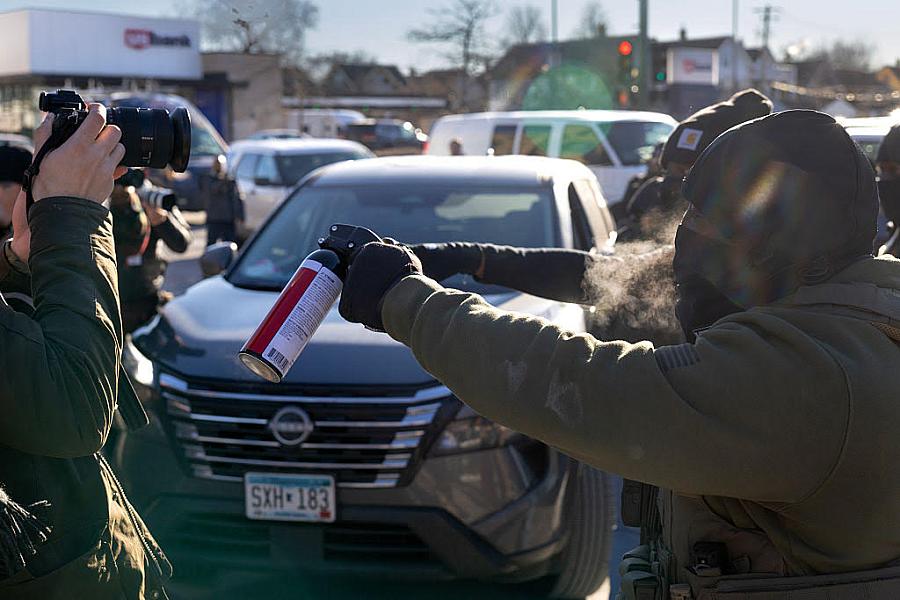
A federal immigration agent threatens photojournalists with pepper spray as they document agents taking a man off the street and placing him in custody on January 14, 2026 in Minneapolis.
Photo by Scott Olson/Getty Images
Federal agents have grabbed, shoved, tear-gassed, pepper-sprayed and detained journalists documenting the Trump administration’s immigration crackdown and protests across the country. In January, four journalists, including former CNN anchor Don Lemon, were arrested after covering a protest that disrupted a church service. Two weeks earlier, the FBI raided the home of Washington Post reporter Hannah Natanson, who has written extensively about the brutal impact of mass firings in the federal workforce.
Journalists are facing a new, volatile reality in doing their jobs and a legal landscape that’s no longer guaranteed to uphold the First Amendment. Journalism and legal organizations say these shifts mark a danger zone for democracy.
They’re obviously a danger zone for journalists themselves.
While the pressures cut across the profession, they fall heaviest on freelancers, self-employed journalists and those from community and ethnic media. These journalists don’t have strong institutional backing, newsroom lawyers, or the high-profile of a former network star. Many are journalists of color at risk of being targeted because of the color of their skin.
Press freedom groups that have worked for years in the most repressive countries on Earth are ramping up efforts to protect and support U.S.-based journalists. The Committee to Protect Journalists (CPJ) and the International Women’s Media Foundation (IWMF) have significantly expanded safety trainings for journalists in this country.
Last year, CPJ spearheaded the US Journalist Assistance Network as a clearinghouse for safety and legal resources, and earlier this month the two organizations jointly launched a rapid response fund. Starting in Minnesota, it will help independent and self-employed journalists and local newsrooms buy safety equipment, pay for urgent medical care, and cover other emergency needs, including psychological support.
This last piece reflects a growing awareness that more must be done to support the mental health of reporters. Law enforcement assaults and arrests of reporters aren’t new — the U.S. Press Freedom Tracker has been logging incidents since 2014. But they’ve accelerated. And what feels new are masked, armed federal immigration agents taking part in roving enforcement sweeps and violent confrontations, which in several instances have turned fatal.
“We’re seeing individuals out there who are recording ICE actions facing deadly consequences,” said Katherine Jacobsen, the U.S. and Canada program coordinator for CPJ. “It’s impossible to overstate the psychological impact on reporters when a member of your community is gunned down.”
It’s inspiring to see reporters like Asal Rezaei of CBS News Chicago, who was hit by a pepper ball fired by an ICE agent while she was alone in her truck, on assignment, near an Illinois ICE facility. The truck windows were open and the chemicals engulfed her, causing vomiting and a burning sensation. Shortly after, she stood beside her truck and told the story on camera.
Lots of journalists have shown the same fortitude. At the same time, it’s sobering to read accounts by journalists who have worked under authoritarian regimes and now hear echoes of their experiences in this country.
I recently came across a social media post by journalist Elaine Díaz Rodríguez that stopped me cold. Safety gear, she wrote, is not going to give journalists the full protection they need in these times. “I led a team of more than 19 full-time staff and hundreds of freelancers in Cuba over seven years, doing investigative journalism under a dictatorship,” she wrote. “Every one of us at some point was broken inside.”
Díaz Rodríguez said she and her team were repeatedly detained, strip-searched, interrogated, and their families were threatened. Fear and intimidation were the point — an official strategy to suppress reporting.
“It is easy to reach for quick fixes,” she wrote. “To pizza-party your way out of burnout. To life-vest your way out of ICE coverage. But the biggest vulnerability for any journalist is not external. It is how you react as a human in that moment. Building resilience, not protection, is the only way forward.”
Minneapolis, of course, is not Havana. But amid expanding government surveillance and hostility to free speech, there may be more parallels than most of us want to admit. That makes stories like Díaz Rodríguez’s increasingly relevant here.
“Of course we used digital security measures,” she told me. “Of course we used physical security measures. But that’s not where the government attacked us… They were attacking the mind.”
That is where the Journalist Trauma Support Network comes in. It aims to fill a long-standing gap in the news industry: access to mental health care that understands the occupational culture of journalism and the stresses of reporting.
The network was launched in 2021, amid COVID, newsroom layoffs, job insecurity, and escalating harassment online. Now those tensions are compounded by “trauma overload and stress overload in this country,” said Emily Sachs, a clinical psychologist and director of the network.
It’s part of the New York-based Global Center for Journalism and Trauma, which provides training to news organizations on trauma’s wide-ranging biological and psychological effects. Not surprisingly, demand for those sessions is growing in this country.
Sachs recruits and vets mental health professionals to take part in a six-month training program in trauma-informed therapy designed specifically for journalists. While therapists are in the program, they treat journalists for free. Once they graduate, therapists may join the network’s directory and journalists can seek them out for fee-based care.
Research shows that in covering news, more than 80% of journalists encounter trauma and violence, far more than most people. The camaraderie in the profession and the mission of public service can boost resilience, and we’re seeing that now. Many journalists in the thick of ICE sweeps and protests are protecting themselves and one another by sharing information in group chats, working in teams and collaborating across outlets.
Still, resilience has limits. Until now, most journalists have not had access to the kind of training, debriefing sessions and counseling that’s routinely offered to trauma-exposed first responders. And our profession rewards toughness and emotional detachment. The trauma support network offers permission to seek help.
“We’ve talked to people who are hearing screaming and crying from neighbors while they're working on a story,” Sachs said. “They’re trying to compartmentalize and inside, there’s this constant arousal. They’re thinking, ‘What am I doing here? Does it matter?’
“What we are hearing is that people’s usual coping strategies just aren’t cutting it anymore,” she added.
Sachs told me some journalists feel guilt and shame about their emotional struggles, because their work may not place them in the same heightened danger their colleagues — or their neighbors — are facing on the street.
And some journalists who are covering ICE actions “are feeling very torn between their responsibility to family and community and to getting the story out,” she said.
The pressures on journalists are not likely to ease up anytime soon. If our profession is going to continue to document what’s happening in communities, reporters need training in digital security, protective equipment, and strong legal backup. They also need support for the emotional and psychological toll the work can take. Protecting press freedom means caring for people who practice it every day, body and mind.