

The Health Divide: Surviving violence isn’t the same as healing

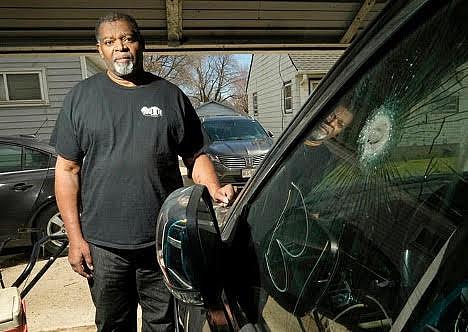
Pastor Kevin Simmons stands next to the Jeep he was driving when he was shot during a carjacking. A bullet hole is visible in the driver’s-side window.
(Photo by Mike De Sisti / Milwaukee Journal Sentinel)
Across the country, hospitals are beginning to recognize that saving someone from violence is only the first step. Helping survivors recover emotionally is just as important.
As Wisconsin prepares to open its first trauma recovery center, it is joining a growing national movement to treat the invisible wounds that often outlast physical injuries.
Milwaukee Pastor Kevin Simmons, 61, didn’t realize the emotional trauma of being shot and left for dead until weeks after he was released from the hospital. He was sitting alone in the living room of his home when an overwhelming fear suddenly came over him. He couldn’t shake the thought that someone might drive by his house and start shooting.
“I could never get comfortable sitting next to a window,” he said. “It was worse when I was alone, but that uneasiness is still there.”
Simmons was shot in the early morning hours of Oct. 9, 2023, during an attempted carjacking and robbery while driving for Uber after dropping off his 14-year-old passenger.
The teenager pulled out a gun, pressed it against Simmons’ ear and pulled the trigger. Simmons was shot six times and left for dead.
A passerby found him lying unresponsive on the side of the road. “If it wasn’t for the Good Samaritan, I would be dead,” said Simmons, a minister and community advocate.
Nearly three years later, Simmons said he is still trying to cope with what happened. He never received mental health counseling after the shooting. Instead, Simmons leaned on his faith and relied heavily on his church community as he recovered.
While he never ruled out talking with a mental health provider, he didn’t think he needed one. He believed he could work through the emotional scars on his own.
Simmons’ response is not uncommon. National data from the Centers for Disease Control and Prevention show Black and Hispanic men are significantly less likely than white men to receive mental health treatment, even when they report symptoms of anxiety or depression. Instead, many rely first on faith, family and trusted community members for support.
That’s why efforts to bring trauma-informed care directly into neighborhoods matter. When mental health services are available in familiar community settings and delivered by professionals who understand the people they serve, seeking help becomes less intimidating and more accessible.
This fall, the Medical College of Wisconsin plans to open the state’s first trauma recovery center, offering free mental health care, case management and support services to children and adults recovering from violent crime, domestic violence, gun violence and other traumatic experiences.
It will join a growing national network of trauma recovery centers that recognize recovery doesn’t end when a patient leaves the emergency room.
When the ER is only the beginning
The idea behind trauma recovery centers is simple: meet survivors where they are instead of waiting for them to seek help on their own.
Across America, many victims of gun violence, domestic violence and other violent crimes never receive mental health treatment. Some don’t have insurance. Others don’t know where to turn. Many are simply trying to find housing, transportation or legal help while coping with the emotional aftermath of violence.
Trauma recovery centers were designed to address those barriers by providing trauma-informed counseling, case management, legal advocacy and other support services under one roof. Instead of expecting survivors to navigate a complicated health care system while coping with trauma, the centers bring services directly to the people who need them most.
Research suggests the model works.
Research from the University of California, San Francisco, where the nation’s first trauma recovery center was established, found survivors who received care through the program were more likely to stay engaged in mental health treatment, experienced fewer symptoms of post-traumatic stress and depression, reported a better quality of life and were more likely to return to work than those receiving traditional services.
Those findings matter far beyond California. But most of that evidence comes from where the model began, and researchers say it still needs testing in more cities.
Trauma specialists say that gaps in care can affect every part of a person’s life, from relationships and employment to long-term physical and mental health.
And the effects of trauma don’t stop with the victim. After Simmons was shot, his wife received a phone call around 3 a.m. telling her Simmons had been shot. When she rushed to the hospital, doctors told her he was shot in the head.
“Do you know what kind of trauma my wife went through just hearing that?” Simmons said. “She still talks about that moment when she didn’t know if I was going to pull through.”
When violence strikes, entire families carry emotional wounds.
Time alone doesn’t always heal trauma
One of the biggest myths about trauma is that time alone heals.
For many survivors of gun violence, domestic violence and other violent crimes, the emotional wounds deepen if they aren’t recognized and treated. Fear, anxiety, depression and post-traumatic stress can make it difficult to sleep, return to work, rebuild relationships or simply feel safe again. The days and weeks after a traumatic event are a critical window to connect people with support before those symptoms become more deeply rooted.
Early treatment isn’t about asking survivors to relive the worst day of their lives. It’s about helping them understand that what they’re feeling is a normal response to an abnormal event. It’s about teaching healthy coping skills and making sure they don’t have to navigate recovery alone. The American College of Surgeons now requires that trauma centers screen patients at high risk for post-traumatic stress and other mental health needs.
For health reporters, stories about violence shouldn’t end when the victim leaves the emergency room. The bigger questions often come afterward. Did that person or family receive mental health counseling? Could they afford it? Did they know where to find it? How is the family recovering?
Reporters should also look beyond crime statistics and ask what kind of resources communities have to help people recover. A city may invest millions in trauma care that saves lives in the operating room, but what happens after patients are discharged?
Black and Hispanic communities experience a disproportionate share of violent crime, yet stigma, cost, transportation and distrust of the health care system continue to keep many people from seeking mental health treatment. Closing that gap isn’t simply a mental health issue. It’s a health equity issue.
Simmons’ story happened in Milwaukee. But survivors like him live in every city in America.