

The Health Divide: These states are teaching kids gun safety. But are Black and Latino youth being left behind?
Author(s)

Image
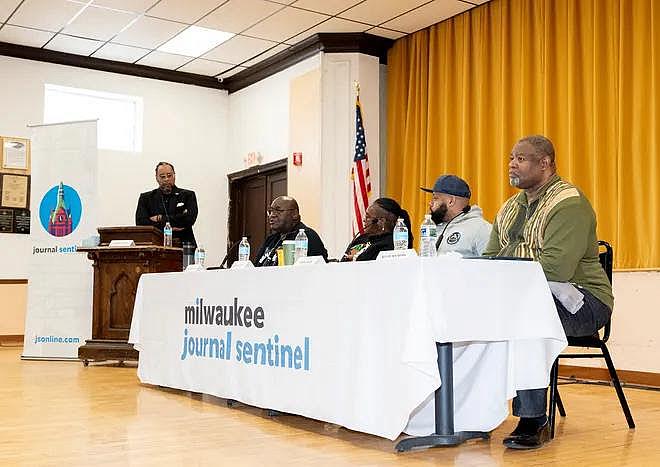
Columnist James Causey, at left, participates in a panel during the "Behind the Gun: Milwaukee Gun Owners Safety Summit," hosted by the Milwaukee Journal Sentinel on March 7, 2026, at the Prince Hall Masonic Temple in Milwaukee, Wisconsin.
(Photo via Journal Sentinel)
Published on
March 23, 2026
Gun violence has become the leading cause of death for youth aged17 and under, surpassing traffic accidents in 2020. In response, some states are promoting gun safety training for children as young as 5 to help reverse this trend.
Lawmakers face a significant challenge: they want to ensure that children are safe from guns in their homes while also navigating the country’s heated discussions about gun laws.
Supporters argue that training helps children learn how to behave safely if they encounter a gun. In contrast, opponents claim that this policy shifts the responsibility onto children instead of adults, and point out that accidental shootings often happen because adults fail to store guns properly.
So far, Arkansas, Tennessee, and Utah have enacted laws requiring public schools to teach children gun safety. At least five other statesare considering similar legislation.
In early March, I moderated a discussion with four panelists on the responsibilities of gun ownership. During the conversation — “Behind the Gun: Milwaukee Gun Owners Safety Summit” — two principal questions emerged concerning gun safety and children: Does gun safety instruction effectively enhance the safety of children? If it does, do Black and Hispanic children have the same access to gun safety education as their white counterparts?
Research on the impact of gun safety training for children shows a range of findings. Studies on teaching children gun safety have produced mixed results: a systematic review found that child-focused educational programs generally did not prevent children from handling firearms in unsupervised situations, though a recent randomized trialfound that a brief gun-safety video reduced unsafe behavior around real guns in a lab setting. Public health experts typically recommend that gun safety education be part of a broader strategy that includes secure storage solutions, like gun locks or safes, to effectively reduce the risk of injuries and fatalities.
While the effectiveness of gun safety training for children remains unclear, one thing that is clear is that Black and Latino children are currently being left out when it comes to teaching children gun safety.
Based on available studies on children's firearm safety training and education, white children make up around 58% to 74% of children receiving such education. Although Black and Hispanic youth made up a small percentage of the participants in these programs, gun violence disproportionately affects them at far higher rates. Black youth represent 14% of the U.S. youth population but accounted for 46% of all firearm deaths in 2024. Hispanic youth make up 27% of the U.S. youth population, yet they represent 19% of all firearm deaths.
(The Hispanic youth population tends to be younger, leading to a higher proportion of children and teenagers than adults, compared to other groups. As a result, a “lower percentage of deaths” can hide the fact that firearms are still a main cause of death among Hispanic youth.)
“I’m at this point: If white kids are getting trained in how to best deal with guns when they encounter them, then Black and Latino kids need to receive the same education, and that’s not happening,” said Michelle Bryant, an African American radio pundit and gun owner.
Teaching gun safety to youth has been controversial
In 2023, when Arizona was debating legislation to require gun safety education in schools, Gov. Katie Hobbs, a Democrat, vetoed the bill. She argued that requiring firearm safety training to be mandatory in schools is not an effective way to prevent gun violence and that it could have both immediate and long-term impacts on the health and well-being of students, teachers, and parents — by creating a false sense of security when the real issue is not just knowledge about guns, but access to guns.
Earlier this year, a group of Republican state senators from Georgia proposed a bill that would mandate firearm safety classes starting in kindergarten and continuing through a child’s senior year of high school. “If we can save a life or make a difference, then that’s what this bill is for,” said Sen. Rick Williams, one of the bill's co-sponsors.
While politicians and critics debate the best ways to prevent child gun deaths, most agree that too many children are dying from gun violence, and change is essential. Since 2013, 21,000 children and teens aged 17 and under have died in gun-related incidents, with 2,228 fatalities in 2024 alone, according to a KFF report.
The concept of a gun summit emerged after my colleague John Diedrich, an investigative reporter at the Journal Sentinel, and I consulted with community groups in Milwaukee. Many expressed that the city’s "Put Down the Guns" message has lost its impact. Among the city's largest youth communities, Milwaukee Public Schools, 23students were shot and killed outside of school between June 2024 and 2025. That's enough to fill a classroom.
The problem stretches far beyond Milwaukee. Gun violence has been the leading cause of death for Black children since 2006 in the U.S. In Black communities, it’s both a cause and a consequence of the deep-rooted systemic and structural challenges they face. The alarming rates of gun violence we see today are the result of a long history of racial discrimination, including forced segregation and the lack of financial investment in these neighborhoods. Ongoing gun violence continues to hinder economic opportunities and discourages potential investment, a damaging cycle that deepens inequities.
These issues are ripe for community engagement
Health journalists play a crucial role in discussing gun safety training for children, given that gun violence is a significant and preventable public health issue.
Do these training programs effectively reduce accidental shootings? How accessible are these training programs to all children? What impact does gun violence have on various communities? These are all strong angles worthy of additional reporting.
Another way to do more on this issue is to engage the community and listen to local groups. Consider holding a panel discussion. Invite community members to talk about how gun violence impacts their lives. Make sure to highlight the experiences of young people, who are heavily affected, and look for ways to elevate their voices.
We chose a community engagement approach because we thought it would be the best way to raise awareness about the issue. Diedrich and I visited different television stations to share our plans, and they invited us to discuss our initiative.
What made our event special was that we listened to the community's needs and held the gathering at the Prince Hall Masonic Temple in the Harambee Neighborhood, an area particularly affected by gun violence. We also wanted a location that was easy to reach to reduce transportation issues. We hosted 14 different community groups focused on reducing gun violence in the city. Our goal was to encourage collaboration among these groups to break down barriers and improve their efforts to tackle gun violence.
The event was appreciated, with attendees asking for another gathering, this time focused on the Hispanic community on the South Side of the city.
For our next event, we plan to emphasize safety more clearly. We will have demonstrators teach attendees how to use gun locks, how to store guns safely in a gun safe, and provide hands-on instruction with replica firearms. This is the kind of service journalism our communities need today.