

The Health Divide: Want to see your primary care doc? Join the club.

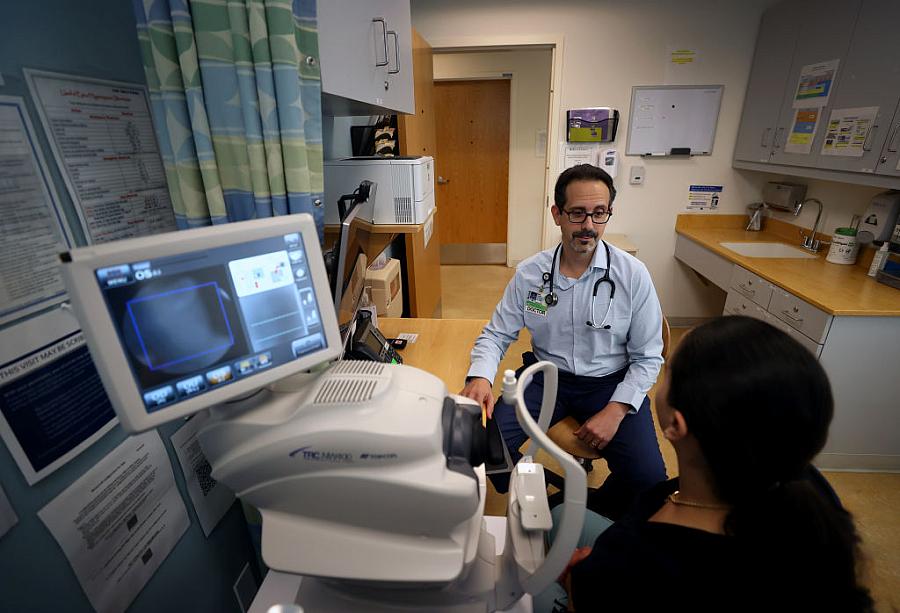
(Photo by David L. Ryan/The Boston Globe via Getty Images)
My daughter moved to Eugene, Oregon, recently and I promptly urged — OK, nagged — her to find a primary care doctor.
She asked around, then came back with news that surprised me.
The doctors she was hearing about didn’t take insurance. Instead, they charged a membership fee, generally $100 to $150 a month. In return, they promised to provide regular checkups, unlimited office visits for preventive care and minor problems, same or next-day appointments and discounts on some prescriptions and lab tests. Also, a clinician would answer your calls — no maddening phone trees!
I wondered: Was something peculiar happening in Eugene?
Actually, no.
I wandered around online and learned that the health care landscape in the region has been battered by corporate buyouts and provider consolidation. Nothing unusual about that, though specifics vary from place to place.
In Eugene, Optum, a subsidiary of the multinational UnitedHealth Group, acquired a large medical group with clinics throughout the area. The company closed the outlying clinics and imposed new, wildly unpopular rules. For example, one clinician was told to limit follow-up visits to eight minutes, so more visits could be squeezed in, the Pacific Northwest Hospital Medicine Association wrote in testimony to the state legislature.
Physicians “left in droves,” the association wrote. Thousands of patients, low-income and rural residents especially, were left without primary care.
Into this breach came concierge doctors and other new ventures that charge a fee monthly or annually for personalized primary care. These models are sweeping the country. From 2018 to 2023, the number of membership-based primary care practices jumped 83% nationwide, from 1,658 to 3,036, according to a recent analysis in Health Affairs. More than 7,000 clinicians were working in such practices.
These models offer doctors a refuge from the dysfunction of corporate fee-for-service medicine, which rewards volume and high-priced procedures rather than compassionate, comprehensive care, and sucks up so many hours with bureaucracy.
Doctors in membership-based arrangements generally cap their practices at a few hundred patients, a fraction of the 2,000 to 2,500 patients a physician typically handles in a large health system. They’re able to reclaim much of what corporate health care has robbed: autonomy, time and close, consistent relationships with patients.
But appealing as all this may be, both for doctors and patients, an escape hatch is not a solution to deep, systemic problems in health care. If membership-based practices keep growing fast, they may, in fact, make the problems worse.
The Association of American Medical Colleges projects a shortage of 20,000 to 40,000 primary care physicians over the next decade. Already 30% of Americans — more than 100 million people — don’t have a regular source of primary care. What will happen as more doctors shrink their practices in hopes of providing more personalized care?
“As you scale these models, certainly they’re going to be great for people who can afford it. It offers a lot of benefits for the patient and the clinician,” said Dr. Jane Zhu, associate professor of medicine at Oregon Health & Science University and lead author of the Health Affairs study. “But as it stands, it’s not scalable to everybody.”
Membership models come in two basic forms. The luxe version, concierge, is aimed at patients who can pay $3,000, $5,000 or upwards of $50,000 a year for ready access to a super-attentive doctor, longer appointments and in some instances, house calls. Concierge doctors typically bill insurance for medical services and often coordinate care with specialists.
My daughter stumbled upon the lower-cost model, called direct primary care (DPC). “Philosophically, they’re wed to a broader population,” Zhu said. I checked out DPC websites in Eugene and some practices explicitly welcome everybody, including patients on Medicaid.
“I’d be interested in knowing who on Medicaid can come up with $100 a month to see their DPC physician,” Zhu said.
DPC doctors don’t accept or bill insurance, which eliminates what may be the biggest source of frustration for a clinician. But patients still need coverage for the services the doctor doesn’t provide, including expensive tests, specialists and hospitalizations.
The Republican megabill of 2025 gave a boost to DPCs by allowing people to pay for them with health savings accounts under certain circumstances.
Journalists should track the rise of these models, as reporter Karen Brown did in this New England Public Media story focused on rural western Massachusetts. How many physicians have moved from conventional practices to concierge and DPC in your community?
Do they deliver what they promise to patients? How many patients do they serve? As the primary care landscape shifts, who is left behind? What is the impact on already overburdened fee-for-service practices and safety net health systems?
Journalists should also investigate who owns membership-based practices, and how that affects the quality of care. Zhu and her colleagues found that independent ownership of concierge and DPC ventures fell from 84% to about 60% in the five years they studied, while corporate-affiliated practices grew by an astonishing 576%. Private equity is investing heavily in this space.
That’s a testament to the popularity and the lucrative potential of these models. But as they draw corporate and private equity investment, doctors may face the same pressures to maximize volume and profit they tried to escape.
As for my daughter, she eventually found a doctor she thinks she’ll like, in a small, conventional independent practice. It took tenacity and multiple phone calls to get an appointment. Having good insurance helped.