

The Health Divide: When a Black teen goes missing, does urgency follow?

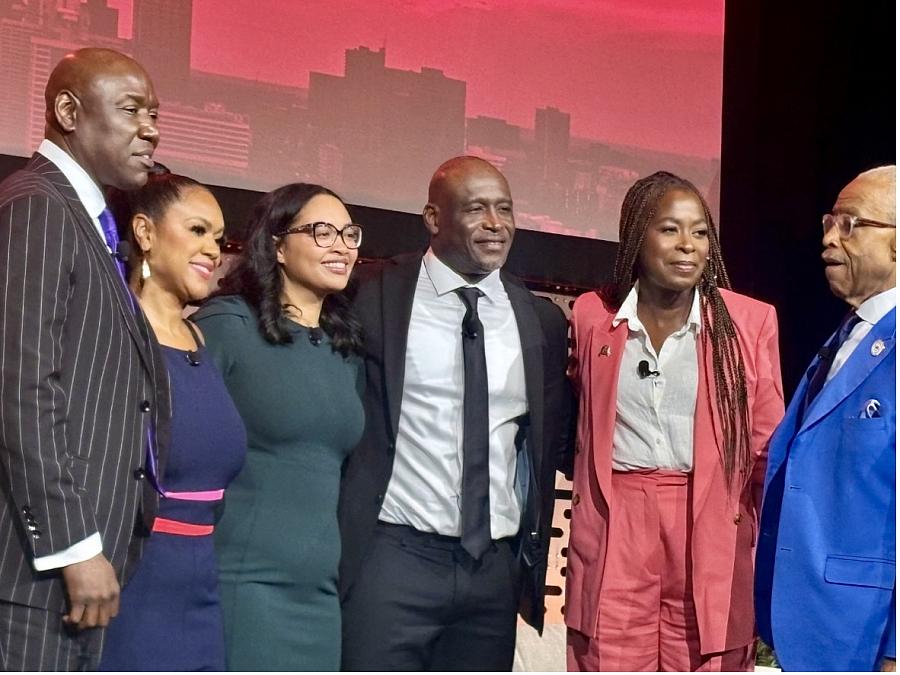
From left, attorney Ben Crump, moderator Tiffany Cross, Christine Wells-Wonsley, Elmore Wonsley, NABJ president Errin Haines, and the Rev. Al Sharpton onstage at the National Association of Black Journalists convention in Atlanta on Aug. 13.
(Photo by James E. Causey)
Before Christine Wells-Wonsley told a room full of Black journalists about the last time she saw her son, Nolan Wells, she broke down in tears.
“Nolan is and was an incredible person,” she said. “No matter where you were in life or what was going on, he was going to be your biggest cheerleader.”
When Wells-Wonsley once hesitated about starting a podcast, Nolan encouraged her.
“You should do it. I can help you with the videos. I’ve got you,” she recalled him saying. “That’s the kind of person he was. … He was our bright light.”
Wells-Wonsley and her husband, Elmore Wonsley, were speaking at the recent National Association of Black Journalists convention in Atlanta about their 18-year-old son, who went missing July 4 after a boating trip with friends to Horn Island, a barrier island off the Mississippi Gulf Coast. His body was found just offshore in the water two days later. His death remains under investigation.
Nolan's story raises broader questions about racial disparities surrounding missing Black youth and the toll those disparities can take on families. Black youth are disproportionately represented among children reported missing in the United States. Research has also found disparities in how missing Black children are covered by the media and how long some remain missing.
Nolan's parents believe their experience trying to get help finding their son fits into that broader pattern.
Black youth disproportionately represented among missing
The FBI’s 2025 Missing Person and Unidentified Person Statistics recorded 323,767 missing-person entries for those 17 and under. Of those, 136,954 were for Black children.
That means Black children accounted for roughly 42% of juvenile missing-person entries, even though Black children make up just over 15% of the U.S. child population. (The FBI numbers don’t necessarily represent individual children because the same child can be reported missing more than once.)
Still, that disparity should force us to ask harder questions.
Why are Black youth so overrepresented among those reported missing? Why have studies found that their disappearances receive less media attention? And when a Black family says their child is missing, are their fears treated with the same urgency as those of other families?
These questions don't mean every missing Black child is treated differently because of race. But the disproportionate numbers also mean we can’t dismiss race from the conversation.
At NABJ, Nolan's parents said that after learning their son had been left behind on Horn Island by his friends, some of whom they had known since Nolan was young, they began calling authorities. They said they encountered confusion over which agency had jurisdiction and their inquiries weren’t met with the urgency they expected.
Records released after Nolan's death provide a glimpse into what happened.
According to an incident report from the Jackson County Sheriff's Department, Wells-Wonsley called the department at 12:22 a.m. July 5 to report Nolan missing. She had previously contacted Ocean Springs police and the Mississippi Department of Marine Resources while trying to determine which agency had jurisdiction.
At about 1:38 a.m., Marine Resources was told the Jackson County Sheriff's Department would take the lead. According to Marine Resources records, deputies had spoken with Nolan's friends, who told them Nolan had voluntarily remained on the island.
Based on that information, authorities said there was no reason at that point to believe Nolan was facing an emergency. His parents have questioned that account, saying it would have been out of character for their son to remain on the island without his phone and without telling anyone how he planned to get home.
By about 8 a.m. that morning, Marine Resources launched a patrol vessel toward Horn Island. Nolan's father and his former football coach were already searching for him. A larger multi-agency search followed later that day, eventually involving patrol boats, aircraft, drones and sonar.
So, while authorities ultimately mounted an extensive search, during the first hours after Nolan was reported missing, officials were operating on the assumption he had voluntarily remained on the island and wasn't in immediate danger.
That makes authorities’ initial assessment of Nolan's disappearance important.
Lee Hawkins, a journalist, author and Pulitzer Prize finalist who received a National Fellowship from the USC Annenberg Center for Health Journalism in support of his book chronicling his family’s history of racial trauma, said the family's concerns about the response can't be completely separated from Mississippi's racial history.
“The reality is that Mississippi is ground zero for the legacy of slavery, the legacy of Jim Crow and Jim Crow apartheid,” Hawkins told me in Atlanta. He added that he isn't suggesting racism necessarily played a role in Nolan's case. But given Mississippi's history, he said Nolan's family deserves a full explanation of what happened to their son.
Without those answers, Hawkins said, questions about whether race affected how Nolan's disappearance was handled may always linger in the family's mind.
When seeking answers brings more trauma
Wells-Wonsley said the trauma worsened with the discovery of Nolan's body, which was ultimately found on the island where he was reported missing.
The family hired civil rights attorney Ben Crump and the Rev. Al Sharpton got involved in the family's effort to get answers. The NAACP joined the family's legal team seeking a more thorough investigation, while members of the Congressional Black Caucus have called for a federal investigation.
Dr. Lia Knox, a Milwaukee mental health counselor who specializes in trauma and culturally responsive care, said the continuing uncertainty surrounding Nolan's death can make the grieving process especially difficult. Every unanswered question, interview or legal development can pull the family back into the trauma.
Wells-Wonsley isn't only grieving her son, Knox said. She also has to worry about whether someone will call her employer again and whether publicly fighting for answers about Nolan could threaten her livelihood.
Nolan's family still doesn't know exactly what happened to him on Horn Island. They also continue to question whether anything could have been done differently after he disappeared.
Their experience doesn't by itself prove that Nolan received a different response because he was Black. But his case doesn’t exist in isolation. It happened in a country where Black children are dramatically overrepresented among those reported missing, and where research has found disparities in the attention their disappearances receive. That’s the divide we can’t ignore.
For Nolan’s parents, those statistics are no longer abstract. They lost their bright light. Now they're fighting for answers about what happened to him and asking whether the systems they turned to when he disappeared responded with the urgency and level of effort their son deserved.
While journalists can't control how law enforcement responds when a child goes missing, we can control whether that child's disappearance receives attention. Newsrooms should think critically about which missing child cases reporters cover — and to what extent.
Families shouldn't have to generate national outrage before we pay attention. When a child disappears, the question shouldn't be whether that child or young person is worthy of our attention. It should be: What can we do to help find answers for families while holding institutions such as law enforcement accountable for their response?