

The Health Divide: When it comes to crash-test dummies, the average woman is nowhere to be found

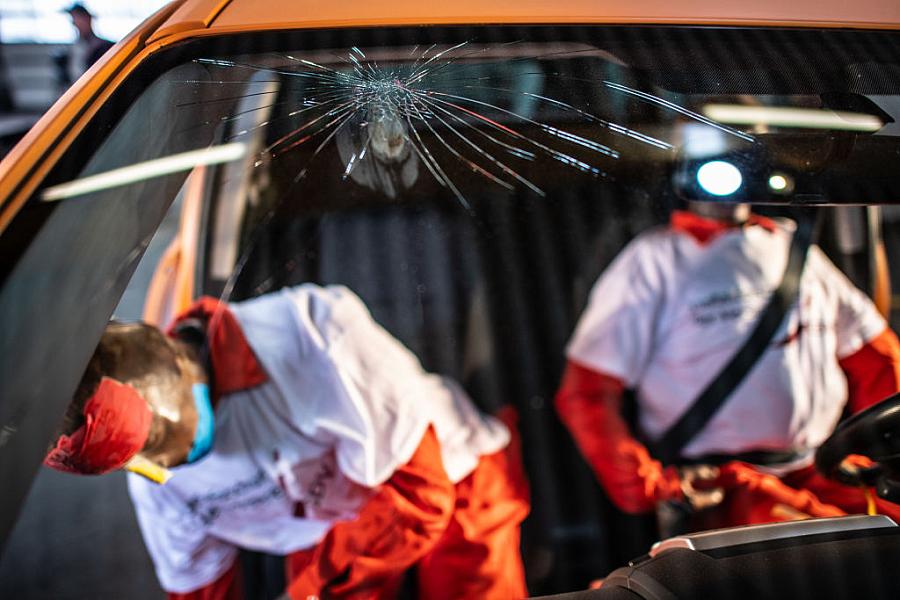
Photo by Guido Kirchner/picture alliance via Getty Images
For far too long, the products used to keep us all safe and healthy have been designed for a male body. And that can harm women.
Take personal protective equipment (PPE), for example. Some 80% of women firefighters say they have issues with poorly fitting gear and respirators, according to the National Fire Protection Association. As a result, women have a 33% higher risk of injury on the job. The same problem is so pervasive in construction that in 2024, the Biden administration finalized a rule requiring employers to provide properly fitting safety clothing and equipment for every worker.
Even in health care, where women make up three-quarters of the frontline workforce, gowns, masks and gloves have traditionally been designed based on male anatomy. In a study during the COVID pandemic, women reported issues such as poorly fitting surgical gowns at four times the rate of their male colleagues, and were much less likely to feel safe on the job.
The story has been the same in medicine. For example, it took decades for the FDA to halve the recommended dose of Ambien for women, after it became clear that the effects of the sleeping aid persisted longer in their bodies than in men and increased the risk of a car crash the next morning.
And that brings us to car safety. Perhaps no other example of the male bias in design affects more people.
Widely used crash-test dummies are modeled on the average man, or what was average in the 1970s, when the dummies were originally designed to be 5’9” and 171 pounds. (The average U.S. man today weighs 200 pounds.) Crash tests also use dummies modeled on the smallest 5% of men and the largest 5%.
Data from these tests guide the standards for life-saving car features such as seat belts, seat contours, air bags and headrests. Where and how these safety features come into contact with the body matters.
We’ve known since the 1960s that cars are more dangerous for women. While vehicles are much safer now, the odds of getting injured in a head-on crash are 46% higher for women than men, and 55% higher in a rollover, according to a report in January by the National Highway Traffic Safety Administration. The risk of death is higher too, though the gap shrinks with newer cars.
A “female” crash test dummy has been used for decades. But it’s a scaled-down version of the male model, so it doesn’t account for differences in biomechanics, spinal alignment, abdominal structure, neck strength or anything else.
It’s also small — at 4’11” and 108 pounds, it represents the smallest 5% of adult females. And the dummy has generally been used in the front passenger or back seat, not the driver’s seat.
How refreshing, then, to see the U.S. Department of Transportation last fall unveil designs for what it hailed as the first advanced female-specific crash test dummy. Called THOR-05F, it is based on data on the female body and has more than 150 sensors to measure injury risks in a frontal crash.
The agency used the announcement to reiterate the Trump administration’s executive order rejecting “gender ideology” and asserting there are only two sexes, male and female, rooted immutably in biology. But wherever one stands on transgender rights, there’s no denying that THOR-05F — Test device for Human Occupant Restraint, 5th-percentile Female — is an improvement over the mini-male model.
Still, the name gives away its huge limitation. Like the female dummy already in use, it represents the smallest 5% of women — and overlooks the other 95%.
“It does not in any way, shape or form represent the female part of the population,” said Astrid Linder, a professor of traffic safety at the Swedish National Road and Transport Research Institute. “The average female is still ignored.”
Linder is the world’s foremost expert on female crash-test dummies. She began working on the issue in the 1990s, when she was involved in a project to measure the impact of low-severity rear-end crashes and discovered, to her dismay, that the only dummies around were male.
In 2022, she and her colleagues released the world’s first average-sized female crash-test dummy — or seat evaluation tool, as she calls it. It’s 5’3” and 137 pounds, with a bust, narrower shoulders and wider hips. It’s made to test rear-end crashes, the most common type of collision, side by side with a mid-sized male dummy, to make sure men and women are equally protected when they’re driving or riding as passengers.
Linder partnered with Volvo, which is using the female model in crash tests. But until laws and regulations require automakers to use anatomically correct female dummies, the male model will be the default.
A bipartisan Senate bill introduced in 2024, the She DRIVES Act, would require the use of a female dummy and a more technologically advanced male dummy in tests of crashworthiness. The Congressional Budget Office estimates the bill would cost the federal government roughly $3.5 million a year, for five years, for testing, staff and equipment. It’s a small price for better safety.
The bigger challenge is public and political will. “We need to want to do it for it to happen,” Linder said.
In the U.S., the recent federal endorsement of THOR-05F is one step on a long journey ahead. The Transportation Department must publish technical specifications and issue a final rule on the model. Then, the department said in a statement, the model “will be considered for use” in the government’s New Car Assessment Program and in testing for compliance with federal vehicle safety standards.
There is no mention of when we might see federally approved designs for an average-size female dummy, or one made to test the impact of collisions from anywhere but the front.
Nevertheless, THOR-05F is a big deal because it acknowledges that designing things for the mid-size male and calling it universal is not safe. From hospitals to highways, too many of us are stuck with safety equipment that fails to protect us when we need it most.