

How cuts to farm-to-school programs under Trump opened a new reporting beat for me

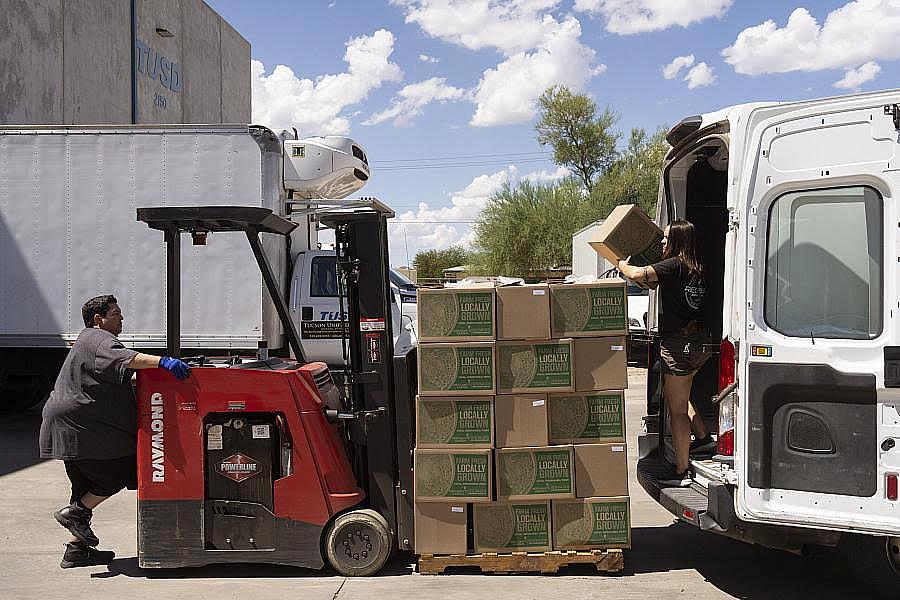
Boxes of locally grown lettuce from Pivot Produce are offloaded at the Tucson Unified School District’s food warehouse.
Photo via Rebecca Noble/Capital & Main
In March 2025, I attended a luncheon at Jar restaurant helmed by renowned Los Angeles chef Suzanne Tracht to celebrate the achievements of school food professionals working to improve meals for kids at public schools across California. The event was festive, and Tracht prepared the same dishes school chefs serve students in their own cafeterias. We ate delicious plates like a Thai basil lentil burger on a whole-grain bun, kiwi chicken chile verde, and a long-simmered birria. Each dish was prepared using produce, meat, and dairy procured from small, local farms with money granted to the schools from the federal government.
I soon learned the luncheon’s timing was auspicious. Seated at my table was a school nutrition director. When I expressed enthusiasm about the economic and nutritional value of these federal farm-to-school programs, she leaned across the table and quietly said, “You know, the farm-to-school programs were cut two days ago.” She went on to explain that school meals were often the most reliable and healthiest meals kids get, and she worried how the defunding of this program, along with other Trump administration budget cuts, was going to affect her students’ already precarious food security.
That sounded like a story worth telling. A quick Google search revealed the cuts came from the U.S. Department of Agriculture, which abruptly canceled the Local Food Purchasing Assistance and the Local Food for Schools programs, programs that provided more than $1 billion to help schools and food banks buy produce, meat and dairy from local farms and ranches. The investment boosted longstanding farm-to-school programs that helped schools and local farmers build new relationships while enabling children to access fresh, healthy foods.
Investigating the impact of these cuts on school districts and farmers around the country seemed like a smart way to look at how dismantling one program could tell the bigger story of food equity and security, systemic attempts to address chronic disease in children, school nutrition, food literacy, and how local farmers play a role in the school food ecosystem.
I know, that sounds like a lot to pack into a two-story series, but the Impact Fund for Reporting on Health Equity and Health Systems gave me the time and resources to do in-depth reporting and essentially enroll myself in a self-directed crash course on a new beat. By the time the project was over, I had hundreds of pages of transcripts and I had spoken with over 30 sources all over the country. I consulted esteemed nutrition experts including Marion Nestle, professor emerita of nutrition, food studies and public health at New York University; researchers at institutions like the Rudd Center for Food Policy; as well as activists, school food professionals, and policy wonks. Most importantly, I traveled to Tucson where I could observe firsthand how these programs worked on the ground, which gave me the anecdotal material to create a compelling, people-driven narrative.
My first story examined the contradictions in what Health and Human Services Secretary Robert F. Kennedy Jr. and the Make America Healthy Again movement stood for, and how their policies and budget priorities were not reflected in the current administration’s policy. The biggest challenge reporting that story was getting sources to feel comfortable making critical statements about the government. Some sources were happy to talk, but many were cautious. I tackled that obstacle by first asking sources if they’d talk on background and not for attribution. Once they felt comfortable with me, after I demonstrated I had mastered the complex topic, I was able to negotiate on-the-record comments. As one source said to me, farm-to-school isn’t a Democrat or Republican idea, it’s just a good idea.
My second story took a closer look at the impact of farm-to-school cuts and how they endangered the progress school food programs have made not only improving food quality but also boosting local farm economies. But I soon learned school nutrition is part of complex set of federal programs and services that are intertwined with other food security safety nets like the Supplemental Nutrition Assistance Program. That’s because children in families receiving SNAP are automatically eligible for free school meals, so when families lose SNAP, many children lose that automatic access. With the passage of GOP megabill that President Trump signed in July, and its massive cuts to the Supplemental Nutrition Assistance Program, the Congressional Budget Office estimated the legislation will result in 96,000 kids losing free meals at school in a typical month, as their families lose eligibility for SNAP.
One challenge here was anticipating a part of the story that hadn’t yet happened. Most families won’t experience SNAP cuts until next year, so I had to use my reporting, research, and data to demonstrate the health impact of these programs. For example, access to school meals can help reduce rates of poor health, lower body mass index, as well as improve classroom behavior and reduce visits to the school nurse, according to research compiled by the Food Research and Action Center, a nonprofit that works to end poverty-related hunger in the United States.
In a news landscape where food security is front and center, it was also important to point out that our inflated economy with rising food costs makes it harder for working families to purchase fresh, healthy fruits, vegetables and meats. Instead, many families rely on less healthy ultra-processed foods as a cheaper alternative. And since SNAP provided funds for food literacy programs like school gardens, cooking classes and access to farmers markets — programs that help families learn how to access and cook healthier food — I could cite the research demonstrating the success of these programs, trace the consequences of losing the funds, and show how they might impact children’s health in the future.
By highlighting the achievements made by a well-funded school district like Tucson Unified School District, I could also illustrate why these programs work and use their success as a solution that illuminated the problem in regions that may now never have a chance to initiate or improve an existing farm-to-school ecosystem.
One of the more gratifying outcomes of my project was the satisfaction of mastering a new beat that I will continue to report on and use in my career as a freelance journalist. The feedback I received from these stories was also impactful. The stories circulated widely on social media and since I wrote them for the nonprofit newsroom Capital & Main, they were reprinted widely in national outlets including Rolling Stone, Yahoo, and MSN. But what was more meaningful to me was knowing that my stories were circulated among farmers unions, school food professional organizations, farm-to-school advocates, and nonprofit organizations that focus on food security and children’s health. My articles gave them a tool to share their stories within their communities and show why farm-to-school programs matter.