

How I showed what funding cuts will mean for people experiencing domestic violence and homelessness

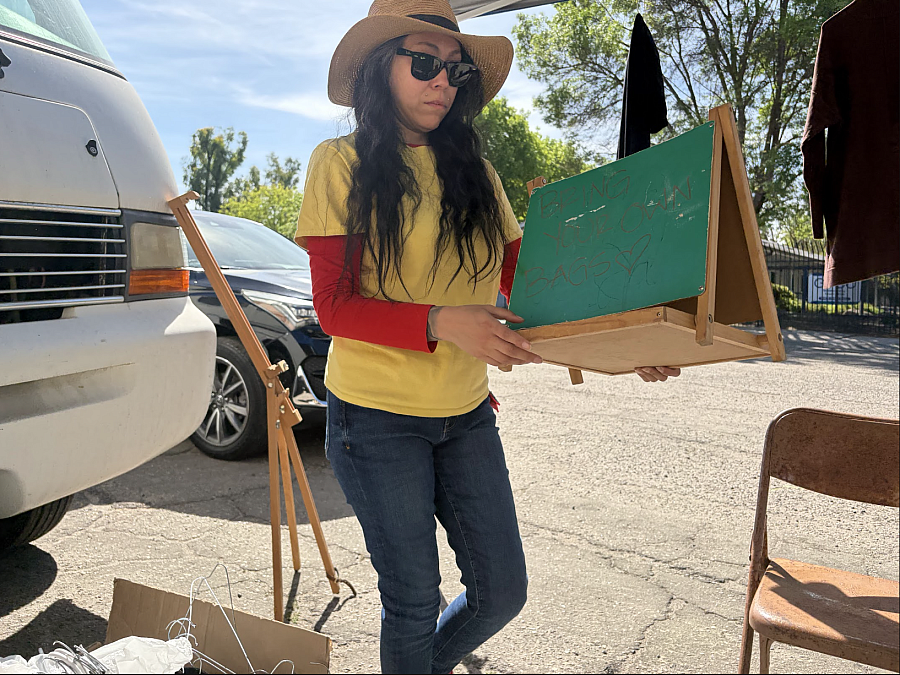
Lethal Gee sets up donations outside the San Joaquin Valley Free Medical Clinic and Needle Exchange in Fresno.
(Photo by Megan Myscofski)
As a local reporter, I’ve grown used to a pattern in the second Trump administration where I learn of big cuts happening at the national level, follow them through California’s reaction and existing policy on the topic, then observe what happens on my own beat. Even when the administration retracts the cuts, I’ve found that there’s still a story in the chaos created by the back and forth.
With the support of the USC Annenberg Domestic Violence Impact Reporting Fund, I reported a series of three stories explaining and illustrating the impact of federal and state funding cuts on people experiencing both domestic violence and homelessness in Fresno, which has one of the highest rates of domestic violence calls in California. For example, California’s cut of funding from the Victims of Crimes Act dropped from about $400,000 in 2018 to $87,000 in 2024.
I focused on programs that were already spread thin, where the people carrying them out readily admit that they do not reach the people they need to by a large margin. What’s more, the people who stand to benefit — survivors of domestic violence — have many reasons not to seek them out. If a stint in a shelter, for example, doesn’t lead to safe, permanent housing, their only option might be to return to an abuser who is now upset.
Those tasked with carrying out the work are very limited in the long-term planning they can make because they know from experience that short-term funding might not be followed by more support.
Much of my work as a reporter is centered on regular people’s experiences following decisions made by those in power. Making sure my audience hears from those people about their own experiences is also one of the toughest parts of my job. For that reason, I approach sourcing these stories differently. I usually cast a wider net and interview more people than I would otherwise. Sharing a traumatic story is difficult and can put a person in a vulnerable situation, and I want to know they’re very sure they want to do it before I move forward. If I am in contact with multiple sources, one can have second thoughts before, during or after an interview, and I can still reach my deadline. Neither of us feels pressure to make an interview work when they know they might have regrets about it.
I also believe in not talking about a population without talking to them. Each first-hand account I collected for this story is not representative of the whole, but it does open a window into the real effect of policy choices for voters, neighbors and leaders. But that piece is usually the hardest to get.
Telling the story of these cuts also goes beyond talking to people who are missing out on services. There are multiple points along the chain where we can look for impacts and accountability. The state of California, for example, can offset at least some federal cuts with its own funding. I think that’s an important political story for residents to follow — California won’t be able to make up for every lost dollar, so the governor and legislature are making hard choices about what to keep afloat, cut back on or scrap completely. Fresno’s ability to serve survivors of domestic violence is part of that story as much as it is about national policy.
Additionally, I’ve found the ongoing changes and inconsistencies are the story for the people who feel the greatest impact of these funding decisions. Many of the people I’ve talked to for this story and others who have experienced homelessness, housing insecurity or domestic violence say that they’re wary of seeking out services for a host of reasons, but often because they have already done so many times and felt discouraged by the results.
People who do this work say they feel that, too. I’ve spoken with people in government and in private organizations who say they hesitate to hire or raise salaries, for example, when funding is on an upswing because they don’t know if they’ll be able to maintain their staff when it comes back down, which could be the following year. The people they’re serving notice when there’s high turnover or the work is inconsistent.
Although many government programs experience booms and busts in interest and funding, Trump administration cuts have moved uniquely fast. Even if another upswing comes with a change in Congress or a new administration, I foresee unpacking the impact of these cuts for many years to come. If I want to keep an audience with me, I believe the best way to do it is to localize their impact, with the voices of those affected explaining what the numbers actually mean in practice. It could be the difference between a home and a way out of a difficult situation — or more closed doors.