

Q&A: Health insurers deny care across the board, with few able to fight back

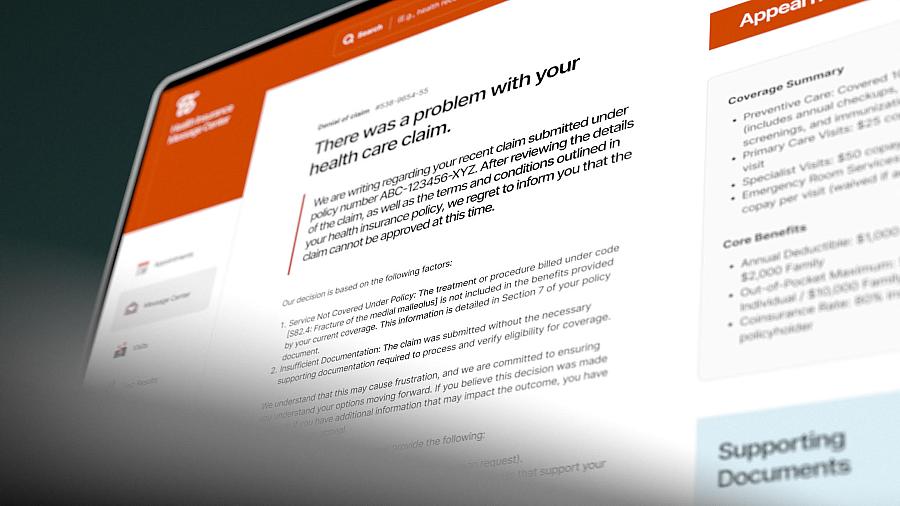
(Getty Images)
Tens of millions of Americans have been denied coverage for a treatment prescribed by their doctor. That’s anywhere from 20% to 70% of people with health insurance, according to various surveys. And while denials are often overturned on appeal, most people never undertake the maddening, time-consuming task of challenging them. A recent KFF analysis of Affordable Care Act marketplace plans found that fewer than 1% of denied claims were appealed.
A new book examines the political decisions that have given insurance companies so much power to determine what health care services we can obtain and when. It also sheds light on who’s most vulnerable to insurance denials, who’s most likely to fight back and win, and how the rigmarole involved in getting insurers to pay for care widens health disparities.
“Not too surprisingly, I find that marginalized patients end up suffering most,” said Miranda Yaver, author of “Coverage Denied: How Health Insurers Drive Inequality in the United States,” published by Cambridge University Press.
Yaver, an assistant professor of health policy and management at the University of Pittsburgh, surveyed 1,320 adults and interviewed more than 100 people about their health insurance experiences for the book. The Center for Health Journalism spoke with her about her research and the stories she’d like to see journalists tell. The following conversation has been condensed and edited.
How would you summarize your core finding?
There are only modest differences in one’s vulnerability to denial from insurers. The real inequity is in what happens next. Does this mean that you're going to have to postpone medical care? Are you going to have to postpone non-medical purchases? Are you going to be able to navigate the appeal process?
Tell me about those modest differences — who’s more vulnerable to an insurance denial?
Women and the LGBTQ community are more likely to use services that insurers don't like to cover. Women are at an elevated risk of some mood disorders, and insurers are not as generous as they should be in covering mental health. Women are probably more likely to need genetic testing and go through fertility treatments, both areas where there’s been a lot of pushback from insurers. And in the LGBTQ community — again, the mental health space is rife with denials. And insurers have pushed back over the years on gender-affirming care.
You did not find that poorer people and people of color face denials at particularly high rates. Were you surprised?
That was certainly my prior — I was thinking, well, obviously marginalized patients are going to be denied more.
How do you explain why affluent people get more denials?
A lot of analysis shows that wealthy people are getting more care. And more care is not always better care. People who are approaching health care from a position of relative privilege may be demanding more care that’s low value, or may be more likely to bring a medical malpractice suit, which potentially invites defensive medicine. That yields more insurance denials.
What inequities did you find when it comes to appeals?
Minorities and sicker patients are less likely to win appeals, just because it is so cumbersome. There's so much red tape, it demands so much health literacy. These groups are also more likely to have to postpone medical care, potentially leading to worse outcomes.
A KFF poll in January found that the public considers prior authorization to be the most frustrating, annoying obstacle to getting care. What did your research reveal about the practice?
Prior authorization used to be very limited. Now it has seeped into most corners of health care delivery — any high-tech imaging, costly tests, procedures, surgeries, most costly prescription drugs, and even some less costly prescription drugs.
How are insurers responding to the public backlash?
We are seeing major insurers pledge to pare back their reliance on prior authorization, but that has been a very recent development. In reality, even as the Centers for Medicare & Medicaid Services has called to streamline prior authorization and potentially pare it back, it has also introduced new prior authorization into traditional Medicare, and so it's really hard to make sense of where officials’ heads are at with this.
You write there’s no good evidence that prior authorization contains health care costs, so is it purely a strategy to boost insurer profits?
If people aren't getting the treatments or medication, the insurers are not going to be out of that money. But there's an asterisk here, because if the patient gets worse and then winds up in the hospital, that can be very expensive.
What do insurers gain by making people jump through hoops that discourage preventive care or effective treatment?
The logic, I think, is cynical. It has to do with patient churn, the fact that we change health insurers every few years. We may change our job, enroll in our spouse's plan or age into Medicare. And so the health insurer might say, “Okay, if we pay all this money for this diabetic patient to get a continuous glucose monitor, that will help them to regulate their insulin well and avoid diabetic complications. Or we could save this money because by the time there would be a diabetic complication, it's another insurer’s problem, not ours.” There’s sort of this passing of the buck.
What do you think of the use of AI to make determinations about coverage?
Major health insurers are increasingly turning to these tools. But as any professor can attest, while a lot of efficiency can be gained, the tools aren't quite there yet. They can hallucinate citations and things like that. When it happens in a student paper, we can deduct a couple points. But when it comes to health care decision making, the stakes are very high. These tools are advancing faster than the regulatory oversight can keep up with.
Are there model laws to protect patients?
California recently enacted Senate Bill 1120, which strengthens oversight of insurers’ use of AI tools. I think it threads the needle really well. It says insurers can basically continue to use these tools to efficiently approve prior authorizations and claims. But if a denial is being recommended, there needs to be a review by a physician in the appropriate specialty. Pennsylvania is pursuing similar legislation.
One of the things that I didn't realize until I wrote this book was that more often than not, the physicians who are doing these peer-to-peer reviews are not in the appropriate specialty. A number of states have worked to address that, but a couple dozen states still have not. So you may be in the situation where your rare neurology treatment is being reviewed by a family physician.
Can people use AI to fight denials more easily?
AI can assist with developing patients' and physicians' appeal letters. Services like Claimable are burgeoning. I do have some concerns about so much health care decision making being reduced to one AI program talking to another AI program.
What stories would you like to see journalists cover?
Two issues from the physician perspective really need more attention.
So, prior authorization requires a lot of staffing support, and that is something that large academic medical centers have. Black and Hispanic physicians are not only underrepresented among physicians, but underrepresented in academic medicine, and they’re much more likely to be in a smaller or solo practice. From a perspective of prior authorization, this would likely mean much more of the administrative burden would fall on their own shoulders.
That trickles down to patients, and we know that Black and Hispanic physicians are more likely to treat Black and Hispanic patients. If your physician is overextended, juggling phone tag with insurers between clinic time, you may have to wait more days for the insurer to approve your medication.
The same concept can be applied to the mental health space. Psychiatrists often operate in smaller solo practices, so more of the administrative workload may fall on their shoulders. This is really important, because we have a mental health provider shortage and we need to bring more people into this area of medicine. But if it’s rife with administrative burdens, psychiatry doesn't look like a very attractive specialty.
I've been trying to figure out how I wanted to study these issues but maybe the answer is, I should just tell journalists to cover them.