

Reporting on water contamination in the Salinas Valley changed my understanding of our food system

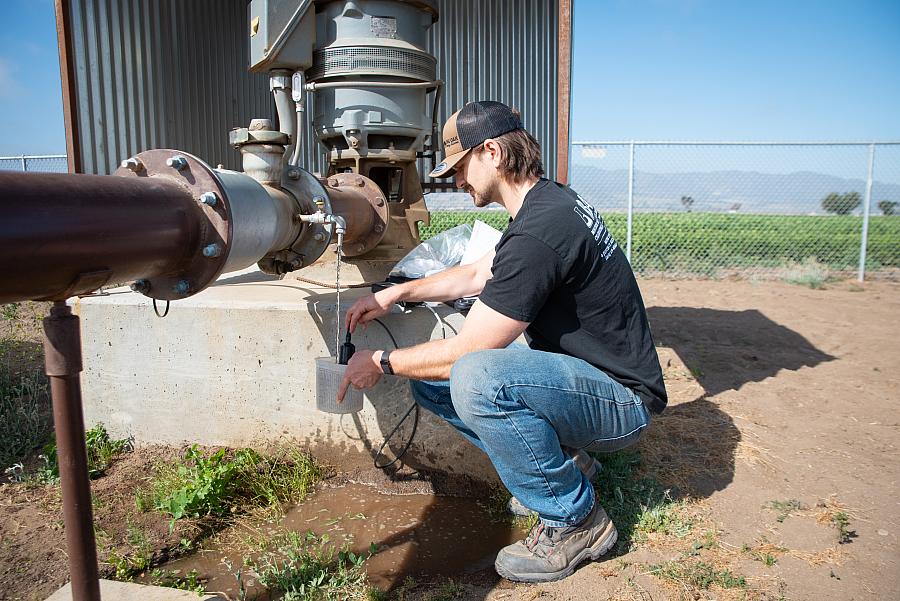
Monterey Bay Analytical Services project manager Drew McCown prepares a well in the Salinas Valley for sampling.
Photo by Erin Malsbury
Much of the nation’s lettuce, strawberries, spinach, broccoli and other produce comes from California’s Salinas Valley. I thought I had a pretty good grasp on what that meant for the people who live here. I had reported on communities demanding to be notified when restricted pesticides are sprayed. I witnessed farmworkers continuing to work through hazardous wildfire smoke, floods and dangerous heat. But there was an aspect of living near agriculture I was still unfamiliar with until embarking on this project.
The health risks from fertilizers tend to get less news coverage than pesticides. Maybe the fact that they’re designed to help grow plants rather than to kill pests makes them sound safer. But excess nitrogen fertilizer can seep into groundwater beneath fields or get washed into surface water, where it dissolves and becomes extremely difficult to remove. Peer-reviewed research and public health pamphlets from around the world link high levels of nitrates in drinking water to thyroid problems, cancers, birth defects and potentially lethal blue baby syndrome.
A research paper about the effects of drought and atmospheric rivers on fertilizer movement and groundwater quality made me curious about the situation in the Salinas Valley. I started my interviews by contacting the authors of that paper. They directed me to scientists who research nitrogen runoff around the Central Coast.
Talking with scientists first gave me a broad overview of what is currently known and what types of conversations growers and health experts are having. It helped me hone in on what types of questions to focus on with other sources.
I learned that in the Salinas Valley, where private wells are common, nitrogen pollution from agricultural fertilizer contaminates the water for over 14,000 people.
Public university scientists and USDA employees were relatively easy to contact, but nearly all of them hesitated to speak publicly about federally funded research. Some refused entirely, citing concerns about the current political climate. I had never experienced that in my years of science reporting, but I had also never witnessed the elimination of so many grants and projects across so many fields of science in such a short period of time. Sustainable agriculture was no exception.
I also quickly learned that this caution was not limited to researchers. Discussions about water come with sensitive politics. Background interviews became a helpful tool for building trust with sources and learning which leads to follow. Clear communication about my intentions and fact-checking process made people more comfortable talking with me. This was especially true for growers who were using synthetic fertilizers.
Meeting in-person was also important, both for the quality of the interviews and the audio recordings. My project was a radio piece, so I tried to meet people in the field as often as possible.
For research outside of interviews, I relied on data from the state and local water boards, health departments, court records and peer-reviewed journals. I found sources who suffered from nitrate contamination through an active court case.
Environmental groups and people at San Jerardo Cooperative, a farmworker community surrounded on all sides by conventional agricultural fields, were in the process of suing the state water board for blocking fertilizer regulation.
Several people at San Jerardo had stories to share. Before interviewing anyone in the community about their health concerns, I first spoke to Horacio Amezquita, a former cooperative manager who had been involved in their struggle for clean water over multiple decades. He provided hours of background information and helped me get in touch with other people there.
I worried residents might not want to talk publicly about their health issues, but I thought if they had already testified about them in a court case, they might be willing to go on the record with me. The cooperative manager helped me set up interviews with people who wanted to share their stories. The interviews were mostly in Spanish, aided by the help of a translator.
These conversations were heavy and deeply personal, and I was grateful for the guidance and inspiration from the mentors and speakers at the California Health Equity Fellowship conference I attended as part of the fellowship. It was important for me to have done my background research about the issue before going into these interviews. That helped me recognize which parts of their stories to focus on and talk with them realistically about their desired solutions.
After three consecutive well closures due to contamination, the community now gets water piped in from a well miles away. But that well, too, has steadily increasing nitrate levels. All the people I spoke to in the community pay for bottled water. The cooperative manager goes to water board meetings to push for solutions, but others have given up hope.
One of the things that drew me to this story was the seeming simplicity of the solution. Other parts of the world have faced the same issue and created regulations on the amount of nitrogen fertilizer that can be applied to fields at certain times.
In Europe, decades of regulations have improved the quality of contaminated groundwater. Using cover crops between seasons and changing the way fertilizers are applied can also help, but change moves slowly here. I found that I needed to dedicate an unexpected amount of airtime to explaining why the possible solutions weren’t being implemented.
The Central Coast Regional Water Quality Control Board tried to set nitrogen limits a few years ago. But the state water board argued that more information was needed and blocked the regulation. In the interim, the state board directed the regional board to find temporary solutions for the 14,000 people affected in the Salinas Valley. The meetings to decide on a solution are ongoing and could take more than a year.
The water board refused interview requests and instead supplied written statements. I later learned this was because of an active lawsuit. An attorney for California Rural Legal Assistance helped me stay up to date on the case.
One of the challenges of reporting this story was keeping my focus within what would fit in my limited broadcast time. There were pieces of the story that I just didn’t have time to include. Those pieces have become the focus of follow-up stories that could keep me busy for years to come.
When I set out on this project, I thought it would be an important story to tell even if only a few people were affected. Instead, the scale and severity of what I found changed how I view our food system and how we approach water management.