

The voices of those with lived experience of addiction changes the conversation on opioid settlement funds

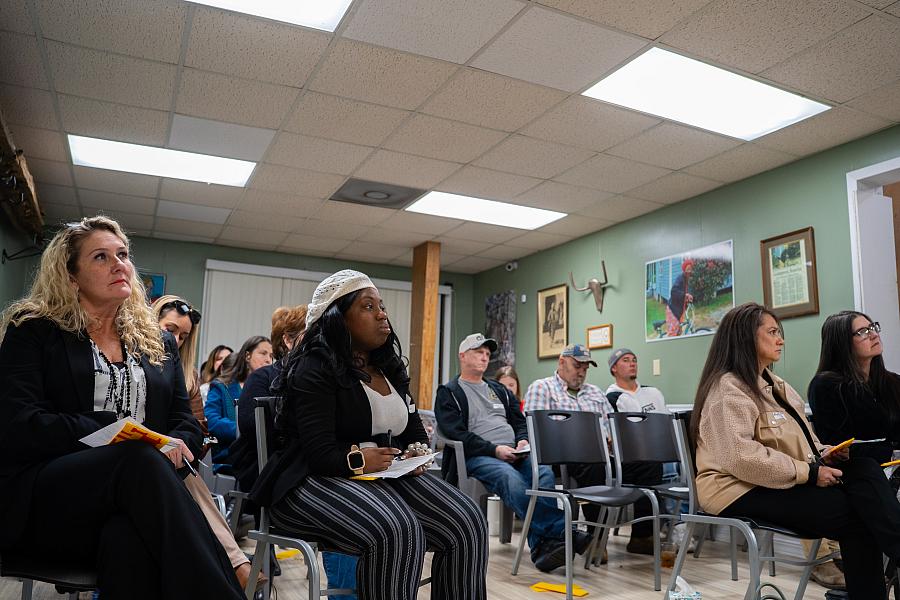
People with experience of the opioid crisis participate in a listening session organized by the Gulf States Newsroom at James Moore’s bike shop in Hattiesburg, Mississippi, on January 28, 2026.
(Courtesy photo/Jay Marcano for the Gulf States Newsroom)
Before I started traveling across Mississippi talking to people living with addiction, I thought of accountability journalism as something you aimed at institutions: governments, agencies, advisory councils, the mechanisms through which power gets exercised and money gets distributed. You follow the money. You file the public records requests. You compare what decision-makers said they would do against what they actually did.
That kind of accountability still matters — and in my recent series, we pursued it. We tracked how Mississippi divvied up nearly $60 million in opioid settlement funds, documented how lawmakers veered from an advisory council's recommendations they had themselves created, and reported on how the small share of funds already distributed to cities and counties was spent on police vehicles and guns rather than treatment. That work needed to be done.
But spending eight months on this project — driving more than 5,500 miles across the state, gathering over 200 written responses from people with lived experience, holding listening sessions in Hattiesburg and Dublin and Biloxi and Jackson — taught me that accountability isn't always pointed upward. Sometimes it's about asking whether journalism itself is being accountable to the people whose lives it documents.
The gap between data and reality
When I started this project as part of USC Annenberg Center for Health Journalism's 2025 Data Fellowship, I knew I wanted to look at the numbers. Mississippi leads the nation in infant and maternal mortality, and parental substance use is a major driver of both. More than 40% of children entering the foster care system in the state do so because of parental substance use. Mississippi has the highest rate in the country of children being raised by grandparents. These are staggering figures, and I leaned into them.
But data, I was reminded again and again, is a floor, not a ceiling. The numbers tell you something is happening. They don't tell you what it feels like to walk outside on Mother's Day and find your husband slumped over in a chair, or what watching a loved one die does to a family, especially the children. They don't tell you what it costs to choose between bringing your youngest son to a treatment facility or not going at all.
The strongest moments in this series didn't come from databases. They came from people who trusted us enough to sit across from a recorder and describe what the opioid crisis had actually taken from them. That trust had to be earned, and the earning of it changed how I approach this work.
What community engagement actually means
Community engagement is one of those terms that can become hollow fast if you're not careful. It can mean posting a callout on social media and hoping responses trickle in. For this project, our community engagement producer Nellie Beckett and I tried to make it mean something more rigorous than that.
We went to Recovery Day at the Capitol in Jackson, an event that champions addiction recovery and related policies. We went to a bike shop in Hattiesburg where James Moore raised a purple flag every time someone in the city died from an opioid overdose. We went to a treatment center in Dublin where we ate donuts with patients and watched one of their children draw a picture of a "healthy family" on a sticky note. We went to a Black Balloon Day memorial in Biloxi where families held photographs of people they had lost.
At each of these places, we asked: What do you think Mississippi should do with this money?
Not one person said law enforcement. Nearly everyone said treatment. Forty percent said support for children and families. More than a third supported harm reduction — naloxone distribution, fentanyl test strips, the approaches that public health evidence supports and Mississippi politics have largely resisted.
We took those 219 written responses to the Capitol in March and set up a table for lawmakers. Some stopped. Some listened. Republican state Rep. Bubba Carpenter flipped through the binder and said, "these folks need to be part of the legislative process." Democratic state Rep. Jeffrey Hullum III closed his eyes and listened to the audio we played.
I don't know what, if anything, those conversations produced in the final appropriations. The legislative process is its own thing. But I know that the people whose words filled that binder — the sticky notes, the survey forms, the handwritten accounts of loss — had never before been in the room where those decisions were made. That matters even when the immediate policy outcomes are uncertain.
The people who weren't at the table
One of the central findings of this series was the absence of lived experience from the advisory council that was supposed to guide Mississippi's opioid settlement spending. The council reviewed 127 applications over eight months. Not one voting member had personal experience with opioid use disorder.
This isn't a minor procedural footnote. The settlement funds exist, as James Moore put it at our Hattiesburg listening session, because of “the greed of the pharmaceutical companies and the distributors and the pharmacy chains that profited off of our loss.” The money is meant to repair damage done to specific people and communities. Deciding how to spend it without those people in the room is a choice — and it has consequences.
In the council's final rankings, the Fairland Center — one of only two residential facilities in Mississippi that accept pregnant women and mothers with young children — landed in the second tier and received no funding from the legislature. A workforce recovery program through the Department of Employment Security, which had never even applied to the council, received $1 million.
The people who could have flagged these gaps — who understood from experience what actually helps someone get and stay in recovery — were not there.
Building the plane while flying it
Michelle Williams, chief of staff at the Mississippi Attorney General's Office, described the opioid settlement process as "building the plane as we fly it." It was a candid and somewhat disarming phrase. I've spent a lot of time thinking about it.
On one hand, it was an honest acknowledgment that Mississippi, like many states, approached an unprecedented amount of money without a fully built infrastructure for distributing it. On the other hand, "building the plane as we fly it" is also a description of what has been happening to the families in this series for years. Alyson Koenig, a patient at the Fairland Center, wasn't waiting on the legislature to figure out its advisory council process. She needed a bed. She got one of the last ones.
The question this series kept asking is: Who bears the cost of improvisation? When systems are being figured out in real time, the people who pay the price for the gaps are rarely the people doing the figuring. They are the people like Koenig, trying to make sure her son doesn't lose his mother while the state works out its application portal.
What I'd do differently
If I could go back to the beginning of this project, I would have started the community engagement work earlier. By the time we were traveling across the state in January and February, the advisory council had already submitted its recommendations. The legislative session was already underway. The people whose voices we collected had missed the window where those voices might have most directly shaped the process.
That's partly a resource and timeline issue — this kind of reporting takes time to set up, and our capacity was limited. But it's also a reminder that community engagement isn't a feature to add to a reporting project. It has to be baked into the structure of the work from the start, or it risks arriving after the decisions have already been made.
Ultimately, the responses we gathered from people with lived experience of addiction were powerful and formed their own dataset. While we were able to present this data to lawmakers during the legislative session, if I could do it over, I would have collected that data while the advisory council was still actively meeting so councilmembers could also use it in their decision-making process. However, the recommendations from the council were just that — recommendations. The state legislature had the final say, and in the end, they veered away from the recommendations of the council.
What this kind of reporting can do
The opioid crisis in Mississippi is, among other things, a story about what happens when institutions fail people systematically and over a long period of time. The pharmaceutical companies that flooded the market. The distributors who looked away. The prescribers who wrote without adequate scrutiny. The policymakers who were slow to respond. The child welfare system that took children without always giving families real pathways to reunification.
Settlement funds don't fix that history. But they represent a rare moment when resources exist — real money, substantial money — that could change what's possible for people who have been living inside that failure for years. The question this series kept asking is: are the people making decisions about that money treating it like the rare opportunity it is?
The answer, so far, is mixed. Some of the appropriations this session will do real good. The Mississippi nonprofit End It For Good will launch family support groups that Mississippi has never had. The state is hiring a third-party administrator to bring more structure to future funding rounds. Conflict-of-interest rules are tighter. These are real things.
But the Fairland Center has no new beds. The 15% of funds that went directly to cities and counties — roughly $63 million — went almost entirely unspent or toward things like police equipment. The advisory council's process, built over eight months of meetings and ranked applications, was treated as optional when it was inconvenient.
The session is over. The money that wasn't spent this year is still there, and the next round is coming. The people whose words we brought to the Capitol are watching.