

As 1 in 6 in Mass. spend half their income on housing, here’s what they sacrifice
This article was originally published in MassLive and produced with the support of our 2025 Data Fellowship.


A mother and daughter wheel a grocery cart through the Catholic Charities of Boston food pantry in Lynn on Nov. 14, 2025.
(Will Katcher/MassLive)
After two years of couch surfing, Quianna Barnwell isn’t sure when she will finally find an affordable apartment for her and her son.
She hopes it’s in Massachusetts, where she was born and has long called home, and ideally near her 7-year-old’s school in Boston. But an attainable two-bedroom has proven hard to come by on $56,000 per year working as an administrative assistant at a Boston hospital.
This fall, Barnwell, 34, learned she earned too much money to continue qualifying for federal food assistance. She had relied on the Supplemental Nutrition Assistance Program, or SNAP, for about $350 a month. Without it, her budget was in disarray.
“The little money I did have for gas and whatever, I now don’t have it,” Barnwell said. “Having to explain to the kid who normally takes two fruit snacks (at a time) that he can only take one, it’s not easy.”
Even when she qualified for SNAP benefits, budgeting each month was no simple task.
Massachusetts is one of the nation’s wealthiest states, but also one of its most expensive. As more families struggle to afford the skyrocketing costs of housing, utilities, child care and health care, food increasingly becomes the budget line they stretch to breaking point.
Barnwell has turned to food pantries and accepted help from family and friends with groceries. But as expenses mount, moving to Texas, as her mother did, is no longer out of the question.
“People might be working 50 or 60 hours a week, and it’s not enough to get by,” said Erin McAleer, the president of Project Bread, a Boston-based food assistance nonprofit. “They have to pay rent, so they’re not evicted. They have to pay for gas. People run out of money, and food becomes the tradeoff.”
“It’s awful,” she said. “These are impossible decisions to make.”
Mass. leads New England in severely cost-burdened households
Barnwell is on years-long waitlists for public housing and rental assistance. In the meantime, she hopes to find an apartment for less than $2,200 a month. Even then, the rent would take nearly half her paycheck.
She wouldn’t be alone.

Quianna Barnwell speaks about her struggle to afford food for herself and her son at a food insecurity town hall hosted by the Boys & Girls Club of Boston in Dorchester on Jan. 15, 2026.
(Will Katcher/MassLive)
An acute housing shortage in Massachusetts has considerably increased the cost of securing a home.
About one in six households in Massachusetts pays more than half its income on housing, the highest rate in New England and among the highest in the country, according to U.S. Census data.
Those 454,000 households are classified by the federal government as severely cost-burdened.
Nearly half a million other households spend between 30% and 50% of their income on housing, the threshold at which they are classified as cost-burdened.
In Chelsea, the densely packed working-class city north of Boston, the cost of rent has left little room for error in Iris Ivette Montufar’s budget.
She has watched it climb in recent years from $1,500 to $2,000. Earlier this year, the landlord tried unsuccessfully to raise her rent to $2,300.
About one in four Chelsea households pays at least half its income toward housing, one of the highest rates in Massachusetts, according to Census data.
The city’s median household income of about $72,000 lagged far behind the state median of about $100,000 in 2023, the latest year the Census data was available.
Missing rent is not an option, Montufar said, especially not with two children and outside temperatures sinking below freezing most winter nights.
“Rent is first, no matter what,” she said.

Iris Ivette Montufar, of Chelsea, has faced increasing rents and living costs that have strained her family's food budget.
(Will Katcher/MassLive)
Budget-busting rents force families to turn to SNAP
In Greater Boston, the median price of a single-family home soared past $1 million last summer, setting a record, according to a regional realty association. The average rent in Boston is more than $3,400, according to Apartments.com and Zillow.
State officials say Massachusetts needs to build 222,000 housing units over the next decade to meet demand and bring prices to heel.
The increasing cost of living has forced more families to turn to the SNAP program, food pantries and other sources of aid, McAleer said.
Census data also show a correlation between the weight of housing costs and the number of families seeking food assistance.
Neighborhoods across the state with the highest concentration of severely cost-burdened renters are about 20 times more likely to have a high concentration of SNAP users, according to a MassLive analysis of Census data.
“People are in the red after they pay rent,” McAleer said. “Food is the tradeoff because you can’t stretch your rent or utilities.”
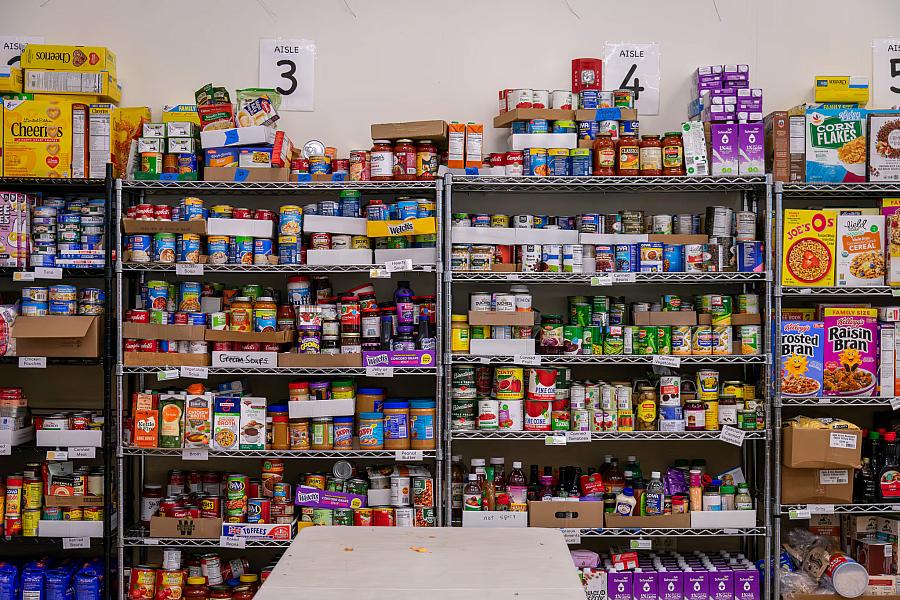
The Open Table food pantry in Maynard on Nov. 17, 2025, before Thanksgiving, the pantry's busiest time of the year.
(Will Katcher/MassLive)
As in Chelsea, roughly one in four households in nearby Lynn pays half its income toward housing. The city’s median household income of about $73,000 is not enough to keep pace with the cost of living, said Michael Satterwhite, a Lynn resident and attorney.
“You can’t have affordable housing based off your income and afford to pay other bills,” he said. “Utilities have gone up. You add that and the cost of food, and it’s not sustainable.”
Montufar receives about $450 in monthly cash assistance from the state. Unable to work consistently because of a back condition, the benefits carry her and her children through the month.
About $500 from SNAP, along with local food pantries, holds her grocery budget together. Each dollar for food that doesn’t come from her pocket can help secure another basic need, she said.
Millions of families like Montufar’s were pushed to the brink in November when the Trump administration cut off SNAP payments for more than a week during the federal government shutdown. More than 1.1 million Massachusetts residents — nearly one-sixth of the state’s population — rely on the program.
“Don’t take it away,” Montufar pleaded, choking back tears, at a late-October rally in Boston, urging the federal government to preserve SNAP.
November marked the first time a president had cut off funding for the program, still commonly known as food stamps. And while benefits were restored as the decision faced legal challenges, the week-and-a-half lapse in funding sent a deluge of families in need to food pantries that were already facing record demand.
“People are just right on the edge,” Alexandra DePalo, executive director of the Open Table food pantry in Maynard, said in November as the organization strained under the crush of new families to feed.
SNAP may now be restored, but numerous other concerns remain, Montufar said. “Thank God, it’s back. But now it’s the rent, the utilities, the heat.”
Satterwhite sees similar struggles each day in the faces of his neighbors waiting in lines at Lynn food banks. It’s a potent reminder of the meals he received at My Brother’s Table, a Lynn soup kitchen, during a period of homelessness as a teenager.
“At My Brother’s Table, you’d see people coming who were working multiple jobs,” said State Rep. Sean Reid, 30, a Lynn Democrat who also was homeless at a young age and found assistance at the soup kitchen when he needed it most.
State leaders have taken a variety of steps to confront Massachusetts’ diminishing affordability, he said.
Lawmakers have passed legislation to open up new housing development, tapped into state funds to blunt the rise in health care costs and assembled a coalition of experts to address the state’s increasing levels of hunger.
“We talk about food insecurity, we talk about addressing health care, we talk about addressing housing and we tend to talk about them in silos,” Reid said. “When it’s really all part of the same affordability crisis that we’re seeing not just in Mass. but all over the country.”
Hungry and missing class, she helped start a campus food pantry
Alicia Wright, a Roxbury Community College student, said her grandmother had attended the school while raising her four children, but dropped out before graduating.
Massachusetts did not make community college tuition-free for residents until 2024. Pursuing a degree in a different era, Wright’s grandmother was forced to choose between spending money on education and her family’s home, food and clothing.
“When things got tight, she decided she had to sacrifice her goal,” Wright, 38, said.
When she attended Roxbury Community College, Kiara Rosario would dread going to class hungry.
Rosario, a single mother living in Boston’s Allston-Brighton area, dropped out of high school and struggled with the law. She wanted to complete her education and become a social worker to help young people in similar circumstances. But entering college in 2021 at age 33, she was straining to feed her preschooler and herself.
The school cafeteria was still closed due to the pandemic. She and other students would visit a support office for snacks during the day, when they could. On occasion, Rosario remembers skipping class to avoid the embarrassment of others hearing her stomach rumble.
An on-site food pantry, college administrators reasoned, would help students complete their degrees, allowing them to study without worrying about putting food on the table. Students also wouldn’t need to skip class to pick up food at pantries elsewhere.
Rosario helped establish the on-site food pantry at the college and now manages it while completing her bachelor’s degree at Boston College.
Rosario said she stopped qualifying for food stamps after leaving Roxbury Community College. Now working part-time at the food pantry, her rent — tied to her income — has increased from about $200 to $1,000.
Although she attends Boston College on a full scholarship, there are also auto payments, utilities and new clothes for a growing 8-year-old to worry about.
“With all that and food, it becomes very hard,” she said.
‘It feels like I’m failing my son’
Pressed for cash, people may choose to purchase lower-quality or less healthy food to keep themselves and their families fed, McAleer said. Parents may choose to cut back on their meals so their children have enough.
Robert Lewis Jr., president and CEO of the Boys & Girls Clubs of Boston, grew up as a “welfare kid” in public housing, he said. His mother worked as a cleaner, and he and his older sister worked part-time.
“But it wasn’t always enough to take care of the family,” he said.
It saddens Lewis to see parents today still straining, as his mother did, to feed their families.
“They have to wake up and ask, ‘Can I afford to take public transit and pay to go to my doctor’s appointment, or do I save these $4, $5 for food?’” Lewis said. “These are the decisions moms are making. I don’t know this because I’m reading it. It’s because the moms are telling me.”
After school, Barnwell’s son heads to the Boys and Girls Club. In addition to its educational offerings, activities and loving environment, she is grateful that the club feeds him a well-balanced dinner each night. It also means five fewer meals to worry about buying and cooking each week.
Barnwell remembers standing in line at Market Basket when the SNAP program was paused in November, agonizing over whether the money she had could cover what the cart held.
She wants to shield her son from her struggle to find enough food and provide him with a stable home, where he can play with friends and have sleepovers.
Since her mother moved to Texas last year, Barnwell has wondered whether life there for her and her son would be easier and more affordable.
For a single parent of one child living in the Boston area, data from the Massachusetts Institute of Technology place the living wage at $58.31 per hour, or $121,000 per year.
In the Dallas area, where Barnwell’s mother moved, the rate is $38.98 per hour, or about $81,000 per year.
A November poll from Suffolk University and the Boston Globe found that a third of Massachusetts registered voters had considered moving out-of-state in the past year because of the cost of living. Respondents said utilities, health care, housing and groceries were the leading strains on their budgets.
In December, Barnwell thought she finally found an apartment for her and her son. It seemed promising and wasn’t terribly far from his school. Only after applying did she learn the rent was $2,700 a month and that she needed to make $33,000 more than her annual salary to qualify.
“As a single mom, it feels like I’m failing my son because he doesn’t have certain things,” she said. “I don’t know how much longer I can do this.”