

Across the street from a Lamborghini dealership, a Mass. food pantry is busier than ever
The article was originally published in MassLive with support from our 2025 Data Fellowship.

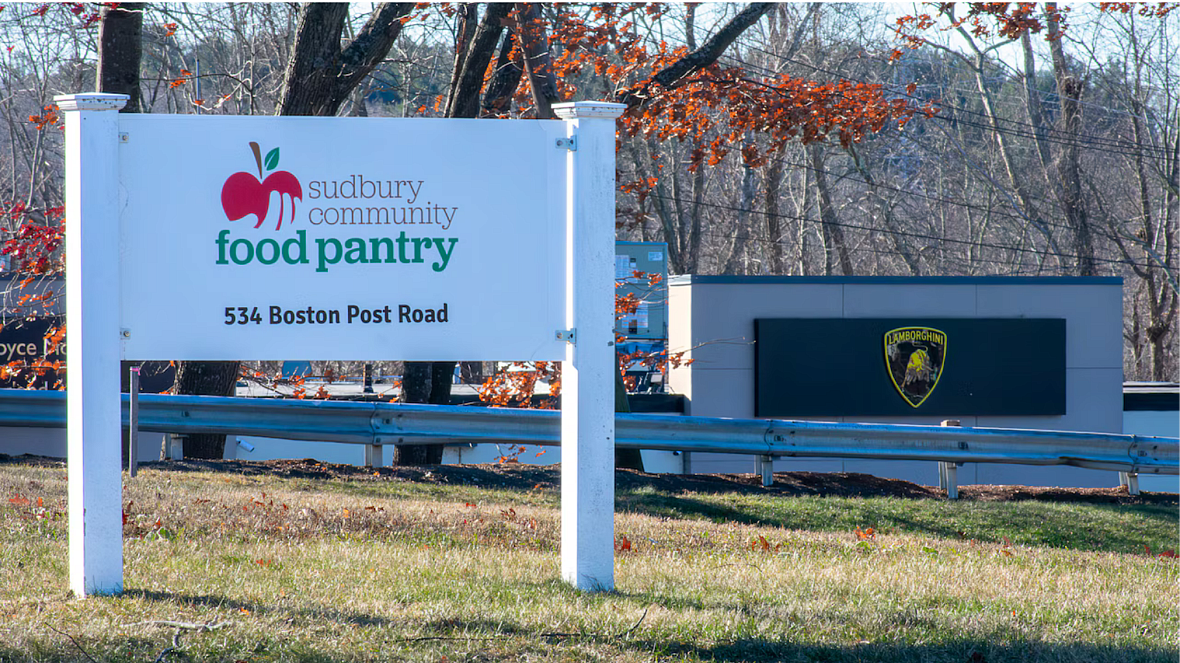
The Sudbury Community Food Pantry sits on the Wayland-Sudbury line, across from a Lamborghini dealership and other luxury car sellers.
Will Katcher/MassLive
3SUDBURY — In one of the highest-earning towns in one of the nation’s wealthiest states, a food pantry across the street from a string of luxury car dealerships is busier than ever.
Last year, more than 1,000 families turned to the Sudbury Community Food Pantry for help putting food on the table. Just across the street, showrooms gleam with Lamborghinis, Bentleys and Land Rovers — a reminder that crossing the street here means crossing into another world.
Even in the most affluent corners of Massachusetts, some residents lack the money to buy enough food. Although far more prevalent in other communities, the problem spares no town. Yet available data often fails to fully capture its scale at the local level in wealthier cities and towns.
Despite ranking among the nation’s highest‑earning states, Massachusetts is also one of its most expensive. As the cost of living continues to climb, food pantries in cities and towns across the state report record demand.
“There is incredible surprise on people’s faces when they hear that anyone in Newton needs food,” said Rose Saia, the executive director of the Centre Street Food Pantry, one of two food pantries in a Boston suburb where the median home is valued at about $1.3 million
“There are many people who wouldn’t consider that people are in need, who think, ‘Newton is so affluent. How could anyone in Newton possibly need food?” she said.
Hunger hides ‘in plain sight’
The city has tremendous wealth. The median home value in Newton is more than twice that of the state as a whole, according to U.S. Census data. The median household income is $190,000, compared with the state median of $104,000.
Yet those figures obscure other realities: In a city of 91,000, an estimated 4,000 Newton residents live in poverty, according to the Census. It’s less than half the rate of the state, but no solace to the thousands who struggle to get by. About 4,000 residents also receive grocery assistance through the Supplemental Nutrition Assistance Program, or SNAP, the nation’s largest food aid initiative.
Last year, Centre Street Food Pantry provided food for nearly 1,100 families each month across Newton and five surrounding communities. The number of families it served was about 15% higher than the prior year.
Saia grew up in Boston, in circumstances she would only later realize qualified as food insecurity — when a person or family is unable to afford enough food or is uncertain where their next meal will come from.
“My dad was in jail in a state far away. My mom got up early for work in the morning and came home late at night,” Saia described in Paint it Black, a 2019 story for The Moth. “Sometimes she left me a peanut butter and jelly sandwich for lunch, but sometimes there wasn’t any bread, so I didn’t go to lunch or recess on those days.”
People living in similar positions “are hiding in plain sight,” Saia said in a recent interview. “You’re standing next to them in the coffee shop. They’re on the train with you or at the supermarket. They might be checking you in at the dentist. You don’t see them, but they’re right there.”
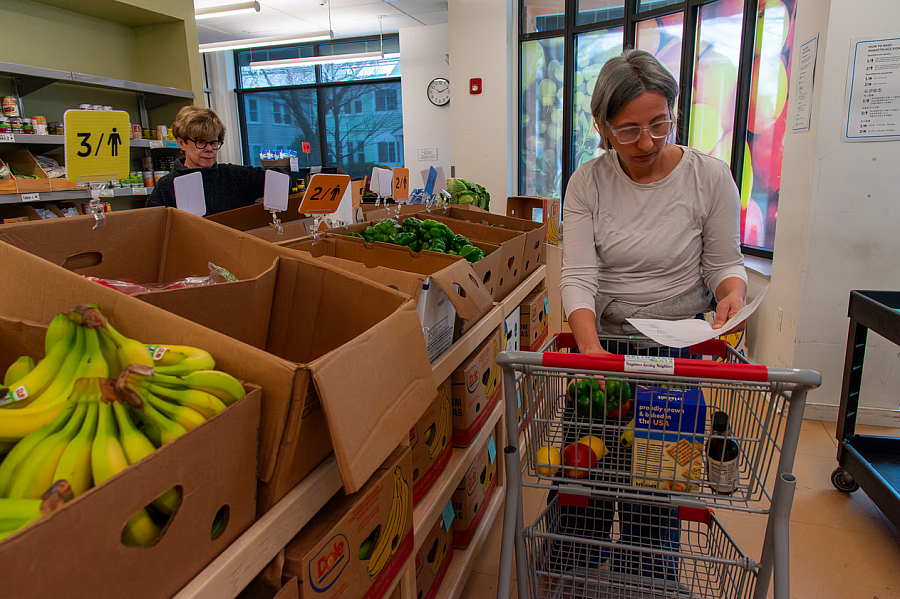
Volunteers for Arlington EATS, a food assistance organization in Arlington, prepare bags of groceries for delivery to families in need.
Will KatcKatchers/MassLive
Volunteers for Arlington EATS, a food assistance organization in Arlington, prepare bags of groceries for delivery to families in need. (Will Katcher/MassLive)
Late last year, the U.S. Department of Agriculture terminated a nationwide study of hunger and food insecurity that it had conducted since the Clinton administration. The findings were widely cited to compare the issue state-to-state. In its final iteration, the study showed food insecurity in Massachusetts was below the national average, but worsening by a “statistically significant” amount.
For a more local picture of how many Massachusetts families are struggling to feed themselves, the state and many organizations turn to an annual report by the Greater Boston Food Bank, New England’s largest hunger-relief organization, and Mass General Brigham.
That sixth edition of the study, published Tuesday, found that food insecurity rose to 40% of Massachusetts households in 2025, a 3% increase from the year before.
The study reports food insecurity rates by county and, in some cases, by region. A town and city-level analysis of hunger in Massachusetts is hard to come by.
“I’d be surprised if there were any community out there in Massachusetts that doesn’t have a food security issue,” said Dan Foley, a volunteer for the Centre Street Food Pantry. “It cuts across all of them.”
In addition to Newton, the pantry serves Brookline, Needham, Waltham, Watertown and Wellesley, a collective population of about 320,000.
About two-thirds of the households the Centre Street Food Pantry serves have children. Many of the people picking up groceries are working parents, who arrive wearing everything from medical scrubs to business attire, Saia said.
The causes that bring people to the pantry are as vast as the population itself.
Some families stretch their means to live in a community with strong schools. Newton is also “a forward-thinking community who offers subsidized housing,” Saia said.
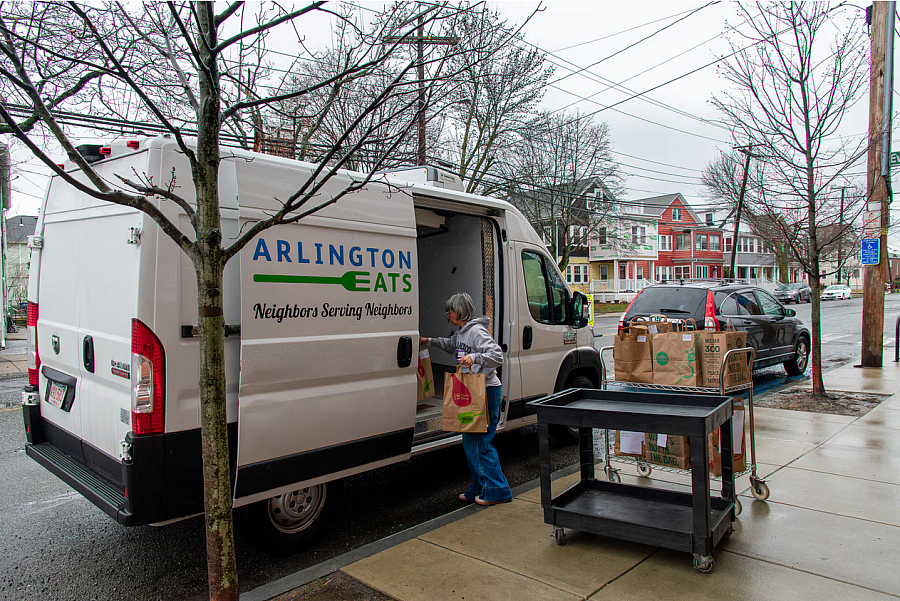
Volunteers pack a truck for grocery deliveries at Arlington EATS, a food assistance organization in Arlington.
Will KatcKatchers/MassLive
Volunteers pack a truck for grocery deliveries at Arlington EATS, a food assistance organization in Arlington. (Will Katcher/MassLive)
Some people are out of work or not making enough to keep up with living costs. Others face unexpected turbulence in their lives, such as an expensive medical diagnosis. Though inflation has fallen from its peak four years ago, basic living costs remain high.
“When 50% or more of your paycheck can go to housing, that doesn’t leave a lot for food or diapers or whatever else you need,” said Andi Doane, the executive director of Arlington EATS, a food assistance organization in Arlington. People seek the organization’s help “so that they can afford to live in their apartment or pay their mortgage.”
The Centre Street Food Pantry’s data suggests more families with children are seeking help, and more people are using the pantry with greater frequency, Saia said. The organization’s data also indicate that families are increasingly consolidating multiple households under one roof to alleviate living costs.
About a mile away, the Newton Food Pantry, based at City Hall, also served about 1,100 households last year. But staff there estimate that thousands more residents need food assistance, yet do not seek it at the pantry.
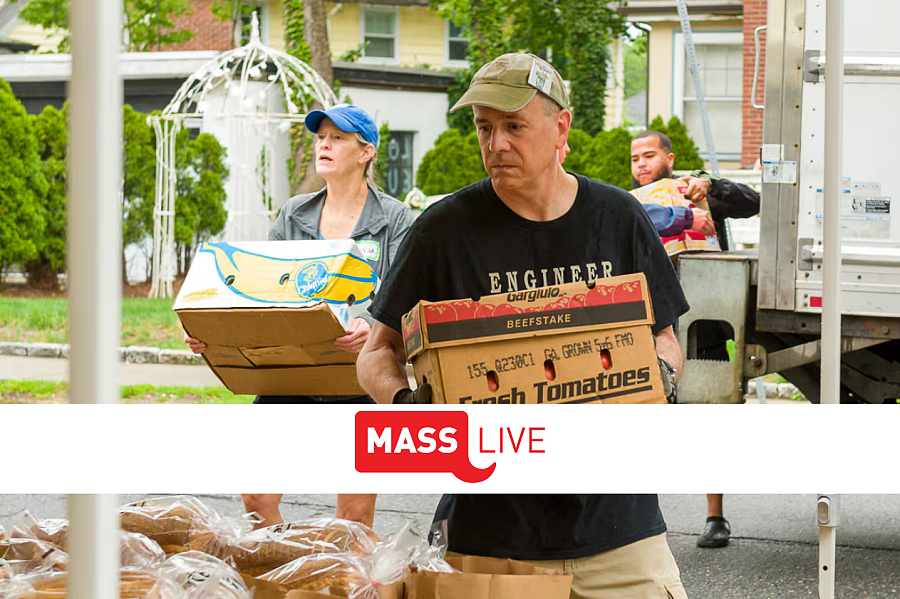
Walker Carroll, a volunteer for the Centre Street Food Pantry in Newton, helps unload a truck of food.
Bruce Wilson
Walker Carroll, a volunteer for the Centre Street Food Pantry in Newton, helps unload a truck of food. (Bruce Wilson)
Older adults, many of whom have lived in their homes for years, may struggle to keep up with taxes and escalating utility costs on fixed incomes, said Sindy Wayne, a volunteer board member of the Newton Food Pantry.
Before the pandemic, as many as 40% of the people served by the Centre Street Food Pantry were seniors. Today, it’s about 12%.
“It’s not because there are fewer of them,” Saia said. “It’s because the pie has grown larger.”
In Longmeadow, some can’t ‘keep up with the cost of living’
In Western Massachusetts, demand is also dramatically increasing at a food pantry in Hampden County’s highest-earning community.
The Longmeadow Food Pantry distributed 44,000 pounds of food last year, up about 9,000 pounds from the year before, said Jamie Walker, the food pantry coordinator.
“I think the biggest misconception is that there’s no need in our community,” Walker said. “But we still do have a significant amount of elderly in our community, a significant amount of veterans in our community and just a significant amount of people who just cannot keep up with the cost of living and groceries.”
Across the four counties of Western Massachusetts, one in two families qualify as food insecure, according to the Greater Boston Food Bank study released Tuesday.
In Sudbury, the food pantry sits on the town’s border with Wayland. Both communities are among the 10 highest-earning towns in the state, with median household incomes of $236,000 and $224,000, respectively, according to Census data.
The car dealerships across the street from the pantry sell some of the most expensive vehicles on the market, about 150 feet from where families in need arrive to pick up groceries.
It’s “a really good illustration of the realities in these communities,” said John Thomas, the pantry’s executive director.
Food insecurity in Middlesex County, where Sudbury is located, rose by 11 percentage points last year, the steepest jump of any Massachusetts county, according to the Greater Boston Food Bank study.
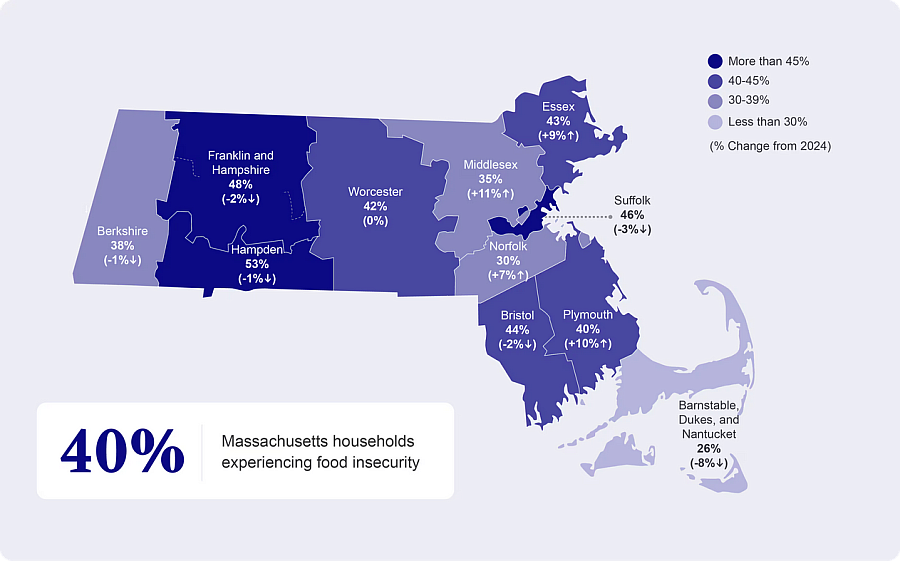
Food insecurity was worst in the Pioneer Valley of Western Massachusetts and in Boston in 2025, but worsened in many counties in Eastern Massachusetts, according to a new study from the Greater Boston Food Bank and Mass General Brigham.
Greater Boston Food Bank and Mass General Brigham
Food insecurity was worst in the Pioneer Valley of Western Massachusetts and in Boston in 2025, but worsened in many counties in Eastern Massachusetts, according to a new study from the Greater Boston Food Bank and Mass General Brigham. (Greater Boston Food Bank and Mass General Brigham)
However, the pantry does not serve only Sudbury. People visited the pantry from 74 towns and cities last year, led by Framingham, Marlborough, Sudbury and Worcester. Some came from as far as Rhode Island.
Families can visit the pantry twice a month. Since 2018, the number of families visiting the pantry has more than doubled.
Federal cuts to funding and food distribution
At the same time, the federal government has cut funding for food aid and tightened the requirements of SNAP and other social safety net programs.
Hundreds of hunger relief organizations in Massachusetts rely on food supplied by the Greater Boston Food Bank and similar organizations.
Since October, food supplied to the food bank by the Department of Agriculture has declined by 36%, the organization said, forcing it to rely more on philanthropic and state funding to purchase food.
No period has ever been busier than during the government shutdown last fall, when President Trump temporarily suspended SNAP payments weeks before Thanksgiving.
One in eight Americans receives grocery assistance from the program, formerly known as food stamps.
Without it, food pantries were inundated with families, including many who had managed to get by on SNAP but were left unable to afford food in its absence.
At the height of the pandemic, Arlington EATS served 300 people a week through its food pantry and grocery delivery. Similar to other food pantries, demand climbed in recent years alongside living costs. When Trump suspended the SNAP program, the organization found itself serving over 600 households a week.
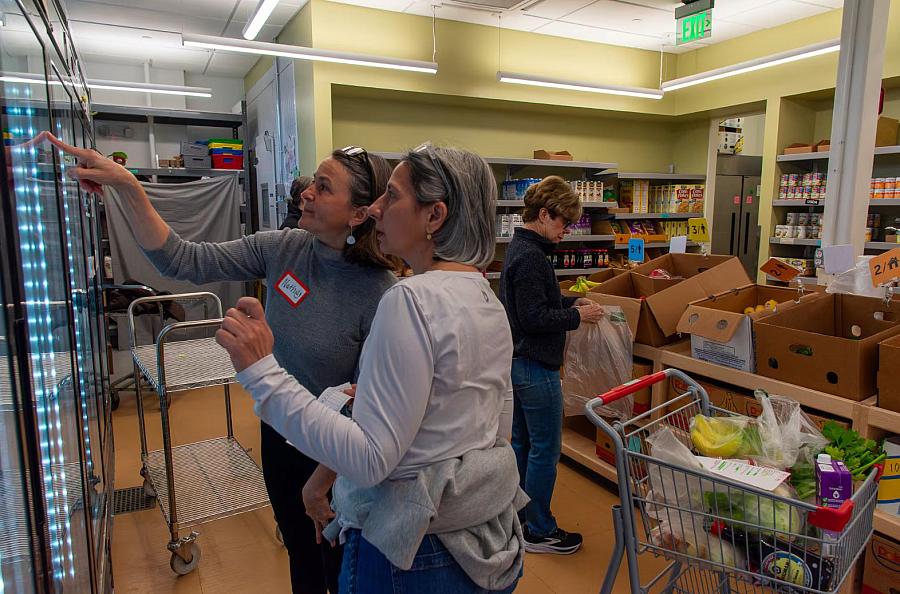
Volunteers for Arlington EATS, a food assistance organization in Arlington, prepare bags of groceries to be delivered to families in need.
Will Katcher/MassLive
Volunteers for Arlington EATS, a food assistance organization in Arlington, prepare bags of groceries to be delivered to families in need. (Will Katcher/MassLive)
“People look at Arlington, and it’s a fairly wealthy suburb of Boston,” Doane said. The median household income is over $150,000 and the median home price is approaching $1 million, according to Census data.
“You see these million-dollar homes going up. The reality is there are neighbors in our own community and our own backyard who are struggling with food insecurity,” Doane said.
With SNAP benefits cut off at the start of November, communities across the state rallied to bolster their local food pantries. Donations flooded into the Centre Street Food Pantry, Saia said. More than 200 people applied to volunteer, more than the organization had room to accept. Pantries in other towns reported the same.
“It was a real example of the community saying, ‘Tell me what I can do. This matters,’” Saia said.
The SNAP program resumed about a week later. The focus of the nation moved on. But food pantries have continued to serve a surge of families in the months since — including in some of the most affluent cities and towns in the state.