

“Don’t Stay Alone. Come Out”: Loneliness and Mental Health Among Korean American Seniors in LA

Lee Myung-hee:
“She told me not to stay alone… to go out somewhere.”
David Jung:
“I come here to gather with friends.
Song Joo:
“We talk with each other and eat together.”
Each morning, some seniors make their way here. Not just for a meal. Not just for a class. They come to ask how someone is doing in Korean. To laugh together, and to make a lonely day feel a little less lonely.
Left Alone
Seventy-two-year-old Lee Myung-hee has lived in LA’s Koreatown for more than 20 years. She built a life here running a small business with her husband. Then came his cancer diagnosis. After her husband died last year, her life was never the same. Her days grew emptier and emptier.
ILee Myung-hee:
“My husband battled cancer for about seven years before he passed away last year… After that, I moved into a senior apartment. I’ve been there for about six months.”
Lee was alone at her husband’s side until the end, but after he’d gone, she found there were still more things she had to face alone.
Lee Myung-hee:
“After the funeral, I carried the death certificate to eleven different places. I took the bus, walked around, and had to become the head of the household. I had nowhere to go. It wasn’t just that I was poor. I didn’t even have money to pay rent. So I used the condolence money and talked to the apartment office. That’s how I moved into a studio in a senior apartment.”
But in Lee’s new room, the loss became even clearer.
Lee Myung-hee:
“The hardest part was… even after throwing so much away, my old furniture still wouldn’t fit, so I had to throw it out. I had no bed, just a blanket on the floor for about 23 days…When I was alone there, I really couldn’t sleep for about four months. I had sleep problems… I had no purpose… Everything felt uncertain. I cried a lot, and I couldn’t sleep. I kept wondering, what am I supposed to live for?
When Loneliness Affects the Mind
Loneliness in later life is not just about being alone. When grief, retirement, health issues and changes in a living situation overlap, a person’s emotional balance can begin to lose stability.
Professor Ki-jung Kang, Department of Elderly Welfare, Baekseok University:
“When we talk about loneliness, we often think of it as an individual problem. But loneliness in later life comes with many complex issues. It can include anxiety and insomnia. When those problems continue, people may move less, and that can even lead to physical health problems. I see it as the starting point of a very complex issue.”
Loneliness Among Korean Immigrant Seniors
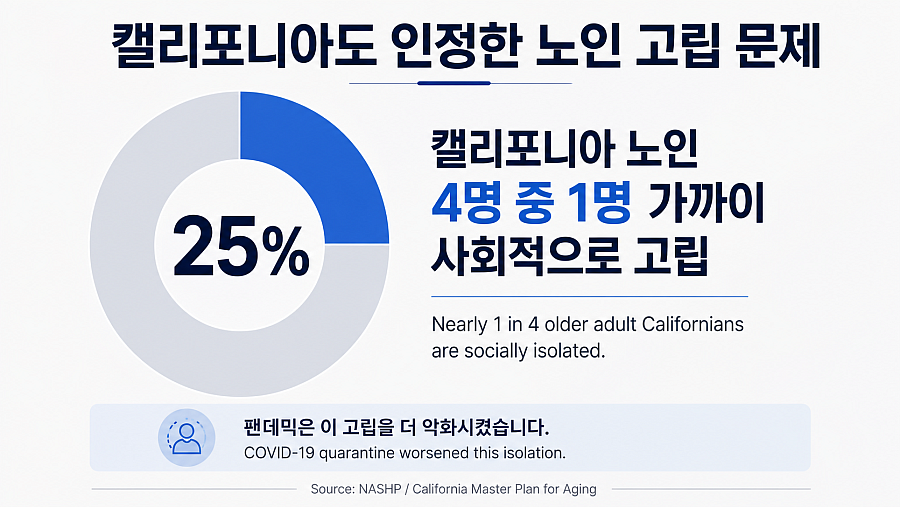
Lee’s experience is not unusual. Nearly one in four older adult Californians are socially isolated and for first-generation Korean immigrant seniors, loneliness can be even more complicated. Language barriers, cultural stigma around counseling, and emotional distance from adult children can all stand in the way.
Lee Hyun-wook, President, LA Koreatown Senior & Community Center:
“I think the biggest factors are the isolation seniors feel, the fear of living alone, and the loneliness they experience within the community.”
According to a 2020 University of Hawaiʻi at Mānoa news release, nearly 30 percent of 2,150 Korean immigrants ages 60 and older in five states — California, New York, Texas, Hawaiʻi and Florida — fell within the category of mental distress. But only 5.7 percent had used professional mental health services.
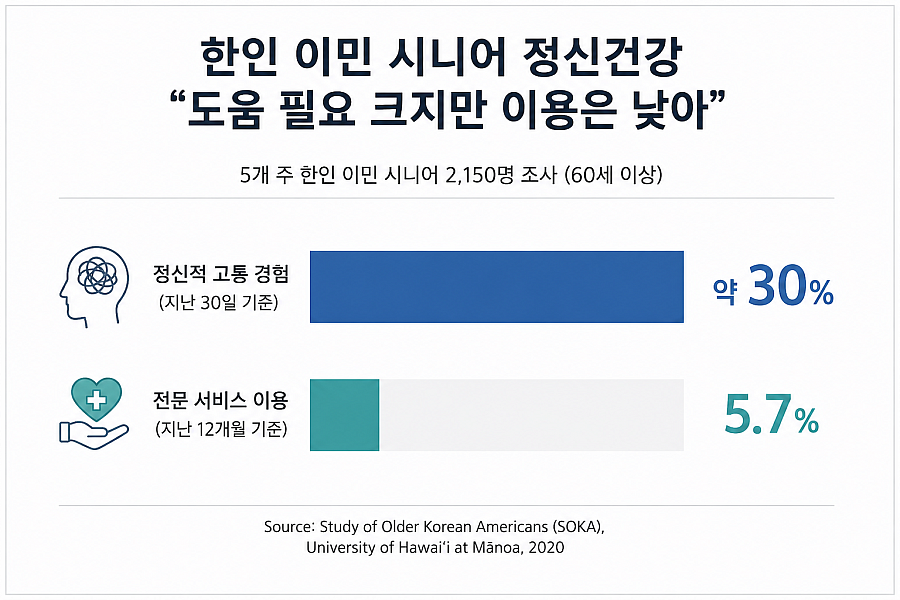
University of Hawaiʻi at Mānoa News, “Fewer older Korean Americans utilize mental health services,” Oct. 22, 2020.
Interview / Lee Hyun-wook:
“There are language barriers and cultural difficulties… There is also a sense of burden. Mental health can be very hard to talk about, so access is often not easy.”
Between Policy and Daily Life
Social isolation among older adults is not only a Korean American issue. California recognizes social connection as an important part of healthy aging, one which the pandemic dangerously undermined, deepening disconnection.
Interview / Lee Hyun-wook:
“The pandemic brought major changes for our seniors and the Korean community. During the pandemic, so many things were cut off… fear, helplessness, and loneliness spread widely.”
The state has also responded with the Friendship Line,a 24-hour emotional support line. It is not only for moments of crisis, but also for older adults who feel lonely and need someone to talk to. But even with policy efforts and dedicated support, loneliness is still a reality of everyday life.
For Korean seniors who are not comfortable in English, there is still a need for a place they can go — for people who can talk, listen, and laugh in the same language.
A Community Living Room
Interview / Lee Hyun-wook:
“Our senior community center plays the role of a sarangbang — a community living room. It is a place for meeting, exchanging information, and easing loneliness. I think it plays an important role.”
Interview / Professor Ki-jung Kang, Department of Elderly Welfare, Baekseok University:
“In fact, many studies show that senior centers can help expand older adults’ emotional and social networks. We call them a safety net. When older adults become isolated and emotionally alone, and fall into depression, senior centers can become a way out and a safety net.”
Coming Back Out
For Lee Myung-hee, the reason she came back out into the world was a few words from a neighbor in her apartment building.
Interview / Lee Myung-hee:
“My neighbor was the one who first knocked on my door. She told me not to stay alone… to go out somewhere.”
After coming to the center, Lee began meeting people again. She also began volunteering with a group that cares for mugunghwa flowers, the national flower of Korea.
Interview / Lee Myung-hee:
“The fact that I can do something… it gives me a more positive life, and I feel proud. That empty time has become meaningful as I spend it with others.”
Her loneliness may not have disappeared completely. But time that once felt frozen has slowly started moving again.
Interview / Lee Myung-hee:
“What has passed is already gone. Don’t stay too tied to it. Try to be more positive… Whether something is bad or difficult, no matter what anyone says, I’m still thankful for it. With gratitude…”
Someone knocking on the door, sharing a meal, calling someone by name. Those small connections can change a day.
Interview / Lee Myung-hee:
“Have courage. Just come once and register. Even if you miss a class or can’t always attend, the fact that you come here means there is life in your day.”
In LA’s Koreatown, lonely days are beginning t o fill up again — with new people, with life.