

The Latina Immigrants in Salinas Who Resist in Community, One Zoom Call at a Time
This story was co-published with Radio Bilingüe as part of the 2026 Ethnic Media Collaborative, Healing California.

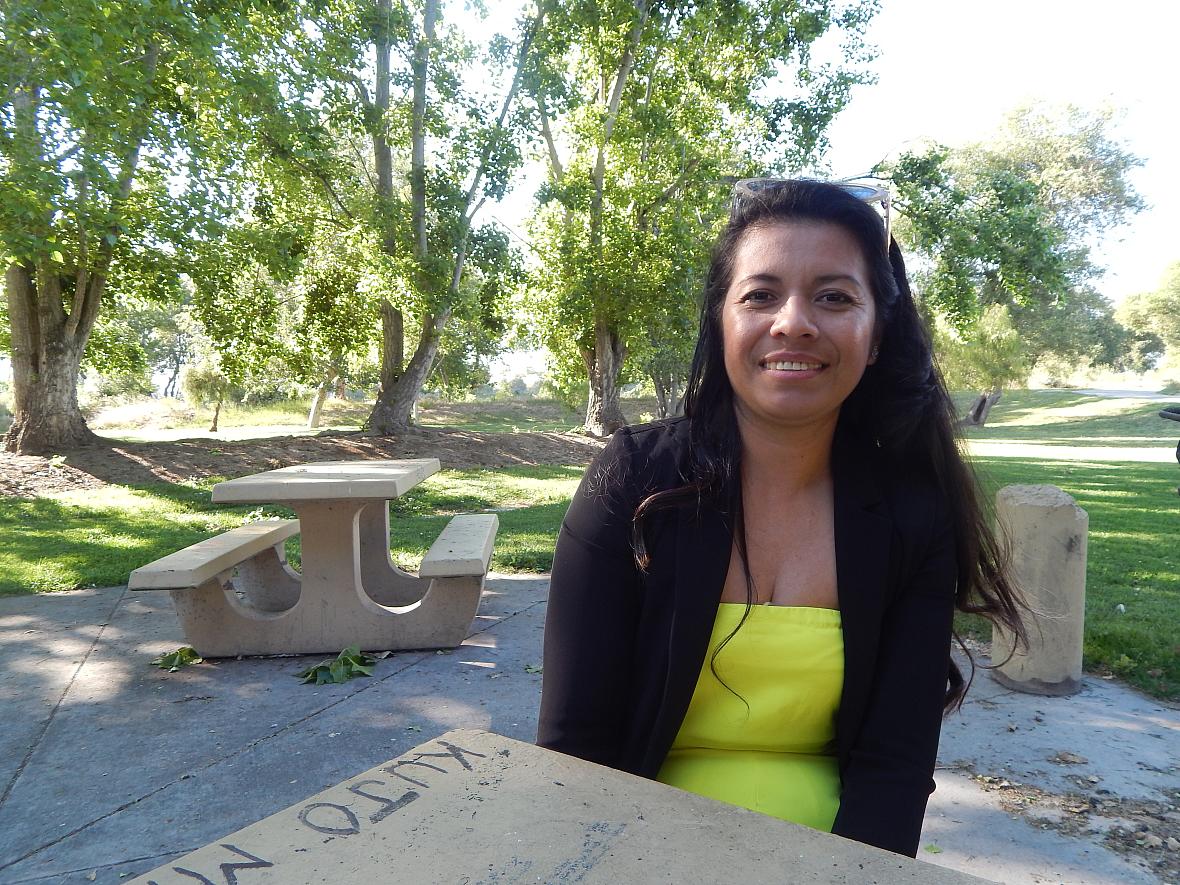
Lisde Lara poses for a photo in Salinas. For Latina immigrants in the Salinas Valley, Mujeres en Acción is community, therapy, and hope.
Sophia Rerucha
“Let’s imagine that we are all here together in a circle. We are all inside it, no one is left out, and we want unity — this is your group.”
With those calming words, Maricela Acevedo starts a regular meeting of Mujeres en Acción (“Women in Action”), a dedicated weekly group that meets on Zoom to work on leadership and economic empowerment for working-class immigrant women living in Monterey and Santa Cruz counties, in Northern California. In Monterey County, more than 60% of residents are Latino.
Once on the Zoom call, each woman inhabits a different reality. Some sit on the couch and log in after a long workday. Others join the call from their phones while handling things around the house.
While Maricela has led this meeting for six years — building community, processing worries, and setting goals — these gatherings have become increasingly important recently as families are squeezed and daily stresses mount.
For example, in this meeting, they reflect on the impact of the economy on their day-to-day. These gatherings have recently taken on new weight as the cost of gas, groceries, and rent…
“In the group, we give people the opportunity to share what they feel and create a space where we all feel okay. It helped me a lot because I felt included, and honestly, it changed my self-esteem.”
Carla Contreras is one of the women who found the support network offered by this group to be transformative.
Around ten years ago, Carla, 34, originally from Mexico, began feeling heart palpitations. She thought she was sick because sometimes she had a fever and headaches. There were days when she felt like she was dying. But whenever she went to the doctor, she says they told her nothing was wrong and prescribed pills that didn’t help.
Carla became so worried that she traveled back to Mexico in 2017 to undergo medical tests. There, she says, they told her to improve her diet by eating more vegetables. Carla didn’t understand what was happening to her. At that time, Carla was studying mathematics at California State University Monterey Bay and expecting her first child. But now…
“I think it was a lot of stress. I was pregnant while I was in college, so I kept all of that inside and never shared it.”
She now believes that her symptoms were the result of panic attacks.
According to the Office of Minority Health, a program of the U.S. Department of Health and Human Services, Latino adults are 12% less likely than U.S. adults overall to report a mental illness. And even when folks do report struggles with their mental health, seeking help remains a consistent barrier.
A 2026 study of more than 4,400 Hispanic and Latino adults found that among those who reported depression or anxiety diagnoses, fewer than 10% received counseling.
“I kept everything bottled up, and I think there came a point in my life where I exploded, and that’s when I developed depression and anxiety.”
For two years, Carla stayed home to care for herself and recover. Therapy was not something she even considered. But in 2022, she learned about Mujeres en Acción.
The group was founded in 2015 with the goal of creating a space for Latina, Spanish-speaking women to parse through any topic that affected their lives — childcare, rent prices, self-esteem, trauma, motherhood — with weekly meetings. The purpose of sharing these things is to help the women open up and feel empowered and seen. Many women, who thought their experiences were unique, feel a sense of community and camaraderie.
Each woman also creates a list of goals — things that she wants to accomplish during her time in a Mujeres en Acción group. This helps the women develop their leadership and self-sufficiency. Several of the women I spoke to had no idea what a goal was or how to accomplish one prior to joining.
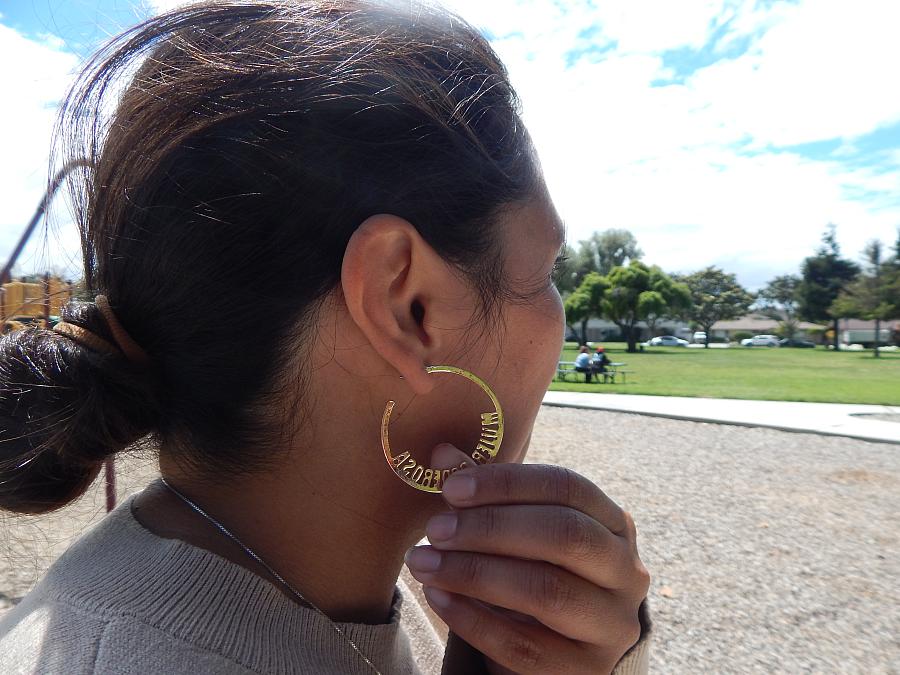
Carla Contreras poses for a photo in a park in Salinas. Her earrings read "Mujeres Poderosas," Powerful Women.
Sophia Rerucha
“We don’t know what success is, what an achievement is, because we are caught up in our daily routine.”
But in every weekly meeting, the women give updates.
“We start to realize that, sometimes, the reason we don’t achieve things is because we’re not prioritizing ourselves, or investing the time. It’s the pressure of wanting to achieve your goal.”
Some women have goals of getting a driver’s license, driving on the freeway, learning English, and starting their own business. And they support each other by checking in on how they’re doing with their goals.
Feeling inspired by what she learned about the group in the presentation, Carla decided to participate. She found a space to reflect on the loneliness she now realizes she felt during motherhood, and to improve her self-esteem.
“For me, it’s like my weekly therapy session.”
Having grown up in a family where feelings were never discussed, Carla now leans on the women in the group — and they lean on her.
“They motivate me, and I motivate them. We help each other.”
One of the rules is that what is spoken in the meetings stays in the meetings. This creates a space where the women feel complete trust and comfort in expressing themselves.
“We are all at different stages in life. For example, getting a driver’s license has the same value as the goal I have, because for you, that is what matters.”
That is Mónica Sánchez. Her goal was to study business administration. Her dream was to improve her financial situation, and she gained the courage to pursue it after one of the virtual meetings in which Maricela asked her about her objective.
Now…
“Through this master’s degree, I was just hired, and I’m going to start working for the county where we live. So now, my life is going to change completely.”
The group has been key in strengthening her self-esteem and confidence.
“Through my peers, there was this motivation of, ‘Let’s do it.’”
For Lisde Lara, another member of the group, achieving her goals means a new focus on herself. She came from Veracruz, Mexico, and has lived in Salinas for two decades. There, she raised her children, who are now 20 and 12 years old.
“My whole world revolved around them. I felt like I couldn’t forgive myself if I left them to do something that was just for me.”
She was happy in her role as a mother, but now she wants to discover herself in a new stage of life.
“I knew the moment would come when I’d have time for myself, and now I think this is that time.”
In the meetings, one of the most important topics is motherhood. During one gathering, Lisde shared a trauma she had carried for a long time.
“Twenty years ago, I suffered a loss. I carried a baby for nine months, and I lost him at birth.”
Sharing it with other women helped her process a pain she had never been able to talk about.
“I’ve had conversations like this with mothers who have gone through those losses. Talking about it helped me. It helped ease and heal my heart a little and allowed me to express what I had been carrying inside.”
Psychologist Alinne Barrera of Palo Alto University specializes in the use of technology to disseminate maternal mental health resources. She explains why sharing difficult experiences can be so important to healing.
“A group of other women brings all of those experiences, perspectives, and advice. And all of that helps each woman continue developing as a person and as a contributor to her community, culture, family, and her own life.”
All the women in the Mujeres en Acción group agree that speaking helps them heal. They have the opportunity to identify their concerns and be heard — something that doesn’t happen in their day-to-day life. And that’s part of a broader problem.
Dr. Alinne points out that there is stigma surrounding mental health in Latino communities, where people with mental health struggles are often seen as weak. As a result, it becomes something people don’t talk about and simply ignore. Motherhood adds another layer to that stigma.
“The role of a woman in the Latino community is very centered around being a mother and provider for the family.”
That creates the expectation that a woman should do everything for her children, a sacrifice that may come at a personal cost. That’s why, in Mujeres en Acción, they open themselves to reconnecting with their passions and dreams.
“Sometimes, as women, without realizing it, our dreams get pushed aside. I always dreamed of becoming a cosmetologist. I think doing hair coloring is beautiful, but then I got married and had children.”
And this is something heard frequently among the women in the group.
“That’s what Mujeres en Acción is for. It’s about saying, ‘Okay, what are we going to do?’ Little by little, because we have many responsibilities at home, but we can make these changes for ourselves, and it truly changes our lives and our families too.”
Being able to exist in a space where community can be created and where one feels heard is no small thing. It can truly make a difference.
“For me, it matters. At home, sometimes there’s no one who asks you, ‘How are you feeling today?’ or ‘How did you wake up this morning?’ That’s what helps us mentally: when other people care about how you feel, ask you questions, and truly support you.”
Participating remotely in the group work for them because they live in different cities across Monterey County.
For example, Mónica, who lives in Greenfield, would need about 45 minutes to travel to Salinas and wouldn’t make it in time. Though she acknowledges that in-person interaction also has advantages.
“When you’re together in person, there’s a more direct connection because sometimes during meetings our cameras are off, so you don’t really know if we’re truly there or not.”
Dr. Alinne agrees with Mónica.
“The dynamic created when people are physically together can’t really be recreated online. You feel it, and that’s what stays with many people after connecting with someone else. But online participation does make it easier for people to connect and share experiences.”
But beyond the logistics, what makes the group powerful for them is being able to talk and share their emotions, doubts, and feelings with others who, without even realizing it, may be going through the same thing, as Dr. Alinne explains.
“Many times we feel alone, like we’re the only ones going through something. Then we mention it, and suddenly someone says, ‘Yes, I went through that too. That happened to me. My sister experienced that. My father talked about it too.’ We begin to realize that our experiences are much more common than we thought, because we had never spoken about them with anyone else.”
For Maricela, who was once part of the groups and now coordinates them, this space has changed her life.
“I’ve been a really shy person, really insecure, with low self-esteem. But the group has helped me. I feel included, and it’s sincerely changed my self-esteem, I feel self-sufficient, I feel heard, and I’ve found a family”.
The group’s impact has extended to her family as well. Maricela says the group has described a new sense of possibility.
“My husband has always been a tractor driver in the fields. And I used to say, "I hope my son becomes very good at operating machinery so he can be like his father and earn a better living," right? I couldn’t even imagine that they could get out of field work. My life was the fields, and that’s what was inside me.”
But after getting involved with Mujeres en Acción, she felt she could dream bigger.
‘Son, field work is something very honorable, very good, but you know the hardships we’ve gone through because the pay is very low. You were born here, this is your language, you speak English … my perspective began to grow, now I tell him, ‘No son, there are other kinds of opportunities. Go, study, do something different.’
Carla also has big hopes for the future of Mujeres en Acción.
“I hope that in the future Mujeres grows bigger. I would love for there to be more groups. Not everyone has the opportunity to be connected with other women like this, and it also encourages us to step outside our comfort zones. I would love for more people to join in supporting Mujeres and for more women to become part of it.”