

Duluth’s aging and lead-laden homes are poisoning children
This article was originally published in Duluth News Tribune with support from our 2025 Data Fellowship.


Ryan Olberding, from left, Honey, 2, and JaCoya Golen sit on the porch at their Duluth home Thursday, Feb. 5.
Clint Austin / Duluth Media Group
DULUTH — Because JaCoya Golen and her family live in an older home with a lead service line, a doctor suggested that Golen’s daughter, Honey, then about 18 months old, have her blood lead level tested.
The test, taken in January 2025, showed Honey had a blood lead level of 34.5 micrograms per deciliter, nearly 10 times the level considered "elevated" by the U.S. Centers for Disease Control and Minnesota Department of Health.
“We got a pretty quick call back from the doctor, and she had basically said, ‘I do not think that this is from the water itself. … Is there anything else?’” Golen said.
The main culprit? A windowsill, covered in lead-based paint, in the 120-year-old East Hillside house rented by Golen and her partner, Ryan Olberding. Honey would prop herself up using the windowsill to look outside, and, because she was teething at the time, began nibbling at the sill, which, testing later confirmed, had lead paint. Jenna Davis, a public health nurse for St. Louis County Public Health and Human Services, met with Golen and Olberding almost immediately after the test came back.
“She’s like, ‘I’m not going to say that yes, she’s OK, don’t even worry about it because it is a high number,’” Golen said. “But she did say that a lot of children with high lead (levels) in (their) blood go on to live very normal, healthy lives. It’s not something that I should torture myself over as long as we’re getting that number down consistently.”
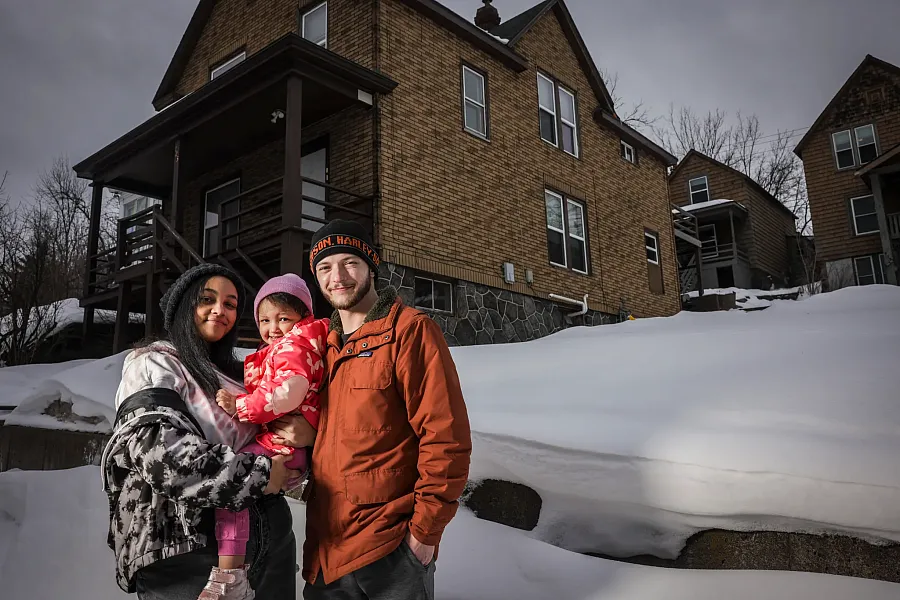
JaCoya Golen, from left, Honey, 2, and Ryan Olberding.
Clint Austin / Duluth Media Group
While there is no lead level that is considered safe, elevated levels of the heavy metal in children can lead to developmental delays and affect learning and behavior. At extremely high levels, it can even cause seizures, and the longer it remains high, the more damage it can do to the kidneys and other organs.
Davis told the News Tribune that if a child’s blood test shows lead levels above 3.5 micrograms per deciliter, public health officials will provide parents with education and resources on lowering lead levels in blood and follow up until levels are no longer considered elevated.
If a test shows blood lead levels above 5 micrograms per deciliter, it prompts a home visit to find the source of the lead, and the county can order the homeowner to make a repair to mitigate the lead source, Davis said.
In both cases, children with elevated blood lead levels, or EBLLs, are tested every three months until they fall below 3.5 micrograms per deciliter.
Honey has been trending in the right direction. In April 2025, Honey’s blood test showed her blood lead levels had fallen to 12.9 micrograms per deciliter and, just a couple weeks ago, a year after her first test, it had reached 4.7 micrograms per deciliter.
“The worry doesn't exactly go away, even when the number is going down,” Golen said, but she’s encouraged that Honey, who is talkative and eager to learn, isn't slowing down or showing signs of permanent damage.
Old houses laden with lead
Stories like Honey’s are playing out throughout Duluth thanks to its aging housing stock. The median age of houses in the city is now 100 years old, according to St. Louis County property data.
And more than 86% of homes standing in Duluth today had already been built by the time lead paint was banned for residential use in 1978.
Portions of two Duluth neighborhoods with some of the oldest homes have the highest rates of childhood blood lead levels in the state, according to test results from 2020 to 2024 tracked by the state health department
The data, previously unreported, show more than 1 in 11 children under the age of 6 in census tracts covering parts of the East Hillside and Endion neighborhoods had a confirmed elevated blood lead level of 5 micrograms per deciliter or higher (the health department in 2023 lowered its definition of EBLL to 3.5 micrograms per deciliter, but its tracking and mapping system still uses the higher figure).
With rates of 9.2% and 9.1%, respectively, the portions of the East Hillside and Endion neighborhoods are the highest in the state and are well above the statewide average of 0.7% of children with EBLLs. The median age of homes in those tracts is also among the oldest in the city, at 117 and 121 years old, respectively.
A third Duluth census tract — covering portions of the Central and East Hillside — has the state's eighth-highest rate of childhood EBLLs at 5.8%. It has a median house age of 125 years old.
In addition to older homes, a News Tribune analysis of U.S. Census Bureau 2020-2024 American Community Survey data shows the areas with the highest rates of EBLLs in children tend to have more renters, higher rates of poverty and are less white than the rest of the city.
Public health officials and community groups see that firsthand.
“Overwhelmingly, old houses are the primary source of lead exposure for children in Minnesota, and especially in those neighborhoods,“ said Stephanie Yendell, a senior epidemiology supervisor at the Department of Health.
While many of Duluth’s old homes also have lead service lines bringing drinking water into the home, Davis said in her 13 years of responding to EBLLs that lead in water has only been the cause of a child’s high blood lead level in two or three cases.
“(Removing lead service lines is) a priority, but in regards to children and risk, it’s a pretty low risk for lead poisoning in water in our city,” Davis said. “It’s more likely the homes and the paint — it’s almost always the paint or lead paint dust.”
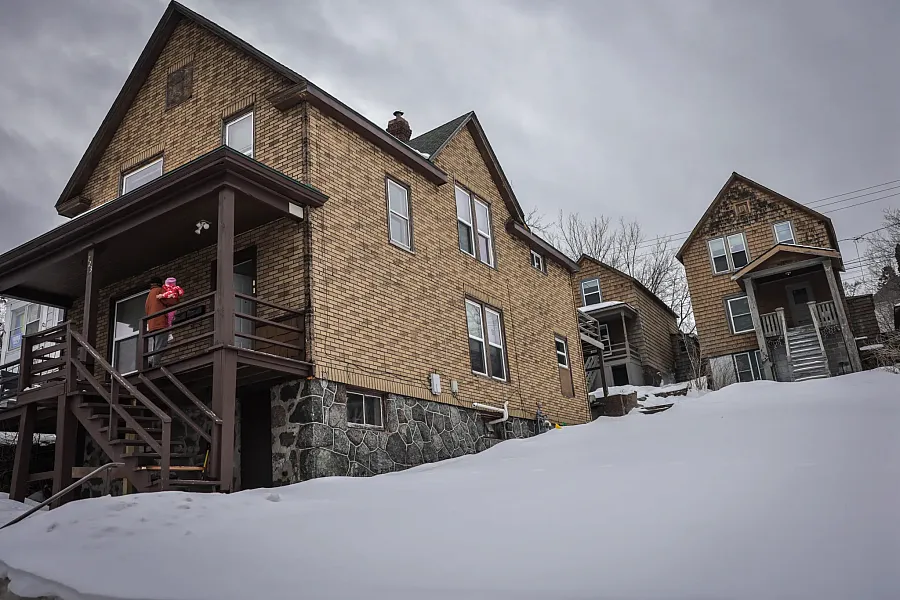
Older homes in Duluth's Hillside neighborhood.
Clint Austin / Duluth Media Group
Davis and Yendell both said young children often are exposed to lead because they are crawling around on the floor and sticking toys and fingers into their mouths. In doing so, they ingest the lead that’s in the dust, particularly in old houses.
And, as Honey demonstrated at the windowsill, windows are attractive to toddlers but also harbor lead paint and dust. “Children love windows,” Yendell said. “They love to interact with windows. When they are learning to stand, they love to just grab onto those windowsills and pull themselves up and interact with the world outside.”
“Unfortunately, when it comes to lead paint, that’s one of the areas that may very likely contain lead paint, and because those windows have that friction of opening and closing, you can have a lot of lead dust there as well,” Yendell said.
But remediating the source of lead in a home and regularly cleaning old homes to keep dust at a minimum can make a real difference, as can healthy eating, particularly with iron-, calcium- and vitamin C-rich foods, which can help deter the absorption of lead in the body, Davis said.
Still, children with sensory needs, who may be even more likely to put things in their mouth and might be an incredibly picky eater, can have difficulty lowering their EBLLs. Davis had a client who was hospitalized with an EBLL of 70 and had to undergo chelation, a treatment that removes heavy metals from the body. But even after some time had passed after the procedure, their EBLL remained in the teens.
Old rentals a major source
Lead paint is nearly everywhere in the city.
So why do some neighborhoods have more children with elevated blood levels than others?
You can look to areas with a higher concentration of rentals, for one. Of Duluth’s 37 census tracts, 13 have childhood EBLL rates higher than the statewide average. Nine of those 13 census tracts have rental rates above the citywide figure of 40.6%, according to Census Bureau data. The three Duluth tracts with the highest EBLL have rental rates of 75.6%, 85.8% and 87.3%.
“Rental units have a pretty well-known issue of not having good repair, and I don’t know if that’s a Duluth-specific thing; I think it’s just a rental thing,” Davis said.
Older rentals also tend to be occupied by young families who may not be able to afford moving into a newer, safer rental or purchasing their own home yet, Davis said.
For Jaeger Moser, the healthy homes program manager at Community Action Duluth, the houses he and the Duluth nonprofit remediate for lead often share some characteristics.
“They’re all old; most of them are rentals as well,” Moser said. “And it seems like the landlords just have not gone in and repainted recently or really done any maintenance.”
After a child is reported to have an EBLL, Community Action can provide lead remediation at no cost to the homeowner thanks to a grant from the health department.
To do so, crews don the proper personal protective equipment and are equipped with a shop vacuum with a high-efficiency particulate air, or HEPA, filter.
After wetting the flaking lead paint to keep dust at a minimum, crews scrape any loose paint away and use a high-quality latex-based exterior paint — even inside, as it is more durable — to cover and seal the area. The process isolates, but doesn’t eliminate, the lead paint and, as long as the protective layer remains in good condition, it can protect the home’s occupants.
While Duluth rentals are required to have paint in good condition and not peeling or chipping before receiving their rental licenses, Kelli Latuska, a city of Duluth spokesperson, said the city does not test paint for lead.
Brittany Plachecki, director of workforce programs at Community Action Duluth, recently bought a home using a Federal Housing Administration mortgage, which has strict requirements on house conditions.
Before the sale closed, Plachecki was required to scrape and repaint its 1980s-era deck because, even though it was built after lead paint was banned, contractors often used leftover paint for years afterward.
“If that’s the standard that I was held to as somebody who was buying the house and would only have to deal with it for myself, I feel like it would be very fair to have the same requirements for rental properties,” Plachecki said.
Back in the East Hillside, Golen said she knows the housing shortage and rising rents might make it impossible for young families to live in newer lead-free homes, but she said she hopes parents know resources to deal with lead exist. She said they should ask their doctor or health care provider about those early, especially if they live in an old home.
A year after finding out about her blood lead levels, all signs show Honey is headed for a healthy, happy life.
“I know the testing is scary,” Golen said. “But if it is a question in your head, you should still get your child tested.”