

Experts say knowing CPR, bleed control could save lives in rural communities
The article was originally published in the Springfield News-Leader with support from our National Fellowship Fund and the Dennis A. Hunt Fund for Health Journalism.

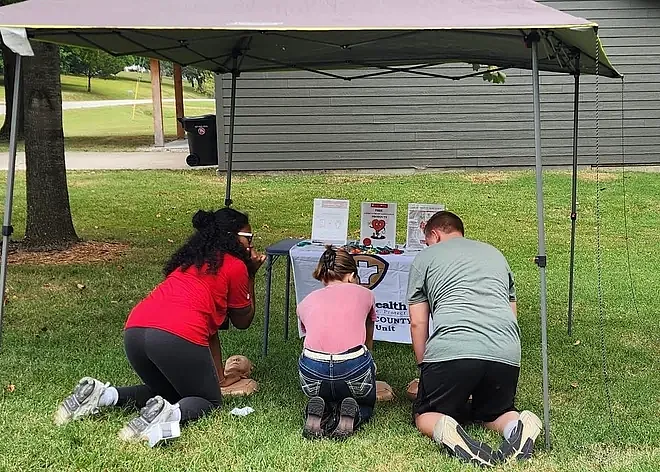
HeartCorps member Olivia Muriel instructs Webster County community members on hands-only CPR in 2024.
Provided By Olivia Muriel
In the 1960s, doctors believed heart muscle died instantly during a heart attack, like throwing a light switch, according to the American Heart Association. Dr. Eugene Braunwald's research proposed a heart attack was more like a dimmer — the damage happened gradually and fast action could limit the extent of the loss.
This wisdom, summed up by the phrase "time is muscle," changed how heart attacks — and later other injuries — are treated. In strokes, which cause blood loss to the brain: Time is brain. In trauma situations like a car accident or shooting: Time is blood. In sudden cardiac arrest, where the heart stops pumping blood due to an electrical issue: Time is brain, lungs and other organs.
Fast intervention is the key to saving lives for many conditions and in urban and metropolitan areas, help from emergency medical services can be a phone call and 5 to 10 minutes away. In rural areas, it can take almost 20 minutes longer than the national average for EMS to respond, according to research from the Baylor College of Medicine in Houston, Texas.
When time is life, waiting for an ambulance can be deadly.
"Help's farther away" in rural communities, said Dr. Dustin Smoot, a trauma surgeon in Sioux Falls, South Dakota. "We know help's farther away. We know from Medicare data that we're 25% more likely to die from injuries in a rural community because you're so far from help."
Washington County Ambulance District emergency medical technician Tyler Weir explained that, in a rural community, the person who calls 911 has to be the first line of help.
"Because of our response times just due to location, time to a hospital, the community’s knowledge to start aid in a situation will aid us as an ambulance in helping make sure a good outcome is a possibility," Weir said. In a rural area, "you call 911 right after you cut your hand off and you’re waiting 30 minutes. That’s where community knowledge comes in: How do you properly put a tourniquet on? How do you control a bleed properly? That will help us buy you time until we get there, and not only that — if you haven’t done anything, then we’re playing catch-up."
Weir said that he tries to pass along that information whenever he's in the community, in hopes that it will spread, because "sometimes it takes that one person to stop, ask a question and learn something, and because of that, it helps someone."
Tim Nikolai, senior rural health director with AHA, has seen rural EMS organizations step up in that way.
"Rural EMS and ambulance services are often very happy to invest time in helping facilitating that training and knowledge because at the end of the day, it’s effectively increasing their capacity to save lives, and that’s exactly why they’re doing the work that they do," Nikolai said.
Bringing information to people where they're at
Rural EMS organizations and health departments like Webster County Health Unit work to bring first responder and CPR classes to their communities.
Webster County initially began providing classes because the nearest CPR instructor was in Springfield, and area daycares couldn't afford to send employees away for training, said Ashley Dedmon, a health educator for Webster County Health Unit. From there, they began to provide CPR credentialing to anyone who needs it.
In 2024, Olivia Muriel spent time in Webster County with HeartCorps, a program offered by the AHA, Centers for Disease Control and Prevention and AmeriCorps. In addition to providing blood-pressure check kits to libraries, she instructed more than 400 people in hands-only CPR. A normal CPR class takes about four hours, Dedmon said, but hands-only CPR can be taught in minutes.
"I’d set up in front of businesses, in front of food pantries to train as many people as I could in hands-only CPR because it is so easy to learn and without that mouth-to-mouth element, people are more willing to take action," Muriel said. She'd visit yard sales, senior centers, farmers markets and schools, too, and was able to educate "lots of different populations because it was so easy to teach and quick" to learn.
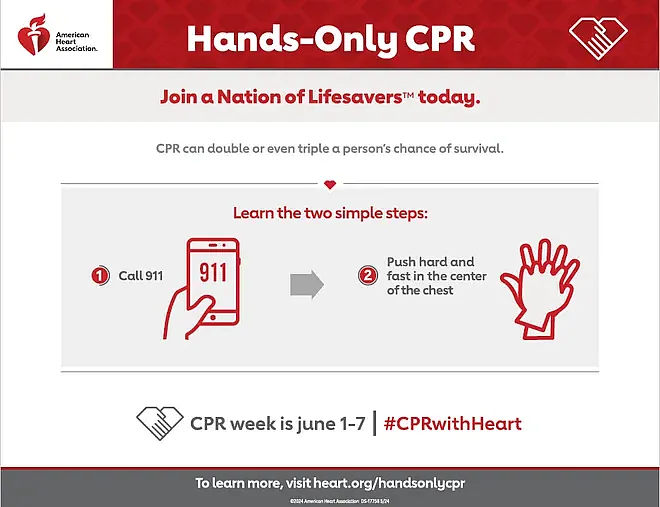
This graphic by the American Heart Association outlines the two steps in hands-only CPR: Call 911 and push hard and fast in the center of the chest.
Provided By The American Heart Association
The AHA has focused on schools for that reason.
"You think about the amount of time (people spend here) between school days, then Friday night football and whatever else might be happening there, a huge percent of the community is in and out of a school building — polling places in some cases — in a given day or week or year," Nikolai said. "Using that as a place to create an atmosphere of cardiac readiness, hopefully those skills and experiences translate as they go to the rest of the community, both students and staff."
Smoot has brought the American College of Surgeon's Stop the Bleed program straight to people who might need it: Bikers at the yearly Sturgis Motorcycle Rally.
A motorcyclist himself, Smoot had a life-threatening accident while riding in the Bighorn Mountains in 2021. Due to cell service issues, it took EMS 90 minutes to find Smoot and the person he was with. Until help arrived, Smoot controlled his bleeding by keeping his shirt on his wound.
Learn: Find or take an online course on how to stop life-threatening bleeding
Stop the Bleed offers hour-long free classes to the public that teach them how to recognize a life-threatening bleed and to control it. But even Smoot's abbreviated instruction at the rally provided a way for people to take charge.
"Anything that a bystander can do at the scene drastically improves patient outcomes if we can abate that life-threatening hemorrhage," Smoot said.
Smoot also spent a week at the South Dakota State Fair, where he taught a lot of pre-teens and kids how to stop bleeding, demonstrating how simple and intuitive that instruction can be.
"The stuff that we program really empowers someone, because everyone wants to help. But they feel like they don't know enough or they didn't go to medical school, or they're gonna hurt somebody," Smoot said, adding that the program "really really simplifies it and empowers someone to act, to help save their neighbor, their sibling, their mother, their father, their grandparent."
Meeting people where they're at is something Webster County prioritizes, according to Scott Allen, the unit's executive director. When one of the county's Amish communities had two younger people experience cardiac events that needed CPR and emergency response, the unit had to figure out a way to adapt the typical training for the community, Dedmon said.
"Their way of life, they don’t do technology, so even though the AHA (class) is video-based, we kind of had to talk through steps. They have two phones in their community. They’re not walking around with cell phones," Dedmon said. "We altered that class a little bit to fit their needs but they probably had 15 people come out in a range of ages — some were elders, some were younger people. We worked through where would people be, who could make the (911) call."
Dedmon said that the unit has discussed ways they could change the class and hopes they can provide more classes to the community in the future, as well as the other Amish communities in Webster County.
"I would love for all of them (in the community to take the class) especially since they don’t have phones," she said. "They don’t have cars to drive somewhere quickly."
Hands-only CPR
Hands-only CPR, or compression-only CPR, takes away the concern people may have over rescue breaths — mouth-to-mouth contact that supplies the body with oxygen. The compressions are essential for keeping oxygen-rich blood flowing to the brain and other organs, since when the heart stops, the body can no longer circulate blood.
Hands-only CPR can buy time until someone with more skills can help.
Use hands-only CPR on adults and teens, according to The American Heart Association. There are two steps to hands-only CPR:
- Call 911.
- Push hard and fast in the center of the chest.
Stop the Bleed
According to the American College of Surgeons and the Department of Defense's "Stop the Bleed" campaign, uncontrolled bleeding is a major cause of preventable death, with 40% of trauma-related deaths worldwide due to bleeding. Especially in rural settings, where it is likely to take longer for first responders to reach someone, preventing someone from bleeding out can save their life.
While there are online and in-person courses that ACS encourages people to take so they can stop bleeding safely, here are the three basic actions you can take when you find someone who has potentially life-threatening bleeding.
- Applying direct pressure: Expose the wound to identify where the bleeding is coming from. With a T-shirt, cloth or gauze, use both hands to apply direct pressure to the wound. You may need to use your body weight to ensure adequate pressure is applied.
- Packing the wound: If bleeding continues after direct pressure or the wound is large, you may need to pack the wound. Using a T-shirt, cloth or gauze, insert the material into the wound until you can't fit any more material into the wound or bleeding has stopped. Then, continue applying direct pressure to the wound.
- Using a tourniquet: If an extremity such as an arm or leg is bleeding, you may have to use a tourniquet. Place the tourniquet about two inches or two finger breadths above the injury and tighten the tourniquet until bleeding has stopped. Tightening the tourniquet will cause pain. If you can, mark the time the tourniquet was applied or make mental note that you can tell emergency responders.