

Federal, state funding for Duluth lead line replacement uncertain
The article was originally published in the Duluth News Tribune with support from our 2025 Data Fellowship.

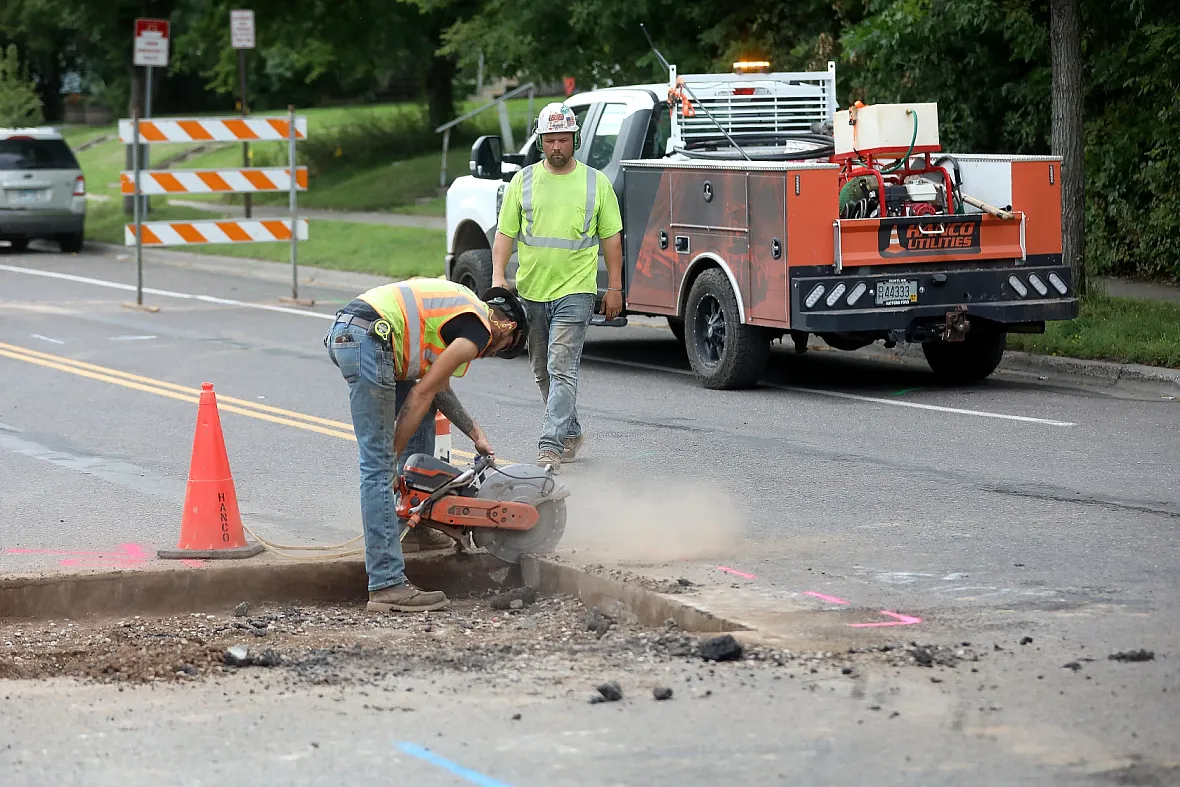
A crew member with Hanco Utilities uses a concrete saw while cutting into the intersection of Third Street and 22nd Avenue West in Duluth as part of a project replacing lead water lines in 2025.
Dan Williamson / Duluth Media Group file photo
DULUTH — In five construction seasons, the city has eliminated a quarter of its estimated 10,700 lead service lines across all types of buildings.
Beginning with just 42 lines in 2021’s pilot project, Duluth has eliminated — mostly through the replacement of active lines, but also by cutting off several unused water lines — a total of 2,665 lead lines, with more than 1,750 lines in 2025 alone.
But state and federal funding uncertainty could stymie that momentum.
Federal funding is only guaranteed through 2027, and without action by the Minnesota Legislature, state funding will run out this year.
“In the absence of these funding sources, there’s really no funding,” said Jon Maruska, a senior engineering specialist at the city of Duluth.
Public health
The median age of a house in Duluth is now 100 years old, with more than 86% of homes built before lead-based paint was banned in 1978 and almost 53% built before 1930, an era when lead pipes were common.
Lead is a soft, malleable material to work with, and it was the preferred material to link buildings to water mains, which are not made of lead, prior to about 1930. After 1930, extruded copper piping and later plastics became the standard, and lead’s popularity dropped off.
Lead can seep into drinking water, especially if the water sits in the pipe. Galvanized pipes downstream of lead pipes can also collect lead and are treated and removed as if they were made of lead.
Elevated levels of the heavy metal in children can lead to developmental delays and affect learning and behavior. At extremely high levels, it can even cause seizures; the longer lead levels remain high, the more damage lead can do to the kidneys and other organs.
While no amount of lead is considered safe, lead in drinking water is rarely the source of a child’s elevated blood lead level in Duluth, as the News Tribune reported last week.
Instead, the cause is almost always lead paint and lead dust.
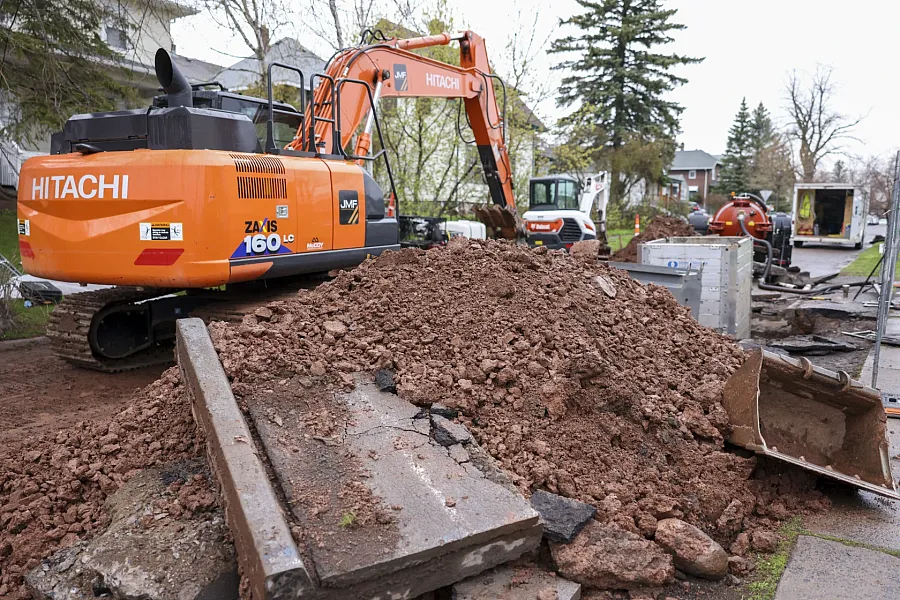
A job site where lead water supply pipes are being replaced on the 1100 block of East Eighth Street in 2023.
Clint Austin / Duluth Media Group file photo
Still, eliminating low-level lead exposure from water would benefit a large portion of the population.
“When we’re talking about lead in water, we tend to be talking about relatively small amounts of lead exposure, but we’re talking about a lot of people,” said Stephanie Yendell, a senior epidemiology supervisor at the Minnesota Department of Health.
“But at the same time, it’s important that we do have these investments into replacing lead service lines, because that prevents that low level of lead exposure for a large number of people for the future,” Yendell said.
Old homes and lead lines
According to the city’s lead service line inventory from this fall and winter, the median age of a house in Duluth that has had its lead or galvanized lines replaced, or still needs to have its service line replaced, is 110 years old.
Among properties classified as “house” by St. Louis County, more than 2,500 have had lead or galvanized lines replaced, with almost 5,100 still in need of replacement. That needed figure is likely to increase as more than 2,300 houses have an uncertain lead status, a category that turns into confirmed lead about half of the time.
Cyndi Falconer, utility programs coordinator at the city of Duluth, said the city has been in more than 90% of homes, allowing the city to map out where many of the lead lines are and get a jump-start on replacements.
“Really understanding how much lead we have in Duluth has allowed us to focus our efforts better and faster,” Falconer said.
The city prioritizes replacing lead lines where the combined factors of known lead line rates, children under 4 and childhood elevated blood lead levels are the highest.
Future funding uncertain
With more cities across the state ready to seek funding for their own lead line replacement project, the state, which distributes the federal funding and has funding of its own, has awarded Duluth enough funding to replace about 620 lines in 2026.
However, due to both the average price of Duluth lead line replacements coming in lower than the budgeted $25,000 per line and some leftover funds from 2025, Maruska said the city expects to replace another 1,000-1,200 lead lines this year.
Those projects will mostly be in the Denfeld, Spirit Valley and Irving neighborhoods, with smaller project areas in the Cody, Gary-New Duluth and Fond du Lac neighborhoods, according to the city.
The ownership of a service line is split — the city owns the portion from the water main to the valve near the curb and property owner owns the portion extending from that valve to the water meter, typically where the line enters their basement.
The Infrastructure Investment and Jobs Act, signed into law in 2021, provides $3 billion per year for lead line replacement. But that only covers fiscal years 2022 through 2026.
That federal funding reimburses the city for 100% of the replacement cost of the privately owned portion, but only 50% of the publicly owned portion.
So in 2023, the state passed a $240 million bill to match federal funds and cover the remaining cost, ensuring homeowners don’t foot the bill for replacing their service lines.
“Unfortunately, that initial investment is running out,” Elizabeth Wefel, a lobbyist with the Coalition of Greater Minnesota Cities, said earlier this month. “And the program will run out of money at the end of 2026 if the legislature does not make a significant investment in this program.”
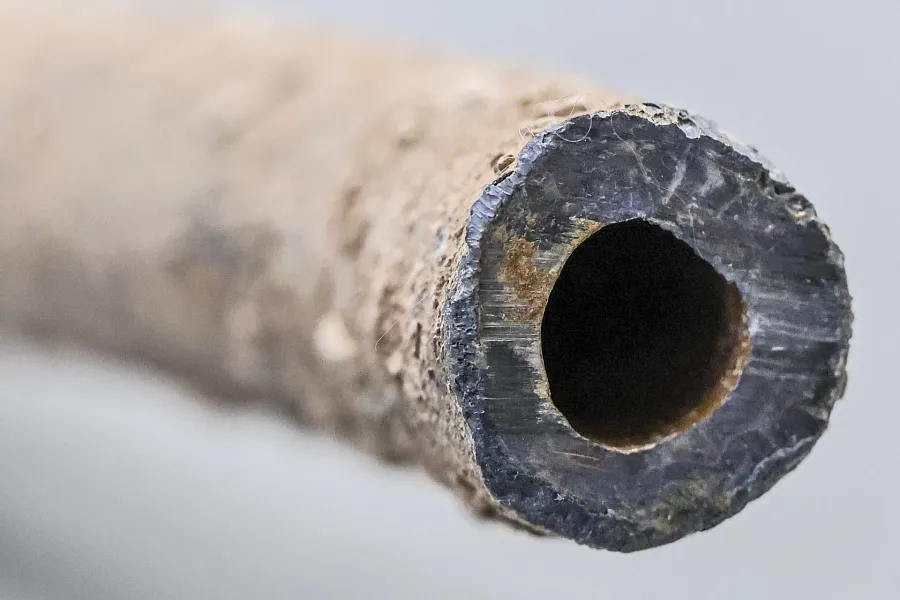
The end of a section of 5/8-inch lead pipe used as a residential supply line seen on Wednesday, May 25, 2022, at City Hall in Duluth.
Clint Austin / Duluth News Tribune
The coalition is urging state lawmakers to pass another $250 million in funding for lead line replacements, and has made it one of its top priorities for the legislative session, which began Tuesday. Without additional funding, the 2027 construction season is at risk, Wefel said.
Maruska said there would be some federal funds available in 2027, but without the state covering half the cost of replacing the public portion, he doesn't expect many property owners to pay themselves.
And, Maruska said, the 2037 lead line replacement deadline comes with a caveat.
“It says we’re required to offer service line replacement; we’re not required to pay for it. How many would actually happen if we’re offering and not paying for it?” Maruska said. “It would be a pretty small number.”