

What is radon? How can you test for it in your home? What you need to know in Ohio
The article was originally published in The Columbus Dispatch with support from our 2025 National Fellowship and Dennis A. Hunt Fund.

This investigation was made possible with support from the Kozik Environmental Justice Reporting Grants at the National Press Foundation and the National Press Club Journalism Institute and from the Dennis A. Hunt Fund at the USC Annenberg Center for Health Journalism.
An invisible killer is likely lurking in millions of Ohio homes.
The environmental threat of radon, a toxic gas, has been widely known since the 1980s. But, few know of the harms of the gas and many Ohioans may only learn of its existence when they purchase a home. But it can seep into any building, including workplaces, schools, houses and apartments.
Here is what Ohioans should know about radon, its dangers and what they can do about it if their own homes tests high for the gas.
What is radon?
Radon is an odorless, colorless and naturally occurring gas that forms when certain metals, such as uranium, thorium, or radium, break down in soil or groundwater, according to the U.S. Environmental Protection Agency.
Residents are at risk of unknowingly inhaling the toxic gas once it gets into their homes. While radon is usually the most concentrated in basements, it can be a problem on upper floors as well when levels are high.
Homes without a basement can have radon problems on the first floor, according to the EPA.
Is radon dangerous?
The Centers for Disease Control and Prevention has deemed radon the second-leading cause of lung cancer after smoking.
No level of radon is considered safe, but the EPA recommends radon remediation once levels reach 4 picocuries per liter. Inhaling radon at that level is equivalent to smoking eight cigarettes a day or having 200 chest x-rays a year, according to a 1990 CDC toxicological profile of radon.
At least 21,000 Americans die every year of radon-related lung cancer, including an estimated 2,900 who have never smoked, according to the EPA. Radon exposure is estimated to contribute to 2,559 cases of lung cancer a year in Ohio, according to the CDC.
Radon also is known to cause DNA and cell damage, according to Columbia University.
Studies have shown radon can enter a person's bloodstream and cause brain inflammation, a known risk factor for dementia, according to Columbia University. It has also been linked to stroke, heart attacks and, more recently, leukemia.
Why is radon common in Ohio?
Glaciers that moved through the region tens of thousands of years ago deposited minerals throughout Ohio as they passed through, including uranium and radium.
Radon is created when metals such as radium and uranium that are naturally present in the soil start to decay. Once that happens, it releases the toxic gas known as radon, according to the EPA.
An estimated 50% of Ohio homes may have high levels of radon, according to the Ohio Department of Health.
Each of Ohio’s 88 counties have buildings that have tested positive for dangerous levels of the radioactive gas. And homes in Licking County's 43055 ZIP code have the highest concentration of radon in the nation, a 2025 Harvard University study found.
How can I get a test for radon?
There are multiple ways to test for radon.
The Dispatch has partnered with The Columbus Metropolitan Library to let library card holders borrow continuous radon monitors. The plug-in devices can show the amount of radon in a home in real-time and over an extended period of time.
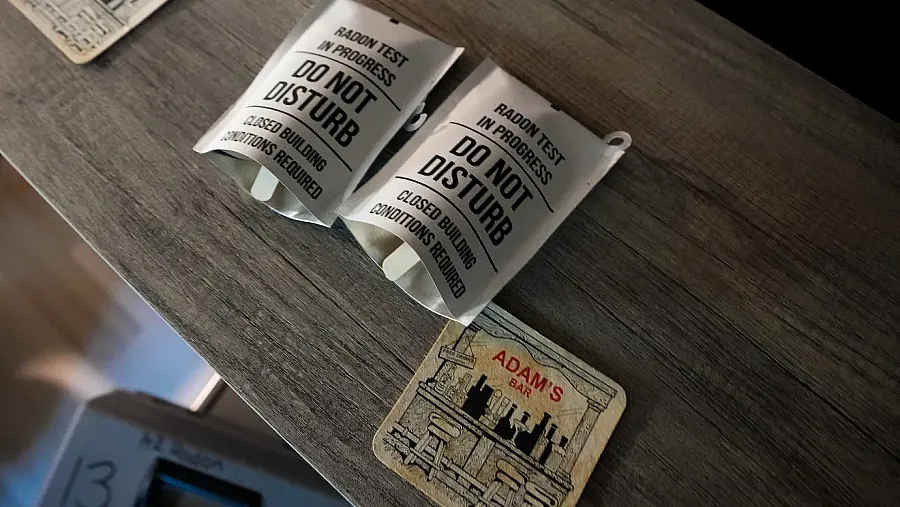
What does radon testing look like? See Ohio residents' experience. An A-Z Solutions technician tests for radon in Columbus area homes, searching for the invisible gas tied to health risks.
VIEW GALLERY
Borrowers can report their results back to The Dispatch through a QR code on the device to help the news organization continue its reporting.
The Ohio Department of Health also offers free radon test kits to Ohio residents. Those who wish to receive a test kit can sign up for one online.
Tests can be purchased at local hardware stores for about $20. Continuous radon monitors typically cost around $100 or more.
To hire someone to test for radon, Ohioans can check out this list of professionals from the Ohio Department of Health. Prices vary from around $150 to $300 to hire a licensed company to test for the gas, according to the National Radon Defense, a national network of radon professionals.
What do I do if my house has high radon?
The EPA's action level for radon is 4 picocuries per liter. If a home tests at 4 and above, it's recomended homeowners or renters have a mitigation system installed or speak with their landlord about remediation.
Systems typically cost between $500 and $2,500, depending on the type of system and the building where it's being installed, according to National Radon Defense.
Ohio does not offer funds to help pay for a mitigation system.
The City of Columbus's Healthy Homes program previously helped residents pay to mitigate radon, but federal funding for that program has been scrapped. Another Columbus program that focuses on lead abatement may also be able to help residents pay for radon mitigation, officials told The Dispatch.
What does the law say about radon in Ohio?
Unlike several other states, Ohio has no laws requiring radon testing in homes, apartments, schools, daycares or workplaces.
Since 1993, Ohio has required home sellers to disclose previous radon test results to potential buyers.
Ohio requires state licensure of radon professionals, including people who conduct testing and install mitigation systems. Ohio law also requires the governor to convene an advisory council on radiation in general.
In 2021, lawmakers approved a bill establishing January as Ohio's radon awareness month. The bill was named in honor of Annie Cacciato, an Ohioan who died of lung cancer in 2021 and believed her disease was caused by radon.