

From Incarceration to Community: The Path to Healing Urban Violence

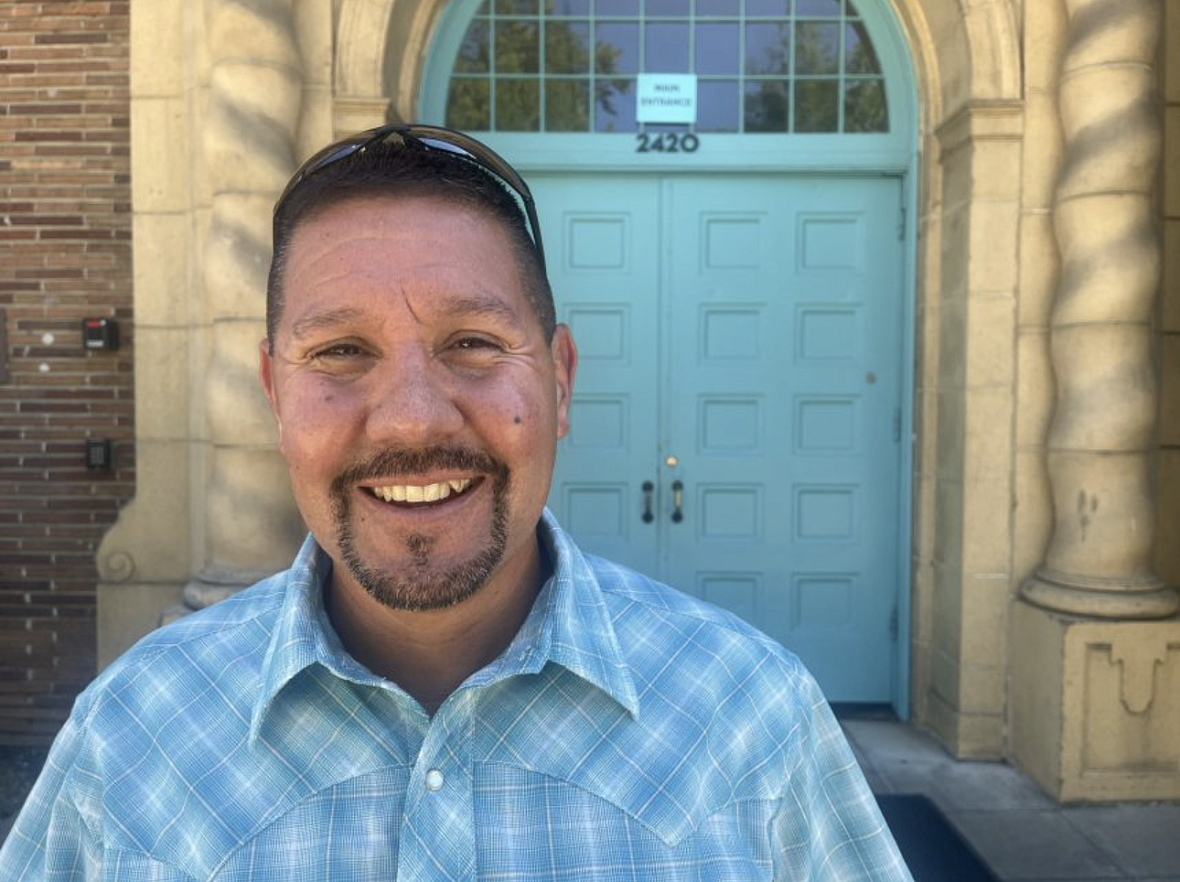
J Vasquez was imprisoned for 25 years, practically half his life.
Sophia Rerucha
Every morning when he wakes up, J Vasquez opens up the windows in his room and looks out the window. It’s a sort of ritual that the 49-year-old Sacramento native treasures.
J: “Being in a room that didn't have windows gives me a lot of anxiety. That still does to this day.”
J is referring to the cells that he was in for 25 years, nearly half of his life.
J: “I’ve been home seven and a half years, but to this day, most of my life has still been spent inside there.”
While J has adapted and thrived during his time outside, spending time with his partner and their dog, writing legislation in Sacramento and working with nonprofit CURYJ, his time inside still deeply affects him.
J grew up in Sacramento, and around 14 years old, he joined a gang. One night, when he was 16, he and a friend were invited to a party, but when they arrived, they saw rival gang members.
J: “The gang mentality is about using violence and to me at that time was okay. I put it in my mind that that's how you solve conflicts.”
What he thought would be a fun night ended in tragedy. J killed a rival gang member, another teenage that was just 19 years old.
J: “It's sad to say, and I hate to say this because it makes me feel heartless about the time. Even when I got arrested, I was always thinking about myself, like what's gonna happen to me.”
At the beginning, J was in a juvenile facility while he awaited his trial. But when he turned 18, he was sentenced to 31 years to life in prison. There began his life in Salinas Valley State Prison, a maximum security prison in the Central Valley.
A study published in American Psychologist explains that justice-involved youth exhibit “particularly high rates of ACEs, which place them in greater need of behavioral health intervention and at greater risk for continued justice involvement.”
Technically, these are known as Adverse Childhood Experiences. Family separation, domestic violence, drug abuse, and alcoholism are a few of the common lived experiences identified for incarcerated youth.
María D. Vázquez is a therapist that worked for several years at a juvenile justice center in Oxnard, California. According to her, the majority of those in the facility were Latino boys. According to the Congressional Hispanic Caucus Institute, 20% of those incarcerated youth were Latino, although they make up 25% of the U.S. youth.
Doctor Vázquez explains that, when she would talk with the parents of the youth, they weren’t able to properly support their children because they had to focus on meeting their own immediate needs, such as working.
Dr. Vázquez: “A lot of these kids were raised by their siblings or raised themselves. And I want to be extremely clear. This isn’t because they didn’t care about or didn't love their children, it was a question of financial necessity.”
Because so much of that early experience is shaped by the adults raising us, the effects tend to ripple through families across generations. Clinical psychologist Evan Holloway of General Hospital of San Francisco explains why parents can carry so much weight.
Dr. Holloway: “From infancy, our parents have the strongest influence on our entire lives. And through development, it affects us because we interact with them more frequently.”
If a child doesn’t have a support network to process these experiences of violence, then they can compound and increase the chance of exposure to the justice system.
Dr. Vázquez: “Trauma is something that people tend to have developed way before being incarcerated. And if you live in a community where there’s a lot of violence, a lot of police, then chances are, you’ll get caught pretty easily. And also, in environments where you’re forced to adopt survival behaviors, those behaviors are likely to get you incarcerated.”
For J, this sounds familiar.
He tells me his childhood in Sacramento in the 80s and 90s was marked by domestic violence, his parent’s drug abuse and alcoholism, poverty, and his parent’s divorce.
J: “It was just a very challenging upbringing. We didn't have much money, we lived in a poorer neighborhood, working class neighborhood. The gang lifestyle and poverty was already there in the neighborhood. It’s not like I went to seek it out. It was already there.”
J is the oldest son of a Chicano family and because of that, he says he was his dad’s favorite child. J’s oldest memories are of their outings and the games his dad would play with him when he was little. But when his dad left, things changed. J was 4 years old.
J: “I didn't understand the divorce. So as a child, in my mind, ‘Why is he gone? Was it me? Was I not good enough? Is that why he left?”
J felt abandoned. At the same time, while he was growing up, his childhood friends began getting involved with neighborhood gangs; at 14 J did the same thing. It was a support system where he felt validated, supported, and loved by other young men.
J: “I look back on it now, it's just a bunch of kids with a lot of trauma, trying to be there for each other and not understanding that the lifestyle we're living was just causing more harm and more trauma to other people as well to ourselves and to our loved ones.”
And then, more than ten years after his departure, J’s dad reentered his life.
J: “I had that craving for my father to be in my life ever since that divorce when I was four. And so when my dad started coming back in my life, I felt like, ‘this is it.’ This is something that I wanted and I needed.”
What J didn’t know was that his dad was dying. He had developed cirrhosis of the liver from years of alcohol abuse. Shortly after reentering their lives, his father died. Those deep feelings of loss were there when his mom took him and his younger brother to a counselor, but J was unable to express his feelings; they were repressed.
J: “It seemed pointless to me. I didn't know how to express myself. Here I am, getting deeper involved, really in the gang culture. And I just didn't care anymore.”
A month after his dad died, J was incarcerated for the first time for stealing a car. He was just 15 years old. When he got out, he just fell deeper into the gang lifestyle. Six months after, in 1993, shortly after his 16th birthday, the night came that changed his life and left him incarcerated for 25 years.
J: “It was a very violent place. I don't remember any real educational opportunities. They didn't even run the vocational classes they had there, because we were always on lockdown.”
J recalls his arrival at Salinas Valley State Prison, when a guard told him something he has never forgotten.
J: “He was like, ‘Hey youngster, do yourself a favor and hang yourself, you’re never getting out of here. I just remember just thinking to myself, ‘Yeah, I'm gonna grow old and die in prison.”
To J, this compounded the cycle of abuse and hopelessness he felt.
Dr. María D. Vázquez wrote her master’s thesis on reintegration into society for formerly incarcerated Latinos. Part of her investigation showed her that being incarcerated as a youth has the potential to cause regressions in the development of the brain.
Dr. Vázquez: “Identity development is extremely important during that period. Who am I? How do people see me, think of me, what do they expect of me? That affects a person’s development.”
She says she saw how the people she interviewed experienced childhood trauma, and being incarcerated caused even more trauma.
For J, the endless cycle of violence in jail seemed infinite. When he was 23 years old, he was sent to solitary confinement, without any contact for two years. Then, something happened.
J: “It was the first time I was alone with my thoughts and four walls. Within that time, I just did a lot of introspection and soul-searching and I was thinking of myself, ‘Like how the fuck did get here?’ I was trying to figure out, not so much in prison, but in my life in general. ‘Who am I? This is not me.’ So I started questioning things within myself. And that was the moment where I just wanted something different for my life.”
Even now, J can’t quite describe the beginnings of his transformation although he does recall a powerful moment of clarity along the way.
J woke up before dawn to attend a shop class and saw the sun rise.
J: “I didn't see the razor wire, I didn't see the gun towers, I didn't see none of that. And I felt free. It was like, processing my trauma and being able to identify, ‘Well this is how I got here, and I'm not a bad person, and just these are the things I could change about myself. Like, that was liberating. I just felt at peace, it was the weirdest thing. That's the most free I ever felt. Prior to going to prison, I never felt that free.”
J refers to it as healing and not rehab, because rehab implies returning to how you were. But to J, he was never at his best, the past wasn’t something he wanted to return to. He began reading self-help books he found in the prison library and attended support groups with other men who shared their experiences and emotions.
“It took me a long time when I was in groups to even start sharing and opening up. It took me years. I would go to the groups and I would just sit there and listen. I still had all these masks on. I still didn't want to be vulnerable because those things could be preyed upon and capitalized inside prison if you're too vulnerable.”
Dr. Vázquez says this is a survival mechanism.
Dr. Vázquez: “To survive in prison, you need to be distrustful. You always have to ask yourself, ‘Is this person helping me because they want to or are they gonna ask me for a favor afterwards. Almost always they expect a favor back. It’s an economy in there.”
But when he attended circles, there were men who he says “were farther along on the healing journey than I was.” Their stories inspired him to open up and share. He describes it as removing one mask after another to reveal himself to himself.
J: And I was able to identify those experiences they had with the experiences that I had. And I don't think I would have been able to do that on my own, even with all the books I read and all the things. It's different when you're actually in circle and people are sharing and you got that synergy going.”
In environments like prison, having the support of other people who have had similar experiences is important.
Dr. Holloway: “There’s a focus these days on Credible Messengers, people with experience who are experts in navigating the system, people you can be honest with about your needs, what you’re suffering through, fighting against stigma against you for being incarcerated. It’s important to have and know that someone out there was successful.”
At 41, after being transferred to lower security prisons over the years, J got out in 2018. He was dropped off in San Francisco’s Tenderloin. But after more than 25 years of being incarcerated, the world had drastically changed.
J: “It was a big challenge with technology; You know, how to use a freaking cell phone, how to apply for a job, because everything was online. Here I am, thinking I'm going to print my resume. My resume was only prison stuff. I was 16 when I got locked up. I didn't know what hell I was doing. And so it was very, very challenging, literally stepping into the future. It's like a 16 year old going to sleep and waking up as a 41-year-old going on 42, 25 years later.”
But on top of this, there were the consequences of being incarcerated. Shortly after getting out, J went to a doctor, who diagnosed him with Post Traumatic Stress Disorder. As Dr. Holloway says, the more time someone spends locked up, the more difficult it is to reintegrate into society.
Dr. Vázquez adds that every individual is different, and what can take someone five years to get through could take someone else 20 years.
Dr. Vázquez: “It's going to be really hard and yes, we want to have realistic expectations, but we also don't want to unnecessarily limit ourselves. Nothing out here is ever going to be as hard as what you were doing in there, you know, and that by itself is extremely helpful.”
Today, J is 49 years old and works as the Director of Policy for CURYJ, an organization that defends the rights of formerly incarcerated people.
J: “What helped me come home is Senate Bill 260. Senate Bill 260 which gave quote unquote ‘youth offenders’ meaningful opportunities to come home and now I get to work on laws to help other people come home as well. So it kind of came full circle in that sense.”
Senate Bill 260, signed in 2013 by Governor Jerry Brown, allowed inmates who committed crimes as minors to parole and demonstrate their suitability after serving at least 15 years of their sentence. Advocates, like J, say the bill recognized that youth are different from adults, and miss out on the opportunity for rehab if they’re imprisoned.
He’s returned to his hometown, Sacramento, to work on writing bills that go through the State Legislature and Governor.
I meet J on a steaming hot July day. He greets me with a huge smile. While we talk, a group of kids passes by.
J: “I love hearing those voices because in prison you don't hear that. I think back on my own childhood and look back at my own innocence kind of lost in a way. I know that everybody has potential for change. Doesn't mean everybody will change. Doesn't mean that we should, in my personal opinion, open the door and let everybody out right now because people are still in their traumas. But how do we help people heal so that if and when they're given an opportunity, they come out here as an asset to the community. That’s the reason why I do what I do.”