

In Kentucky, thousands suffer from severe asthma — and everybody pays
This article was originally published in Courier Journal with support from our 2026 National Fellowship, the Fund for Reporting on Child Well-Being and the Dennis A. Hunt Fund for Health Journalism.

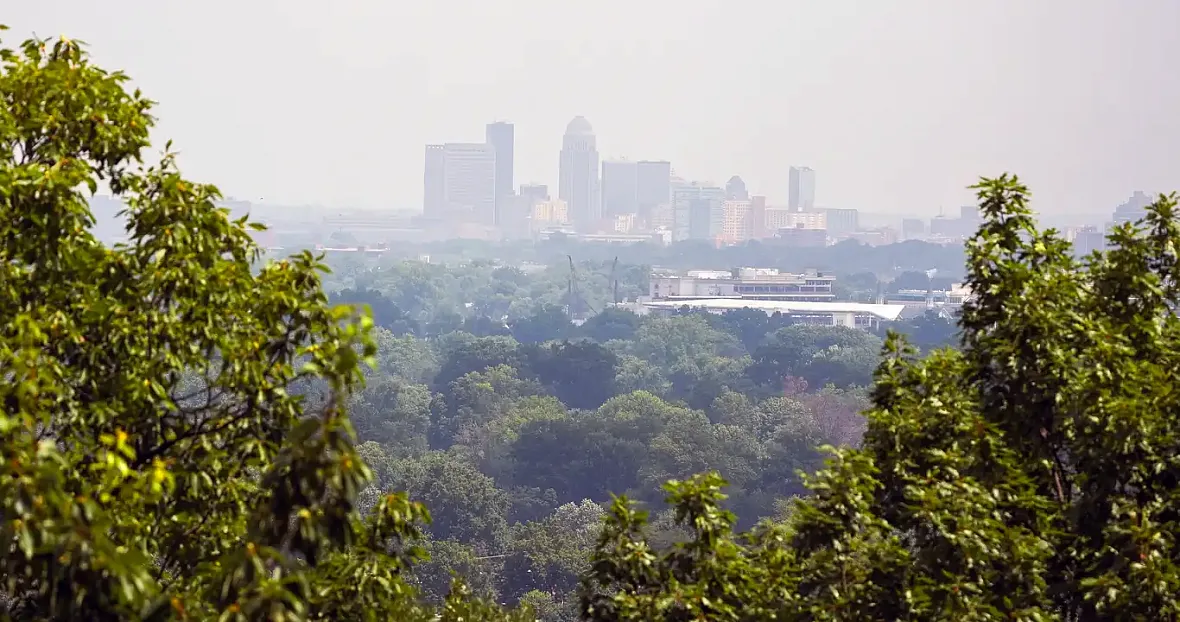
Haze hangs over the city of Louisville in this view from the overlook at Iroquois Park in July 2026.
Michael Clevenger/Courier Journal
Asthma is putting people in the hospital for days or weeks at a time, pulling children out of the classroom, keeping adults out of work, trapping people in their homes, and driving a preventable, uneven and overlooked cost in Louisville.
A common chronic disease, asthma can be managed in almost every case. For thousands here and elsewhere in Kentucky, it is not.
At its worst, asthma is a thief – of health, education, wages, time, opportunity and life – that targets those with less.
Public health data, government records and interviews with 70 people – including Kentuckians with asthma, doctors, parents, teachers and advocates – reveal a pervasive disease, accepted as a fact of life in Louisville, that has long preyed on the young and the old. In a monthslong investigation, The Courier Journal found:
- In some pockets of Louisville's West End, asthma rates are among the highest in the nation. In these neighborhoods, most of which are majority-Black, asthma-related hospitalizations are up to five times higher than in wealthier East End areas.
- Of the thousands of students in Jefferson County Public Schools known to have asthma, nearly half are chronically absent, a staggering rate that likely points to gaps in access to care and medication for kids.
- Louisville children with asthma are living in unsafe housing conditions, including units with mold, pests and ventilation issues. The problem is evident in Louisville's private housing stock as well as government-owned and -subsidized units, and vague laws on habitability have allowed a cycle of sickness to continue.
- Kentucky's attorney general has gone to great lengths to defend polluters from stricter clean air standards, and its legislature has pushed to continue burning coal for electricity, a major source of local and regional air pollution. As Louisville's air quality suffers, recent rollbacks by the Trump administration have opened the door for more pollution.
- Kentucky's asthma management program, which aims to curb asthma proactively through education and intervention, relies on a small federal grant. The state's chronic disease programs "are pretty much perpetually underfunded," one official said.
Statewide, the cost is sobering.
Asthma kills 30-40 people in Kentucky each year. From 2022-25, asthma was linked to more than 50,000 visits to the emergency department and thousands of inpatient hospitalizations. The respiratory disease, affecting more than 400,000 Kentuckians, extracts an estimated $1.7 billion in the state every year in the form of health care expenses, lost workdays and missed school days.
But policymakers have left solutions on the shelf, The Courier Journal found, despite asthma's deep and disparate toll. While huge sums are spent on treating people struggling to breathe in emergency rooms and hospital beds, relatively little investment goes toward eradicating the triggers that brought them there.
"Asthmatics are at risk more now, I think, than ever in my career," said Dr. Evan Kuhl, medical director at the UofL Jewish Hospital emergency department. For a decade in emergency medicine, he's seen patients struggle to access medication and care, even as triggers for asthma continue to pummel the lungs.
Read the entire series: Courier Journal investigates asthma's burden on Kentuckians in 'Breathless'
In an asthma attack, the vital airways that deliver oxygen to the body become narrow. Kentuckians likened the feeling to "drowning on dry land" or "having an anvil on your chest."
The triggers for an attack are many. Allergens like pollen and pet dander; respiratory viruses like the flu; or air pollutants such as industrial emissions or ozone on a hot summer day can set off a life-threatening response. The disease can develop at any age, due to both family history and environmental exposures. The impacts are notoriously difficult to trace back to an exact culprit: the mold in a room, the exhaust from an interstate or the particulates from a smokestack.
"Unfortunately, it's not just one thing," said Dr. Scott Bickel, a pediatric pulmonologist and medical director of respiratory therapy at Norton Children's Hospital. "It's such an interwoven web of factors."
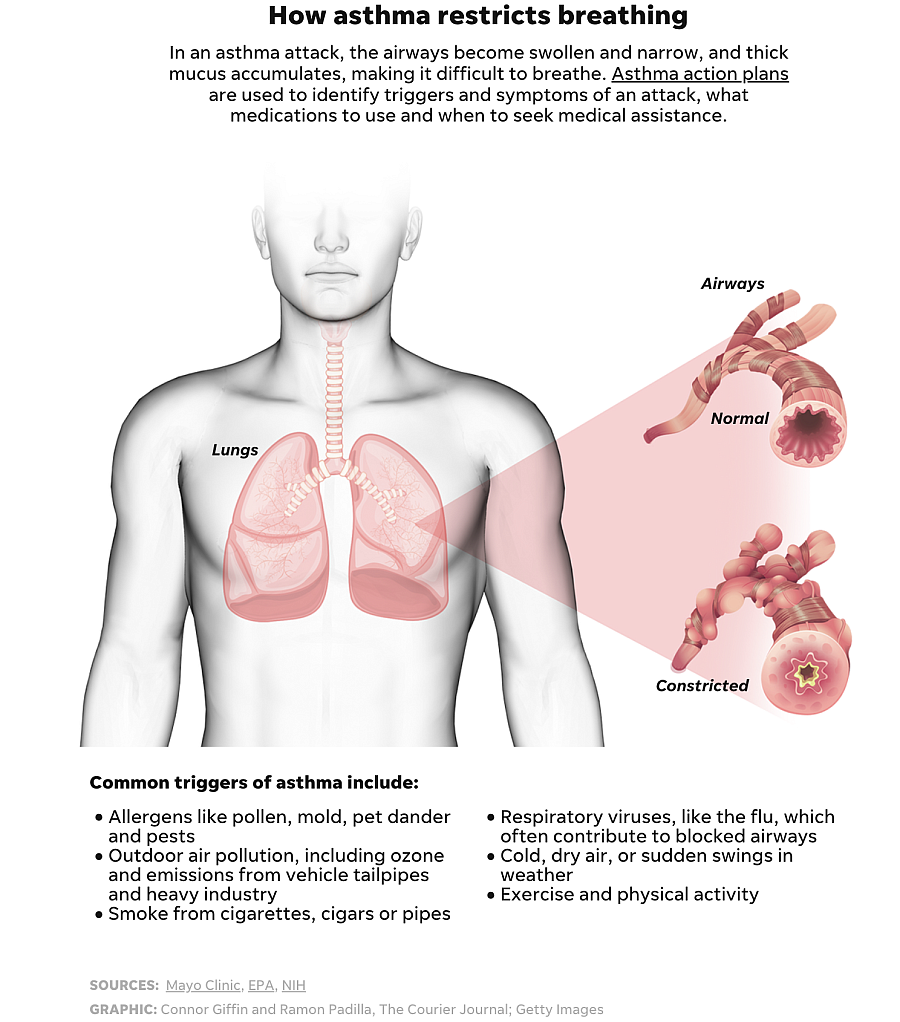
Louisville's asthma burden is attributable, in part, to the city's seat at the bottom of a "bowl." The Ohio Valley is notorious for trapping air pollutants and allergens in a way that can batter the respiratory tract.
But Louisville has also built its neighborhoods in a way that too often places people in close proximity to major pollution sources, allows them to live in unhealthy housing, or neglects infrastructure that could improve health outcomes: a convenient bus route with access to a clinic, or the cooling shade of a tree-lined street.
The Courier Journal spoke with people in a dozen Louisville-area ZIP codes about their asthma history. Many characterized Louisville as an especially difficult place to live with asthma, or said their symptoms ease when visiting other parts of the country. Some said they only developed symptoms after moving here.
"I think we definitely have underestimated the burden that it has," said Dr. Luz Fernandez, a UofL Health family medicine physician, "on the individual, the family, and at large."
When the ER is 'the only option'
Habiba Darur was 17 the first time she felt her airways tighten. Fits of coughing kept her awake through the night. She struggled to inhale.
She wasn't exactly sure how to express what she was feeling, but likened it to "breathing out of a straw." Soon it became difficult to talk or walk.
Her brother rushed her to the emergency department at Norton Children's and explained that his sister was having an asthma attack. Darur was wheeled in and fitted with an oxygen mask. She recalled "having to depend on a machine to breathe."
She ended up in the hospital for about five days, she said. A year later, another attack brought her back.

Habiba Darur struggled with asthma as a teen.
Aug. 31, 2026 Matt Stone/The Courier Journal
With guidance from a pulmonologist, Darur found an asthma management strategy that helps keep her out of the ER. In almost every case, asthma can be controlled with medicine and by learning personal triggers and symptoms.
Still, asthma continues to put people in Louisville hospital beds. More than 5,000 asthma-related hospitalizations were recorded in Jefferson County alone from 2020-24, according to state data.
Asthma-related hospitalizations and ER visits are often an indicator of asthma cases that have gone unmanaged: patients who cannot access an inhaler, make routine visits to a doctor or escape a troublesome trigger of their symptoms. Left uncontrolled, their asthma spirals into a crisis.
"The emergency department is a very expensive place to get care," Kuhl said. "But for many people, it has become the only option."
Louisville has previously ranked among the worst metros in the country for some asthma metrics. In 2024, Louisville had the second-highest rate of asthma-related emergency department visits of all major metropolitan areas, according to an analysis by the Asthma and Allergy Foundation of America.
With modern treatments and improved understanding of asthma, better outcomes are in reach: "Zero ER visits, and zero hospitalizations," said Dr. Wes Sublett, a Louisville physician at Family Allergy and Asthma. "I do firmly believe that for many patients, even with severe asthma, we can get to that."
Last year, the metro notably improved, falling in the AAFA's ranks for emergency department visits and overall asthma burden. But those figures, which account for the multi-county Louisville area, can belie the outsized burden found in the city's worst asthma hotspots.
Where asthma is felt most
Queenie Byrd's summers in the Parkland neighborhood are livened by grandchildren running through the house. Between bursts of play in the front yard, they pass her as she sits in the front room, thanking her for breakfast and hanging on her arms.
Summer also brings allergens and hazy, humid air that aggravates her asthma, trapping her indoors and making her wheeze. In the warmer months, "I'm basically homebound," said Byrd, 55. Asthma has kept her from fishing, spending time in nature and watching her grandsons play football.
"It took a lot from me," she said in September, between breathing treatments.
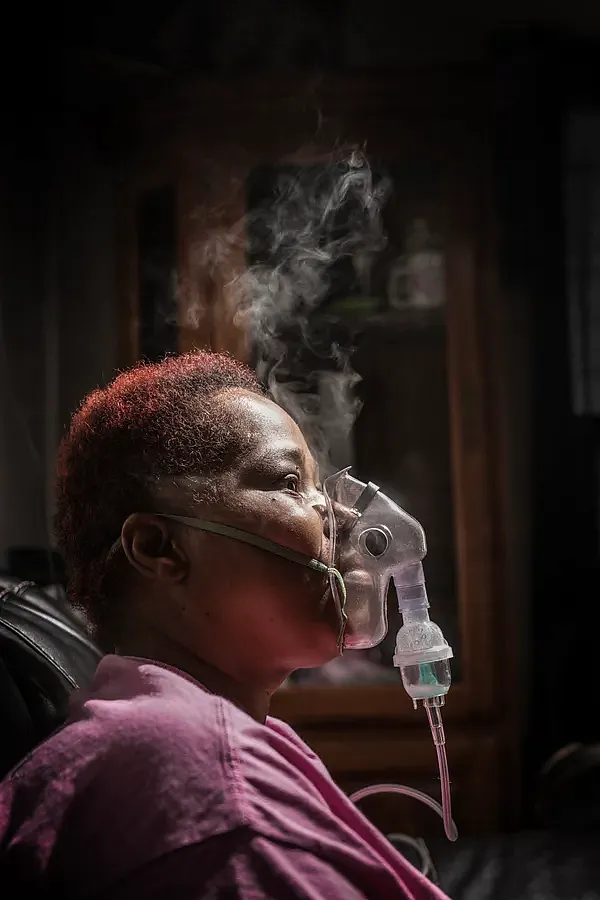
Queenie Byrd uses a nebulizer in her home to treat her asthma.
Sept. 29, 2026 Michael Clevenger/Courier Journal
Asthma has hospitalized Byrd repeatedly since she was diagnosed in 2011, sometimes on a monthly basis. In a severe case, she was hospitalized for more than 30 days, she said as she read through her old medical records. Her asthma has often been complicated by other respiratory illnesses, compounding the effects on her health. It has made her extra careful to avoid sickness and other triggers. A "no smoking" sign hangs on her front door.
Byrd lives 200 feet from a freight train line, within a block of two different industrial plants, and not far from Interstate 264 – all sources of air pollution that can strain the lungs and trigger asthma. She wonders whether local pollution is affecting her respiratory health. In 2023-24, the local Air Justice research project stationed an air quality sensor in her backyard, and found particulate matter levels repeatedly exceeding health guidelines established by the World Health Organization.
Parkland is among several neighborhoods in Louisville's West End with high rates of asthma and asthma-related hospitalizations, as well as higher levels of air pollutants that have been linked to a range of chronic diseases. Residents are more likely to live in older housing with mold or other indoor air quality risks. Households earning lower incomes may have limited options to move out of unhealthy conditions or pay for home repairs.
Residents in Byrd's ZIP code are hospitalized from asthma at five times the rate of residents in the East End. They also have a life expectancy more than a decade shorter − about 65 years.
Of the many chronic diseases weighing disproportionately on Louisville's West End, asthma is among the most common. Doctors know how to keep it at bay, but many in Louisville are suffering from uncontrolled asthma.
Among the most vulnerable are young children.
An 'unacceptable' gap
Children have virtually no control over the air they breathe, whether at home, at school or waiting at the bus stop. Their developing lungs and immune systems make them especially vulnerable to polluted air.
Asthma is a leading driver of school absenteeism nationally. Symptoms often flare up at night, keeping students sleepless and weary during the school days they do attend.
Experts who spoke to The Courier Journal repeatedly emphasized: When children can't breathe, they can't learn.

The empty hallway of a JCPS elementary school. About half of JCPS students with asthma are missing 10% of school days or more, The Courier Journal found.
Marty Pearl/Special To Courier Journal
Over the past five school years, about 46% of Jefferson County Public Schools students with a recorded asthma diagnosis were chronically absent, according to data obtained by The Courier Journal through an open records request – more than 10 percentage points higher than the district rate overall.
In other words, about half of JCPS students with asthma are missing 10% of school days or more.
"That's huge," said Eva Stone, who served as the district's top health official until this year. "That is unacceptable."
The data does not prove that asthma is the direct cause of absenteeism for those students, who might have other barriers to attendance. But it does show a notable correlation that could indicate disparities for the thousands of JCPS students with the disease.
"If asthma is controlled appropriately, that child should be participating in school the same as other kids," Stone said. "The fact that there's a higher percentage of kids who are chronically absent that have asthma tells me there's gaps. There's gaps in treatment, access to treatment, so on and so forth."
JCPS has long struggled to reduce its chronic absenteeism rates, which in some schools exceed 60%. Missed school days are linked to worse outcomes in reading proficiency and other metrics, and can discourage students who feel they’re falling behind. Chronic absenteeism – a predictor of high-school dropouts and struggles in future employment – also causes schools to receive less state funding.
In the most severe cases, asthma-related absenteeism has dragged Louisville families into court for truancy, said Fernandez, who practices family medicine at UofL Health's Mary & Elizabeth Hospital.
"The more days you miss school, of course, the more behind you tend to get," Fernandez said. "These kiddos that are not having control of their asthma, oftentimes, are getting quite behind their peers."
As doctors work as detectives to find the cause of a child's asthma symptoms, many Louisville families cannot find a reprieve from the triggers – even inside their own home.
Unhealthy homes
Louisville receives hundreds of reports of mold in housing each year, in addition to concerns of pests, ventilation and other factors that can trigger asthma. Some of the reports come from parents of children with asthma, who say persistent mold is going unaddressed by their landlord.
Lawyers and advocates who spoke to The Courier Journal said current regulations do not adequately address the issue. Local property maintenance codes and state statutes require property owners to keep units in "clean and sanitary" conditions, but lack specific provisions for mold remediation.
Josh Poe, an urban planning researcher and organizer with the Kentucky Tenant Union, said: "Mold is not illegal."
When the Louisville Department of Codes and Regulations receives a mold complaint, or when enforcement officers "observe something that resembles mold during an inspection, they document it with photos and issue a violation notice when appropriate," spokesperson Emily Martin said in a statement.
The city's code enforcement officers "are not certified mold inspectors, so they do not cite mold specifically," Martin said. She declined an interview with department staff about the issue of asthma, "given the limited scope of our department's role in this matter."
The department has issued notices of violation related to "mold-like substances" hundreds of times in recent years, city records show. Landlords often address these citations by painting over the mold or taking other steps that do not confront the root cause, such as a leaky roof or wall, according to tenants and several Legal Aid Society attorneys who have worked with clients in low-quality housing.
This can produce a cycle of sickness, including asthma attacks. Some parents "feel like they're failing their kids," said Emily Pinerola Lancaster, a Legal Aid attorney, as families find themselves stuck in unhealthy housing – unable to find an alternative, or unable to move without violating a lease agreement.
The issue is not uncommon in government-owned housing and private housing subsidized through government voucher assistance, also known as Section 8. Private units participating in the voucher program are supposed to meet federal standards, and the Louisville Metro Housing Authority said families are moved out of units that continue to fail inspection.
But even when mold is found in a property, lawyers and tenants said a lengthy process can keep families in unhealthy conditions for months before facilitating a move to another home.
Jen Anderson, whose 12-year-old son Antwan has asthma, said it took nearly a year of complaints, inspections and paperwork before they were able to move out of a voucher-supported apartment in Okolona, despite signs of mold and other maintenance issues. Their feet squelched in a carpet soaked by leaky appliances, and Anderson said Antwan's asthma symptoms worsened, causing him to miss school for several days when classes began in August.
"This is ridiculous," she said, "how people are living."
Mold is regularly reported in units LMHA manages, according to work orders and emails obtained by The Courier Journal through Kentucky's open records law. In one notable instance this year, a Metro 311 customer service specialist appeared to plead with LMHA to move a family with children out of a unit where mold had reportedly been "festering" for more than a decade.
"She has to move now. She and her children cannot continue to live in this particular apartment," the customer service specialist said in an email to the LMHA ombudsman. "Certainly, there must be someone within the Housing Authority who can move a mountain, and cut through all the red tape for this family. I sure hope so."
Elizabeth Strojan, executive director of LMHA, said the agency is working with limited resources to address long-standing maintenance issues across its aging properties. She declined to comment on "individual resident matters," but said the agency "relocates public housing residents to hotels or another unit in rare instances when the unit requires remediation for mold or another environmental issue."
Whether in public or private units, the effects of unhealthy housing can last well beyond a lease term.
"It's not just access to housing generally – which is certainly a problem, that there's not enough of it – but also just the quality of it. If your housing is subpar, your family will be sick," said Beth Robinson, a Legal Aid attorney. "These health outcomes, short-term, turn into long-term health outcomes. And then it becomes generational."
Kentucky is fighting in court to loosen clean air standards
In February, when the U.S. Environmental Protection Agency announced it was repealing strict air-pollution standards for coal-fired power plants, it chose to do so from Louisville, below the towering stacks of LG&E's Mill Creek generating station, one of the city's largest sources of air pollution. It was one in a series of Trump administration actions to keep coal-fired power plants operating up and down the Ohio River Valley.
The year before, the EPA canceled a $1 million grant earmarked for the study of toxic air pollution in Louisville's West End. The EPA said, as it had with countless other canceled environmental justice grants around the country, that the initiative was "inconsistent with, and no longer effectuates, agency priorities."
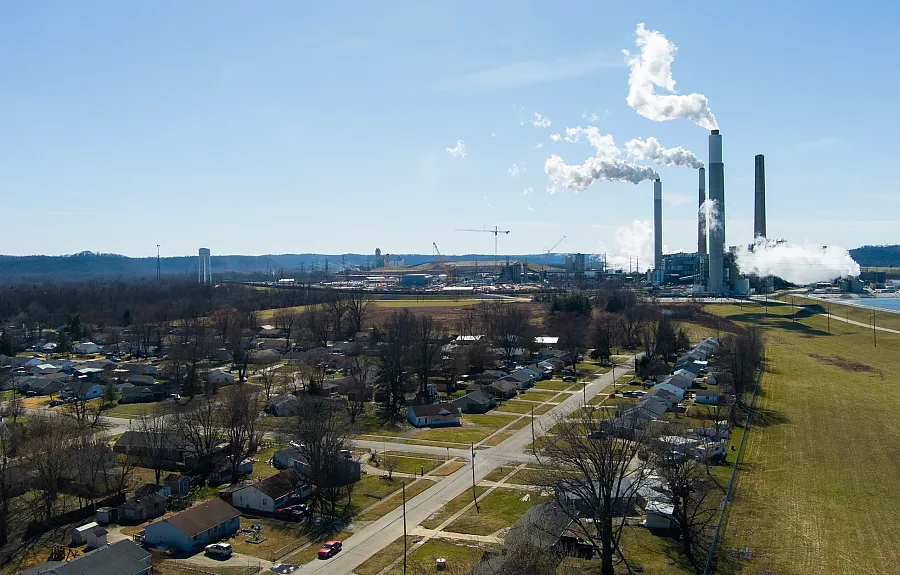
LG&E’s coal-fired Mill Creek power plant in southwest Jefferson County is one of the Louisville area’s biggest air polluters. Recent rollbacks by the Trump administration have opened the door for more emissions.
Matt Stone/Courier Journal
Kentucky has also led multi-state legal fights against more stringent clean air rules. Since 2024, Attorney General Russell Coleman has been suing to block the EPA from tightening standards for particulate matter, calling it an "attempt to solve an air quality problem that doesn't exist." The EPA previously estimated the rule would ease the burden of asthma attacks and yield billions of dollars in health benefits.
After a federal court denied the states' petition this summer, Coleman asked the U.S. Supreme Court to take up the matter, "to let Kentucky breathe a sigh of relief." A slew of trade groups have supported his efforts, criticizing the stronger EPA standards as a "perverse disincentive for American investment" that would increase costs and hurt economic activity.
As the Trump EPA carries out what it calls a "historic" wave of environmental deregulation, it has also altered the cost-benefit equation that shapes regulation. The agency no longer places a dollar value on the health-related benefits of reduced pollution, as it has for decades – only tallying the cost of compliance to industry.
"It's a sort of fraught process to put a dollar value on a human life, and compare it to the potential increase in costs of compliance for a company," said Byron Gary, an attorney at the environmental group Kentucky Resources Council. The cost of a child sent to the ER with breathing difficulty, he added, is in some ways "beyond valuing."
"The cost of a hospital visit is not just the bill that we receive afterwards," said Gary, whose young son has asthma. "That takes a real toll on a person, both the child and the parents."
The Trump administration has knocked down regulations on Louisville's biggest sources of air pollution – coal plants, chemical factories and vehicles – as the city's air quality ranks, by some measures, among the worst in the country. While the area is narrowly in compliance with the EPA's lower particulate matter standard, Louisville has been out of compliance for ozone pollution for years.
Ozone, a lung irritant, forms from the chemical reaction of sunlight and pollution from sources like vehicles and heavy industry. Ozone is a bane of Louisville's hottest months, and when it spikes, emergency rooms know to expect a surge in asthmatic patients in the following days, said Kuhl, the emergency department head. Those visits are preventable, he added, with proper asthma management and better communication of the risks.
Given a blank check to keep Louisvillians with asthma out of the ER, Kuhl said he would take aim at the city's environmental factors, from urban heat to pollution exposures.
"If I could do one thing, it wouldn't be medication, it wouldn't be treatment. It would probably be environmental," Kuhl said. "I think if we could modify or improve the environment in Louisville, to lower that heat at night, to lower the pollutants that people are exposed to, as a society, modifying that would be the most important thing."
'What is a healthy city?'
Broad efforts to address asthma are thinly funded. The Kentucky Asthma Management Program, the primary vehicle for the state's efforts to proactively curb asthma through education and intervention, leans solely on a $520,000-per-year grant from the Centers for Disease Control and Prevention.
Asthma is one of many chronic diseases with which Kentucky is wrestling, often at higher rates than other states and with less money to fight back.
"I would say all of our programs in chronic disease are pretty much perpetually underfunded," said Elizabeth Anderson-Hoagland, Chronic Disease Prevention Branch manager at the Kentucky Department for Public Health.
Additional federal support is available by billing Medicaid for certain asthma-related interventions, ranging from school-based care to community health worker services. But the state is also bracing for deep cuts to Medicaid, approved by Congress in 2025 to take full effect next year and expected to leave more Kentuckians without health insurance, including children.
Experts have also called for confronting asthma at the source by addressing the sprawling web of root causes. Many of the investments that could ease asthma burdens in Louisville – in cleaner air, improved health care access, tobacco cessation, quality housing – could also help curb an array of other chronic conditions, from heart disease to cancer.
Asthma "shares a lot in common with a lot of other conditions that are chronic diseases that are bankrupting the United States of America right now," said Ted Smith, a researcher and cofounder at the University of Louisville's Envirome Institute. He previously worked in the mayor's office under the Fischer administration, where he heard from employers that Louisville's notoriety for asthma, allergies and air quality was making it harder to convince people to relocate to the city.

Tree canopy hangs over Beargrass Creek, providing habitat and helping cool the area. Preserving green spaces and tree canopy in Louisville could help improve air quality and reduce the strain of urban heat.
Jeff Faughender/Courier Journal
Smith worked on the Air Louisville study, which found hotspots of where people in Louisville were reaching for their rescue inhalers. "The most densely clustered areas were identified in the central and western parts of Jefferson County, associated with pollutant exposure around major roadway corridors and industrial activity," researchers found.
The study made recommendations to city leaders about preserving and expanding tree canopy, making zoning reforms to create buffers between people and pollution sources, and establishing designated routes for heavy trucks. Most of the recommendations, issued a decade ago, have not been meaningfully implemented at scale.
With limited resources to tackle chronic disease, Smith said, "We really have to think at a much more fundamental level about: What is a healthy city?"
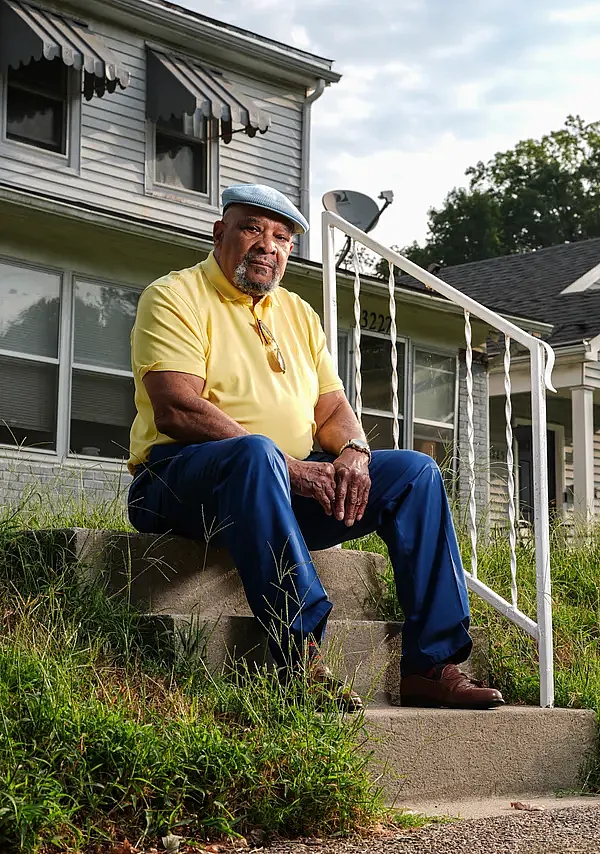
David Cooper sits on a stoop on Kirby Avenue in Louisville, Kentucky, in front of his childhood home in Parkland. He lived in the neighborhood as a teenager in the 1960s, before the Clean Air Act helped reduce local air pollution.
Sept. 18 2026 Matt Stone/The Courier Journal/USAToday Network
David Cooper grew up with asthma in Louisville before the Clean Air Act of 1970, when the city's skyline was shrouded in a perpetual, coal-fueled haze.
As a boy, he didn't have medication to manage the disease. He remembers monthly visits to the emergency room and lots of missed school. Asthma kept him home for an entire semester of second grade, he said.
Between bouts of breathlessness, he helped haul shipments of coal to the basement to feed the furnace of his childhood home in Parkland. Soot settled from unchecked smokestacks onto the cars parked on his street.
Into adulthood, he eventually found a regimen of medication to manage his asthma. Louisville's skyline is clearly visible – most days – from miles away. He hasn't had an attack in decades, but he vividly remembers the feeling. "It takes all of your muscles," he said. "You're fighting just to breathe."
Without the access to health care he's had, he said, "I don't know if I'd still be alive."
His now-adult son also had asthma from an early age. Cooper described the agony as a parent watching his son struggle, and spending nights at his bedside in the emergency room.
"Maybe it helped that I knew what he was going through. But it's heart-wrenching to see your two-year-old having an asthma attack," he said. "You hate to see your child suffer."
Now in his 70s, Cooper feels fortunate to have the tools to keep his asthma in control. But he still worries Kentucky hasn't made enough progress for subsequent generations in reducing risk from the disease. He described frustration with the state's stubborn reliance on polluting coal power, and lack of broad access to the care and medications he credits for his life.
"We haven't done nearly enough," he said.
In Part 2: Nearly half of JCPS students with asthma are chronically absent. What's the toll for education and opportunity?
Read the entire series: Courier Journal investigates asthma's burden on Kentuckians in 'Breathless'Tell us what you think. Submit your letter to the editor.
Connor Giffin is an environmental reporter for The Courier Journal. Reach him directly at cgiffin@courier-journal.com.