

Only 1 in 4 LA County kids on Medi-Cal get required lead poisoning tests
The story was originally published in Los Angeles Public Press with support from our 2026 California Health Equity Fellowship.


Illustration by Alyson Yee.
Kim Bueno-Padilla’s colorful little Boyle Heights bungalow has roses and sunflowers and a tidily-kept front lawn dotted with the tell-tale toys of the home’s young residents, her daughters Emma, 8, and Charlotte, 6.
As pretty as it is, Bueno-Padilla’s home is hemmed in by the toxic footprint from freeways, which are notorious corridors of lead pollution, and of heavy industry that has left a similar legacy. On top of that, city records show her bungalow was built in 1918, well before lead paint was banned in 1978. These are all red flags that should have triggered blood lead level testing for her two children during their first two years of life.
Lead is so toxic to young brains that experts say there is no safe level of exposure. It’s such an ever-present threat that the California Department of Public Health just updated its screening requirements to clarify which children could be exposed, saying “almost all California children are at risk of lead exposure and should get a blood lead test at ages one and two.”
Children enrolled in Medi-Cal are at most risk as they’re more likely to live in old homes with lead paint or spend time with someone who works with lead, among other reasons. That’s why the federal government requires them to get blood lead tested at 12 and 24 months. The state also requires all children at heightened risk of lead exposure to get screened the same way.
Emma, who at 1 and 2 years of age was a foster child enrolled in Medi-Cal, had her blood screened for lead as required, said Bueno-Padilla. But she said Charlotte, who is enrolled under the family’s Anthem Blue Cross insurance plan, has never had the test. Her pediatrician, she said, didn’t raise the idea with her, and she never knew to ask herself.
“If I would have been alerted before, I would have dug into it more to understand what we’re up against with the kids,” said Bueno-Padilla. “You want to protect them.”
In LA County, where lead exposures are ubiquitous thanks to a huge inventory of old houses and a vast industrial footprint, Charlotte’s experience appears to be far more typical than that of her older sister, Emma.
It’s unclear exactly how many at-risk children in total aren’t getting the required testing in LA County as the available data doesn’t show this. The clearest numbers are for children enrolled in Medi-Cal (who make up 57% of kids under 19 in LA). In 2022, only about 23% of Medi-Cal enrolled kids in the county received both required blood lead tests by 24 months.
The LA County Department of Public Health described the testing rate as “alarmingly low.” It should be 100%.
LA County, where testing rates have remained low for many years, is far from an outlier. From 2021 through 2023, less than one-third on average of Medi-Cal enrolled children statewide got both tests by 24 months.
Some health experts argue that not only does blood lead screening need to be expanded, the official blood lead threshold that triggers medical intervention needs to be lowered to match the latest science about the point at which a child’s IQ is harmed by lead exposure. According to data obtained by LA Public Press, thousands of children in LA County had blood lead levels high enough to cause IQ loss, but their parents are likely unaware of the fact.
There appear to be several potential reasons why the rates are slow, including a lack of awareness, training, and urgency among health care providers.
In 2022, the Department of Health Care Services, which oversees Medi-Cal, switched to a performance-based system for blood lead screening among Medi-Cal managed care plans, with sanctions if goals aren’t met. Since then, statewide lead testing has improved slightly. Still, health experts are calling for the state to do more.
In LA County, the Board of Supervisors launched “Lead Poisoning Prevention Week” in 2024 to help spread the word and ordered the county health department to take action on the issue. In turn, the department organized its own series of community outreach and education initiatives, on top of what it already does through its childhood lead prevention program.
While the county has tracked community engagement with these efforts, it’s unclear yet if it has helped move the overall testing rate.
Any attention on the issue is a plus, said Jim Mangia, president and CEO of St. John’s Community Health. St. John’s owns and operates a network of health centers and clinics across Downtown, East, and South LA, boasting an 88% childhood blood testing rate, according to Mangia.
“I don’t think people see it as much of a problem,” said Mangia, when asked why overall rates are so low countywide. “There used to be a lot of advocacy, a lot of urgency, a lot of action around this issue. And I think that’s really fallen off.”
Lead is in everything from our water to makeup
Children come into contact with this potent neurotoxin many ways.
Toddlers might peel off old lead paint from the wall and eat the little chips. They might crawl out in a backyard with lead contaminated dirt, then put their fingers in their mouths.
Family members who work with lead or in lead-contaminated environments (like construction workers) might return home at the end of the day and trail lead-contaminated soils indoors from their work boots or clothes.
A home’s drinking water could be contaminated if it’s served by old lead service lines. More broadly, there are all sorts of everyday items that could contain lead. Traditional cooking pots. Common skincare products. Even costume jewelry.
The thing is, lead poisoning has no symptoms. The only way to know the potential impact is with a blood lead test.
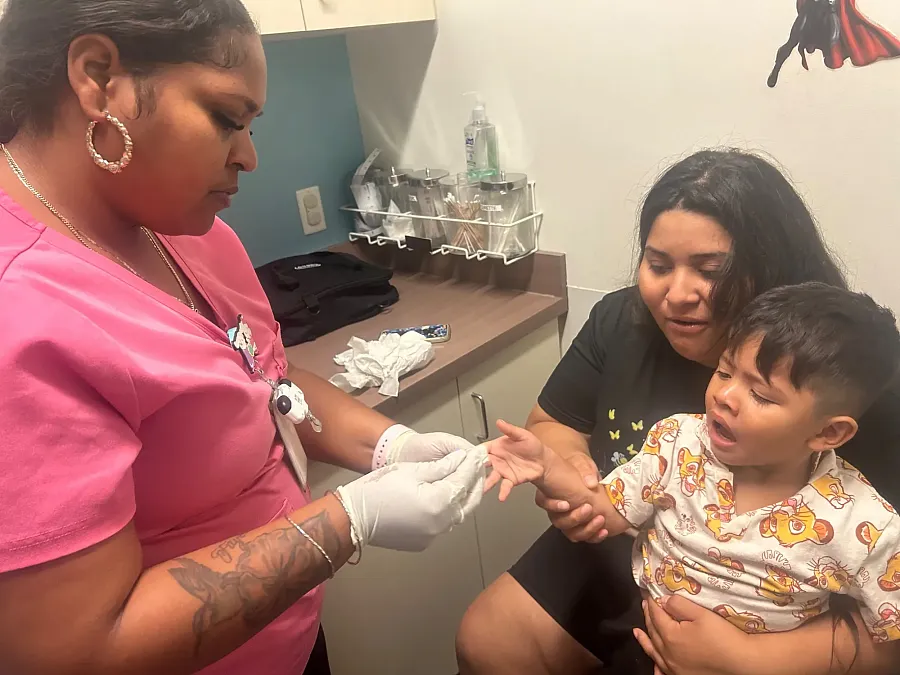
Three-year-old Liam Guzman Romero, held by his mother Gretty Romero, gets his blood lead levels tested by medical assistant Rameisha Salazar at St. John’s Frayser Health Center in South LA.
Photo by Dan Ross.
High lead exposure levels are known to cause severe brain and nervous system damage, convulsions, and even death. Lower lead exposures are linked with IQ loss, shortened attention span, and disruptive behavior. The long-term health implications for adults include reproductive problems, high blood pressure, and nerve damage.
Childhood lead exposures are also linked to higher instances of intellectual delays and higher school dropout rates. A 2023 study found the greater the lead exposure in the womb, the greater the likelihood of disability, adult unemployment, and need for public assistance.
To be sure, overall lead exposures have dropped considerably over the decades thanks to regulations that ban lead in gasoline and paint. But the lead contamination that remains is largely concentrated in low income, neighborhoods of color with old, deteriorating housing and a heavy industrial footprint.
That’s why “this is primarily an environmental racism issue,” said Danielle Hoague, whose PhD was on the effects of lead exposures and whose work now as an independent researcher focuses on environmental health equity.
Why do so few kids get tested?
By state statute, healthcare providers who routinely see children between six months and six years of age are required to do the following:
- Inform all parents about the risks of childhood lead exposures.
- Test every child enrolled in Medi-Cal at 12 and 24 months of age (or perform catch-up testing between 24 and 72 months).
- Test all children not enrolled in Medi-Cal who are deemed at higher risk of lead exposure.
The county and the state, however, have a long way to go before that goal is met.
Health experts interviewed for this story floated several theories for why the county’s testing rates are so low, but specific answers are hard to come by. Most agreed with Mangia’s comments that attention within the medical community on the issue has waned, even though the risk of lead exposures persist.
LA Public Press asked to speak with a county health department official about the issue but was repeatedly denied.
Instead, a department spokesperson shared a report stating the problem stems at least as far back as 2009; it notes the low testing rates are unrelated to the COVID pandemic.
Last year, physicians voiced fears that President Trump’s immigration crackdown would deter some families from getting screened. But that wouldn’t explain why they’ve been so low for so long.
One pediatrician who serves the South LA community told LA Public Press that part of the problem potentially lies with clinics where family physicians are routinely seeing toddlers rather than pediatricians, who receive much more extensive specialized training in early childhood health care.
According to Brian Johnston, a former emergency room physician at the Adventist Health White Memorial in Boyle Heights and a searing critic of the former Exide lead battery plant in Vernon for contaminating the surrounding community with lead, part of the problem lies in the disparities in healthcare access among those on Medi-Cal versus those on private or job-sponsored insurance.
“Why don’t Medi-Cal patients get seen?” Johnston said. “I think the reason is their mothers and fathers are working. They’re poor, and have difficulties with transportation, getting to and from an appointment. And they don’t always have a good relationship with doctors who have too many patients and not enough time.”
In September 2024, the LA County Board Supervisors board asked the health department if it would make sense to mandate lead screenings for all young children within the county’s formal contracts or memorandums of understanding with external Medi-Cal providers.
The health department subsequently chose not to, arguing it would be expensive and difficult to enforce, and that these types of formal agreements generally don’t include medical providers routinely assessing “significant numbers” of young children.
How does California compare to other states?
Some states have taken the position that all kids should get tested, regardless of perceived risk of exposure.
In the state of Massachusetts, where all children are required to be tested, the state’s lead screening rate in 2023 for all children nine to 47 months of age was 73%.
Iowa passed a law in 2008 requiring all children before the age of six get at least one blood lead test. In 2023, 74.49% of Iowa’s children aged 12 to 24 months got tested.
As for improving testing rates across LA County, Mangia said the state Department of Health Care Services should be more aggressive.
“Look,” said Mangia, “the fix is easy because it’s mostly going to be Medi-Cal kids who are going to be exposed. And so the state has a lot of leverage and a lot of leeway to ensure that it gets done.”
After a damning 2020 state audit highlighting the woefully low statewide blood lead screening rates, the Department of Health Care Services promised to do more to “ensure that required blood lead tests are occurring.”
Asked what the department has done since then, spokesperson Anthony Cava wrote in an email that the agency has, among several steps, strengthened lead testing requirements and expanded provider “education and training.” Cava also wrote that in 2022, blood lead testing among Medi-Cal shifted from being a recommended service to one with “measurable performance standards, required reporting, and enforceable accountability.”
The Department of Health Care Services fined a Medi-Cal managed care plan called Health Net about $5,000 in total for failing to meet minimum blood lead testing performance standards in 2023, according to Cava. While no LA-based plan was sanctioned in 2024, county plans were fined an estimated $6,500 again in 2025.
“The increase in sanction total from 2024 to 2025 is reflective in part of Los Angeles County’s performance and the large population they serve,” wrote Cava.
Even low lead exposures can lead to drops in IQ
Many experts consulted for this story stressed the problem of childhood lead exposures won’t be solved just by expanding the testing reach — the blood lead thresholds that health officials use also need to be lowered, they said.
Currently, if a child has a blood lead level of 3.5 micrograms per deciliter or higher, the Center for Disease Control requires the clinician to report the result to the state or local authority, educate the parents on possible sources and to continue routine testing until the blood lead levels drop. The last time this level was lowered was in 2021, from 5 micrograms per deciliter.
In 2023, 1,587 children under the age of six in LA County had blood lead levels above the 3.5 micrograms per deciliter threshold, representing 1.7% of the 91,876 kids tested.
The latest research around lead exposures, however, shows how the steepest declines of up to six IQ points happen from between 1-10 micrograms per deciliter.
According to Bruce Lanphear, a physician and principal investigator with Simon Fraser University, there’s a one IQ point drop for each one microgram per deciliter increase in blood lead levels.
The state doesn’t break the publicly available blood lead data down to the 1 microgram per deciliter level.
Through a Public Record Act request, however, LA Public Press found that in 2023, the latest year of data available, 3,731, or 15.2%, of 24,490 LA County children under 30 months had their highest blood lead levels reported above 1 microgram per deciliter.
These were children who received a venous blood draw, which breaks the test results down to the 1 microgram per deciliter level. The finger-prick test result typically doesn’t do that, explained a California Department of Public Health spokesperson.
According to Lanphear, this statistic underscores the need for health officials to lower the blood lead level that triggers action.
“As blood lead levels decline, the public health system should continually lower the levels considered high. So the reference value, set by CDC, should eventually be lowered from 3.5 to 1 microgram per deciliter,” Lanphear said.
Other health experts agree with Lanphear.
“Zero tolerance for lead in the blood is our position as well,” said Mangia with St. John’s Community Health, adding that testing should also continue beyond age two. “We also test kids up until the age of six and even after,” he added.
Nancy Halpern Ibrahim, executive director and board director of the Esperanza Community Housing, a social justice housing and health equity nonprofit, takes a similar view.
“There’s no normal level of lead in the blood,” Halpern Ibrahim said,
As for universal blood lead testing, “I would rather we just get this right first,” she said, arguing institutional failures around preventative care need to be fixed before any program expansion.
Asked about further lowering the actionable level, a county public health spokesperson wrote in an email that any such changes “would be made in collaboration” with the California Department of Public Health.
Questioned about Bueno-Padilla’s story, Anthem Blue Cross spokesperson Michael Bowman wrote in an email that while the company couldn’t comment on an individual’s care or coverage, it “takes concerns about missed preventive care seriously and expects participating providers to follow applicable California requirements and clinical standards” for childhood lead screening and testing.
“If we receive a concern that a provider may not have completed an applicable risk assessment or offered appropriate testing, Anthem can review it as a potential quality-of-care issue and take appropriate action based on the findings,” Bowman added.
Bueno-Padilla said that had her physician recommended a blood lead test for her youngest daughter, she would have done it. And she thinks a universal testing mandate could be a positive step forward.
“It’s a serious thing,” Bueno-Padilla said, who added that she’ll now get Charlotte tested.
“You don’t know where kids are spending their time, if they’re doing activities or sports in a [contaminated] area, even if they don’t live in the area,” she said. “Why wouldn’t you just want to test for that, just to be sure?”
Correction:
7:59 a.m., September 13, 2026
Health Net for LA County was the only LA County care plan fined by the the Department of Health Care Services in 2023. The other plans previously listed in this article were sanctioned elsewhere in California.