What to do in LA about lead in your yard
This article was originally published in Los Angeles Public Press with support from our 2026 California Health Equity Fellowship.

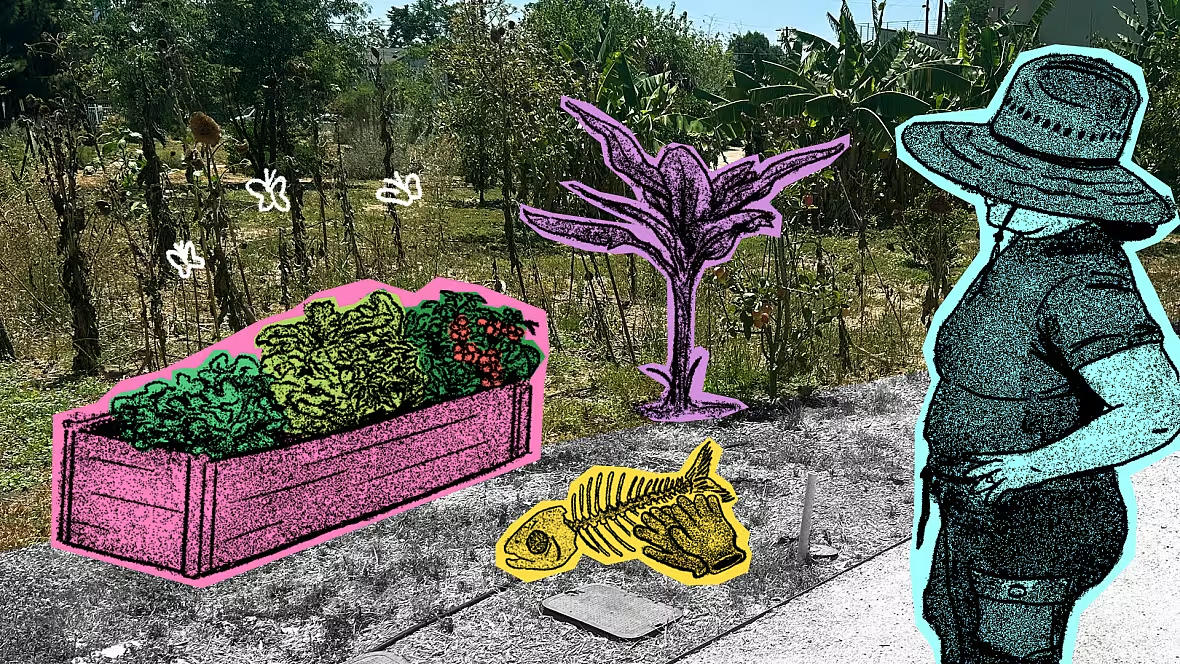
Illustration by Alyson Yee.
Lead is a potent neurotoxin commonly found around everything from old paint, freeways, heavy industry like metal and lead battery recycling plants, urban wildfires and airports.
If you strongly suspect your front or back yard has been contaminated by lead, don’t despair. There are a host of good educational resources and organizations who can guide you through what to do next.
State or federal regulators will sometimes test your soils. But if they don’t, you can try local organizations like the CLEAN program through USC to test it for you. Here are some other LA-based soil testing resources.
This online guide is an excellent manual for deciding which soils should be prioritized for testing and why.
Can you go out and test the soil yourself? Yes, but the tools can cost tens of thousands of dollars, making them unrealistic for almost everybody.
In the absence of state or federal intervention, what options do you have to clean up the lead if it’s detected at high enough levels to cause you or your family harm?
The following is a do-it-yourself guide to fixing the problem.
1. Should I clean up my back yard?
California’s residential soil lead threshold is 80 parts per million (ppm). Soils have slightly elevated lead at 80 ppm to 400 ppm. And they have significantly elevated levels of lead at 400 ppm and above.
If the soil in your backyard is contaminated with lead at levels higher than the 80 ppm threshold, should you clean it up?
Not necessarily, experts say.
First off, there are essentially three ways lead can get into the human body.
The first is through inhalation of soil dust contaminated with lead. The second is ingestion, like a child scrabbling around in the dirt who then licks their fingers. The third is through long-term contact with the skin (such as contaminated dirt under the finger nails).
As Igor Bronz, research senior manager for TreePeople, a nonprofit working toward to make Southern California more climate resilient, explains it, the decision to clean up a lead-contaminated home largely depends on who’s using the soil and how.
Even if your soils have significant amounts of lead in them, “if you’re living with your partner, and you’re both in your 50s or 60s and there’s no kids in the house, no kids coming to the house and playing in the soil, no dust getting kicked up, and you never really go outside to use it, should you care? The answer’s probably no. It’s not going to do anything to you,” said Bronz.
“If nobody’s interacting with it,” he added, “then leave it be.”
But what if you and your kids are active out in your contaminated back yard? What then?
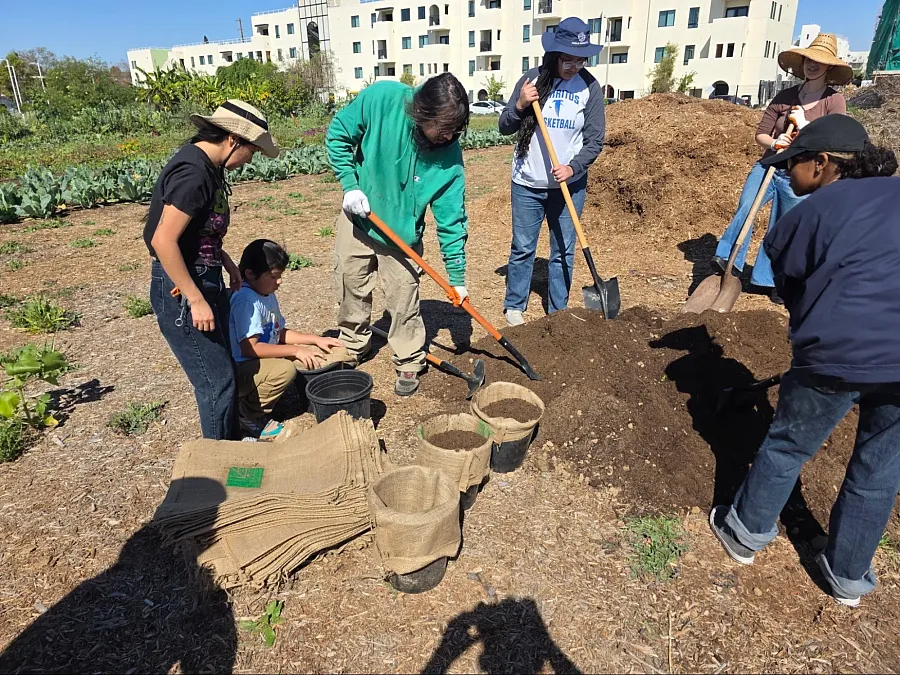
The LA Urban Soil Social Impact Collaborative’s soil mixing event held at Mudtown Farms in Watts on March 7th.
Photo by Igor Bronz.
2. Cover the soil
The easiest, most affordable way to tackle the problem is to cover the contaminated dirt with clean lead-free materials.
“Let’s say you find that you have 1,000 parts per million of lead in your yard, you’d want to cover that with two to three inches of clean soil, another two inches of compost, and maybe another inch or two of mulch,” said Bronz, describing this concoction as a layered sandwich.
You’ll also want to plant it, Bronz said. “The plants are going to stabilize the soil so it doesn’t erode,” he said.
Only, don’t plant something you’ll subsequently want to eat. For that, use raised beds.
The reason experts don’t advise growing anything in contaminated soil isn’t necessarily because the plants will take up the lead into the leaves, the fruits or the other edible parts (more on that in a bit).
“Most of the time, lead, arsenic and other contaminants are in solid form, meaning the plant roots can’t take them up. Plants can only take up something that’s dissolved in water,” said Bronz.
And lead, said Bronz, only becomes soluble when the soil pH is unusually low (around 5).
“So, the reason we say ‘don’t eat root vegetables’ is not because they’re inside the plant. It’s because they’re on the surface,” he said.
For plants like kale, “lead dust can be really hard to wash off,” he said.
That’s why it’s best to peel root vegetables and to remove the outer layer of leafy greens.
There are some other simple everyday things you can do to avoid lead exposures when you’re out working in lead contaminated dirt.
They include wearing gloves and washing your hands, and leaving dirty work boots outside the house.
3. Scrape the top soil
If adding layers of clean soil, compost, and mulch to your backyard isn’t viable — or if your backyard is already just too high — another approach is to dig up and remove the top few inches of soil.
This approach, however, comes with drawbacks.
For one, scraping is expensive. “Becasue once you scrape, then you have to dispose of it somewhere. Most dumpsites are not going to take contaminated soil,” said Bronz. “You’ll have to take it to a specific site probably with a much higher fee.”
Plus, digging up and hauling away the contaminated dirt is a messy job. The lead dust can disperse into the local environment, contaminating other people’s homes and backyards.
Dousing the dirt with water typically lessens the problem but won’t necessarily eliminate it.
3. Soil additives
Lead is an extremely stable metal. Unless you do something like dig it up and haul it away, it can stay there for millenia.
Nevertheless, there are several additives you can apply to soil itself to transform the lead into something far less harmful. Phosphate-based amendments are the classic such strategy.
If, for example, you turn ground-up fish bones (which are full of phosphates) into your contaminated backyard, the phosphates migrate into the soil. In turn, the lead binds with these phosphates, transforming into pyromorphite, a harmless crystalline mineral.
Mason Thomas Reid is a researcher at Ohio State University whose work focuses on techniques to treat lead from soils. He said fish bones are “the OG strategy” for remediating in place heavy industrial lead contamination around sources like old lead smelters.
But when it comes to urban soil lead contamination, “the effectiveness is much less consistent,” said Reid. “It’s difficult to know if it will work well on the soil of a particular urban site,” he said.
The EPA has been trialing a new strategy of applying iron sulfate and heat to soil, converting the lead into a mineral called plumbojarosite. Compared to pure lead, plumbojarosite (converted from lead) is far less readily absorbed into the body.
But the logistics of applying enough heat to the soil in your backyard to be effective makes this approach impractical, said Reid.
Another method is to add biochar (wood burned with little to no oxygen) and other biosolids to soil, which can safely absorb the lead, especially if the biochar is enriched with iron.
While this approach is promising “and has potential,” said Reid, it needs to be studied on a broader scale to understand if and how it should have a more formalized application strategy at contaminated sites.
4. Phytoremediation
Phytoremediation is a fancy term for the process of specific plants taking up contaminants from the soil through their roots, and storing those nasty chemicals within the leaves, stems or fruit.
When it comes to lead, sunflowers are widely believed to be the magic bullet. After the recent fires, for example, the LA Times ran a story extolling their use.
Reid, however, has one simple suggestion when it comes to sunflowers as a treatment for soil lead contamination: Don’t do it.
“I want to be clear, there’s no scientific basis for this claim,” said Reid.
The amount of lead sunflowers will absorb is so small, it could take “millenia” for a contaminated site to become lead free, said Reid.
As we’ve already explained, plants best absorb lead that’s dissolved in water, and lead only becomes soluble in low pH soils.
As such, some people apply acid to contaminated land, with the hope plants will absorb the lead more efficiently.
But what typically happens instead, explained Reid, is that the dissolved lead moves through the ground much easier, contaminating surrounding soils and the underneath groundwater table.
At the same time, there have been promising studies showing how plants paired with fungal communities (as you’d see out in nature) can at the very least help to significantly reduce soil lead levels.
A group of researchers recently studied three contaminated sites in Los Angeles and found that, over a period of just 12 months, native plant-fungal communities massively reduced mixed metal (including lead) and organic contaminant concentrations.
5. Other resources
The Urban Soil Social Impact Collective is a collective of organizations including UCLA and Physicians for Social Responsibility-LA.
A collaboration between UC Irvine, Occidental College and non-profit advocacy group East Yard Communities for Environmental Justice produced this educational page linking to various useful resources: https://faculty.sites.uci.edu/cejrl/get-the-lead-out/
This consortium of organizations have put together a resource for victims of the urban wildfires: https://www.consortium-science.com/
The state Department of Toxic Substances Control has put together several education materials on lead contamination and exposures.
This fact sheet is geared towards LA’s Fire victims: https://dtsc.ca.gov/wp-content/uploads/sites/31/2025/05/DTSC-Lead-in-Soil-Fact-Sheet-August-2025.pdf
This post-wildfire guidance plan is for environmental professionals: Emergency Wildfire Guidance | Department of Toxic Substances Control
This page links to some interesting presentations shared during a 2024 lead symposium: SoCal Urban Lead Symposium: Inform, Involve, Innovate | Department of Toxic Substances Control
This educational series called “Soil Smarts” was put together for the Santa Susana Field Lab cleanup: Soil Smarts: DTSC’s Interactive Learning Series on the Background Cleanup at SSFL | Department of Toxic Substances Control