

Sacramento County Senior Tenants Fight Evictions from Affordable Housing
The story was co-published with the Sacramento Observer as part of the 2025 Ethnic Media Collaborative, Healing California.

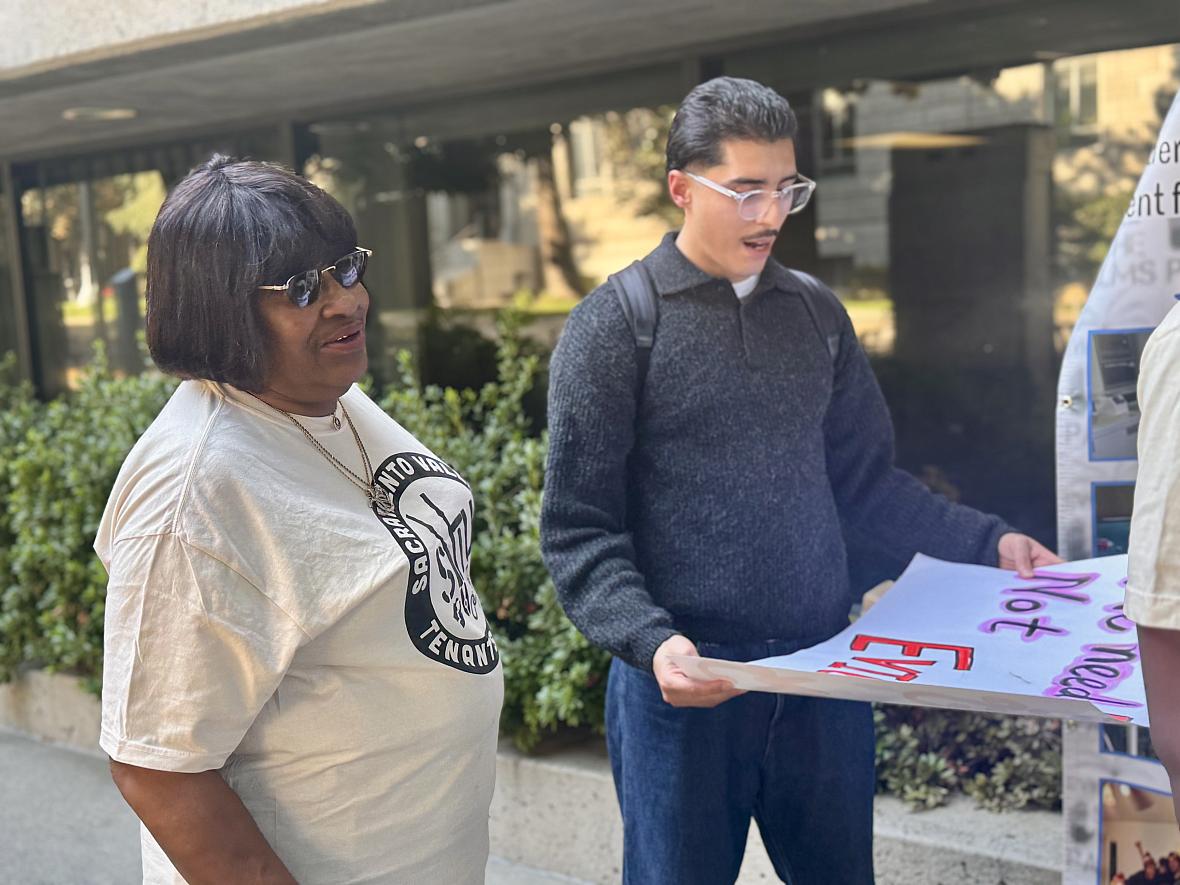
Jacqueline Saffo talks to a member of the Sacramento Valley Tenants Union at a demonstration outside the Sacramento County Board of Supervisors building on Sept. 25. Robert J. Hansen, OBSERVER
A long-standing conflict between residents of the Palms Apartments and their corporate landlord has intensified in recent months, amid deferred maintenance, redevelopment plans, and eviction notices, while Sacramento County has yet to adopt meaningful tenant protections, highlighting the challenges of preserving affordable housing in the county.
The Palms Apartments, a 48-unit complex on Marconi Avenue, became a flashpoint after a January 2024 fire destroyed roughly half of the property and left other units in disrepair. The blaze, which impacted about 20 units and sent at least one person to the hospital, forced many residents from their homes and left parts of the building boarded up.
County code enforcement and the Rental Housing Inspection Program (RHIP) have conducted repeated inspections since the fire. RHIP records show multiple citations for fire hazards, plumbing failures, pest infestations, and structural issues over the years. Officials say they continue to monitor the property and communicate with tenants to ensure compliance with building and housing codes, though tenants argue that fines have historically been insufficient to compel meaningful repairs.
In the wake of the fire, Plenty of Places Apartment Homes, a privately held real estate investment and property management firm, acquired the Palms in March with plans to renovate the complex. According to the company’s website, Plenty of Places focuses on purchasing “properties with deferred maintenance and management issues and have successfully repositioned them,”purchasing and repositioning multifamily properties with deferred maintenance or operational issues, particularly in metropolitan submarkets across California, Nevada, Arizona, and Colorado.
After the fire, many tenants either accepted a buyout or left on their own accord.
Tenants, however, contend the company’s approach prioritizes permanent displacement over phased renovations that would allow residents to stay or return. Only six families now occupy the building.
“We’ve got nowhere else to go,” said Jaqueline Saffo, 72, who lives at the Palms with her husband Cory Braden, 73, who is blind and suffered a stroke this past summer. Their rent initially was $675 and has risen to $989. “Still good,” Saffo said of their current rent. The couple relocated within the complex from the Eastern Wing to the Western Wing as units near them emptied.
Saffo said the couple had no real alternative when the landlord offered $3,000 in relocation assistance. “We didn’t have anywhere to go, and the little money they was offering us couldn’t put us in anything but a motel and wouldn't last a whole month in a motel,” she said. At the time of the offer in June, Braden was hospitalized with a stroke. The couple also says Braden has suffered blood clots and other health issues worsened by heat exposure.
The pair pays for storage for the belongings they left behind from their three-bedroom home, as well as insurance, car costs, food, and medications, which together total roughly $200 a month. “Actually, I don't even want to be in there, but I don't have anywhere else to go,” Saffo said. She explained that living in temporary housing—or, worse, in a car—would endanger their health. “Sleeping in a car is not a good thing for two old people,” she said.
Sacramento County, like much of California, faces a severe housing shortage. Waitlists for affordable housing often stretch for years, rents are rising rapidly, and resources for tenant protection remain limited. Tenant advocates say preserving existing affordable housing is one of the most effective tools for preventing homelessness, particularly for seniors, people with disabilities, and low-income families such as Saffo and Braden.
The situation is compounded by Sacramento County’s ongoing homelessness crisis. According to the 2024 Point‑in‑Time Count, an estimated 6,615 people were experiencing homelessness in the county on a single night in January 2024. Among them, roughly one in five (about 19.8%) were 55 or older, illustrating the particular vulnerability of older adults. For seniors like Saffo and Braden, navigating limited affordable housing options while facing health challenges makes permanent displacement a serious risk.
The 2025 Affordable Housing Needs Report estimated that over 54,000 low-income renter households are in need of affordable housing and close to 8 out of 10 extremely low-income (ELI) households in Sacramento County are paying more than half of their income on housing costs compared to 2% of moderate-income households.
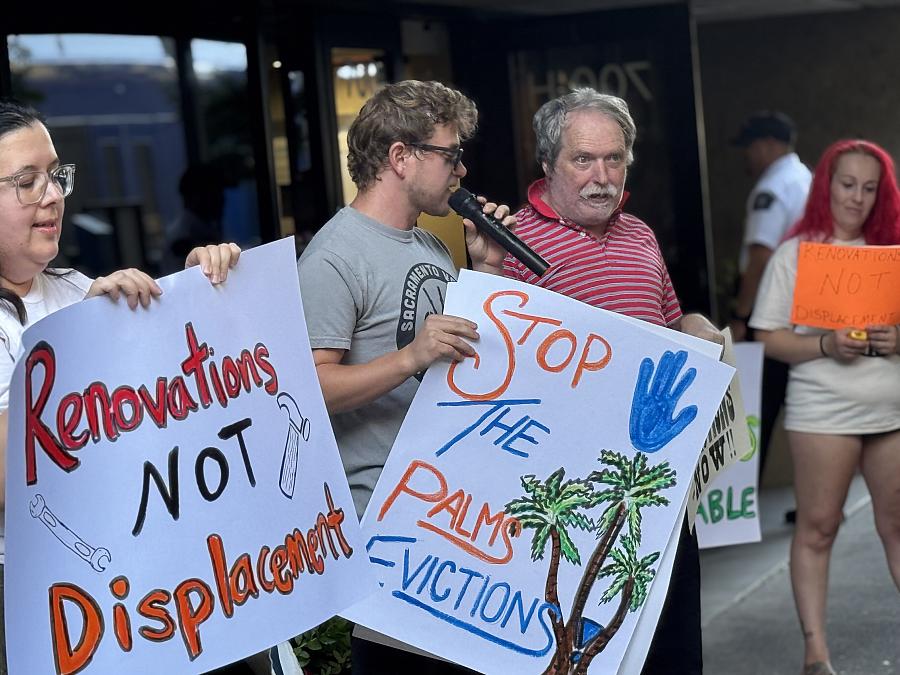
Sacramento Valley Tenants Union member Thomas Murray, center, calls on Sacramento County to help the tenants of the Palms Apartment Complex from “renoviction” as the property owners want all tenants to vacate during remodeling. Robert J. Hansen, OBSERVER.
The Sacramento Valley Tenants Union has criticized the County for failing to preserve affordable housing and enforcingemeaningful penalties for landlords who allow properties to deteriorate. Thomas Murray, a union representative, said the group is pushing for stronger protections against “renovictions,” where tenants are evicted so landlords can carry out long-term renovations. He referenced an ordinance recently enacted in the City of Los Angeles that prevents permanent eviction of tenants for this type of renovation and said the union would like Sacramento County to adopt a similar law.
Researchers have found that stable housing is a key social determinant of health. Those experiencing housing insecurity or homelessness frequently access healthcare systems and yet have worse healthcare outcomes compared to securely housed individuals. For seniors like the Bradens and Saffos, losing affordable housing is a potentially hazardous event, with a costly mental health toll.
For years, the tenants organized as the Palms Apartments Tenants Association (PATA), advocating for safer living conditions and resisting pressure to leave. The group, working alongside the Sacramento Valley Tenants Union, has held meetings with county officials, participated in inspections, and pushed for legal and community support. PATA members say their advocacy has brought limited improvements, but the broader issues of corporate ownership and rising rents persist.
In a show of advocacy, PATA, the Sacramento Valley Tenants Union, and community allies held a demonstration on Thursday, Sept. 25, outside the Sacramento County Board of Supervisors’ Office at 700 H Street, calling for stronger tenant protections and immediate action on safety and displacement. Days later, Supervisor Rich Desmond issued a statement addressing the tenants’ concerns.
Desmond said his office has been in regular contact with RHIP and the County’s Building Department since the 2024 fire and has met with nearby business owners who have been negatively affected by the property’s condition. “My priorities are … to ensure the tenants who lawfully occupy the Palms property receive all the legal protections to which they are entitled as well as assistance with alternative housing options, and that the owner of the Palms rehabilitates the property to increase housing capacity and makes it a positive asset to the Arden Arcade community,” he said.
Desmond also highlighted that his staff had repeatedly offered to meet with tenant advocates to hear their concerns directly, that eviction proceedings have not been initiated, and that County Department of Human Assistance staff are helping tenants navigate alternative housing options.
Tenants propose a staged renovation plan that would allow them to remain in the complex: complete repairs on the fire-damaged building first and relocate residents there temporarily while the rest of the complex is refurbished. Both tenants and some county officials agree that restoring all 45 livable units to safe, habitable condition is crucial amid an affordable housing shortage, but disagreement persists over the timeline and mechanics of repairs.

Attempts to reach Plenty of Places Apartment Homes for comment were unsuccessful; the company did not respond by publication time.
Despite meetings, inspections, and official statements, the six remaining
families remain in limbo while bureaucracy grinds slowly.
This project was supported by the USC Annenberg Center for Health Journalism, and is part of “Healing California”, a yearlong reporting Ethnic Media Collaborative venture with print, online and broadcast outlets across California.