

Vietnamese Seniors Struggle to Afford Life in Orange County
The story was co-published with Nguoi Viet Daily News as part of the 2025 Ethnic Media Collaborative, Healing California.
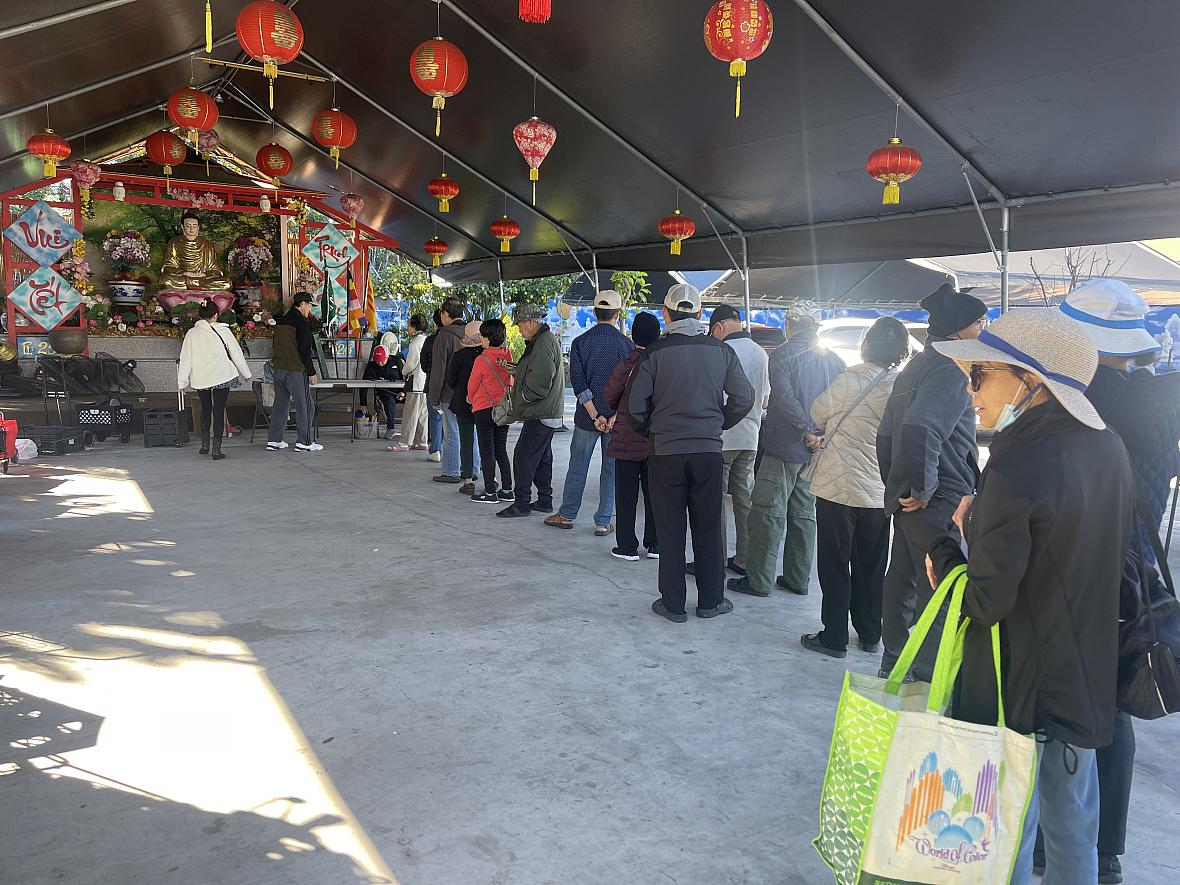
Residents get in line to wait for food distribution at Giac Ly Temple, Garden Grove. (Photo: Nhien Tra Nguyen)
On a cool Wednesday morning, 77-year-old Luong Nguyen steadies himself along the walkway of Giac Ly Temple as volunteers hand out boxes of fresh produce. His wife, Ha Nguyen, stays close–one hand hovering near his back in case his balance slips. Chronic spinal pain, blurred vision, and the lingering effects of a blood clot in his brain have slowed him.
For the couple, these weekly Wednesday food distributions are a lifeline. With rising prices and the stress of stretching a fixed income, they struggle to stay afloat.
At the edge of affordability
Luong retired at 65 after decades of physically demanding work. Today he receives about $1,100 per month in Social Security, but their $1,150 rent on a modest mobile home in Santa Ana consumes the entire benefit check.
That leaves every other cost–food, gas, utilities, health insurance, car insurance–on Ha’s shoulders.
“His whole check goes to rent,” Ha said. “Everything else comes from my income. We don’t spend on anything extra.”
Ha has worked for the last ten years as a sales representative for a digital marketing agency.
About 40% of Orange County residents are “housing-burdened” (spend more than 30% of their income on housing). Renters need to earn 3.3 times the state minimum wage to afford the county’s average rent (about $2,596/month in the cited analysis).
The cost of living in Orange County is among the highest in the state, with growing housing and medical costs linked to worsened physical and mental health for older adults. It is estimated that close to 200,000 older adults do not have the finances to cover basic necessities and may not have enough to eat.
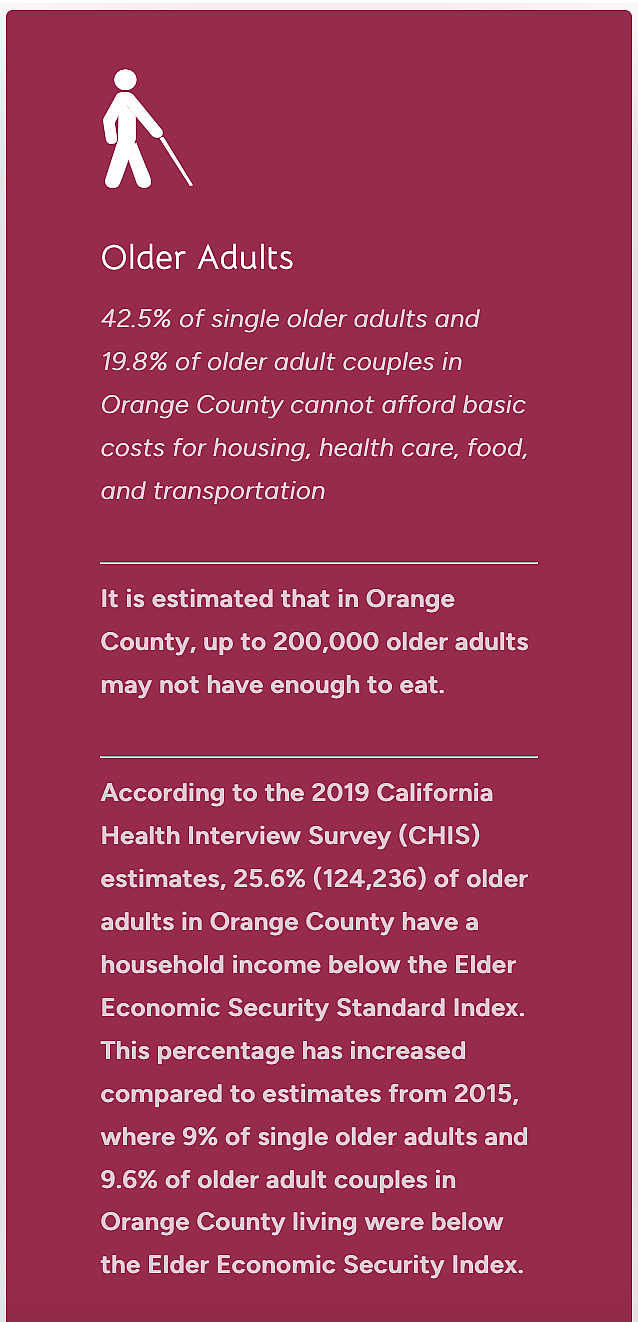
ConnectOC: Additional safety net concerns persist in Orange County for children, adults and older residents. https://www.oc-cf.org/about-us/strategic-initiatives/connectoc/safety-net/
Fresh fruits and vegetables—essential to Luong’s dietary restrictions—are expensive. His medical condition requires more produce and bland meals, which makes Giac Ly Temple’s weekly food distribution even more vital.
Luong’s health problems make daily life complicated. Chronic spinal disease limits his mobility. His eyesight, weakened from complications of a blood clot, makes navigating unfamiliar places risky. He suffers from forgetfulness, dizziness, and difficulty maintaining balance.
Luong has Medicare and pays $165 toward Medicare premiums. He manages his medication, schedules specialist visits, and organizes medical paperwork. Ha accompanies him to most appointments—but her full-time job doesn’t always allow her to leave work.
“If I can take time off, I drive him,” Ha said. “But if I’m too busy, he takes the bus or calls an Uber by himself. It scares me, but we have no choice.”
His unstable gait and limited vision make traveling alone dangerous. These transportation struggles were a major reason the couple applied for In-Home Supportive Services (IHSS).
A support system they needed but couldn’t access
IHSS, a statewide program that pays caregivers to help older adults remain safely at home, seemed like the solution. Ha hoped the program would allow her to reduce work hours without losing income, giving her more time to care for her husband.
But their application was denied.
The reason was that Luong does not have Medi-Cal or Medicaid, which is required for IHSS eligibility.
Their experience is one that county officials acknowledge is common among older immigrants with low fixed incomes.
Thao Nguyen, a supervisor at the Orange County Social Services Agency (SSA) who oversees IHSS applications, said that Medi-Cal is the gatekeeper for program access.
“Applicants need to have active Medi-Cal in order to be eligible for IHSS,” Thao said. “At SSA we have a large team of Vietnamese staff who can assist applicants whose English is limited.”
She added that the agency provides a range of support to help seniors navigate the process.
“IHSS applications can be done by phone or online. We also do interviews in the client’s home,” Thao added. “We help from A to Z. We focus on the clients.”
As of September 2025, Orange County has 14,208 Vietnamese IHSS recipients—26% of all IHSS recipients countywide, the largest share among all ethnic groups.
Yet many eligible seniors still struggle to access the program due to language barriers, lack of transportation, and difficulty completing Medi-Cal enrollment.
For now, Luong and Ha remain outside the IHSS system because Luong is not enrolled in Medi-Cal. However, seniors with limited income–especially those relying mainly on Social Security–can often qualify for dual eligibility through both Medicare and Medi-Cal.
Dual-eligible beneficiaries can keep their Medicare benefits while Medi-Cal helps cover remaining medical costs and, most importantly for Luong, opens the door to IHSS. In California, many Medicare Advantage (MA) plans also coordinate closely with Medi-Cal, and “Medi-Medi” plans streamline services across both programs to reduce confusion for older adults with complex health needs.
Beginning in 2025, California’s Medi-Cal Matching Plan Policy improves coordination for dual-eligible seniors by aligning Medi-Cal managed care plans with the Medicare plans they choose, and this policy will expand statewide in 2026. For seniors, enrolling in both Medicare and Medi-Cal may be the most direct path to receiving IHSS hours and lowering out-of-pocket medical costs.
Another option beside IHSS can be the Program of All-Inclusive Care for the Elderly (PACE) which covers Medicare and Medi-Cal benefits, including prescription drugs. PACE will coordinate healthcare, homecare, transportation, and dental care.
Surviving through community support
Every week, the couple visits Giac Ly Temple early to pick up bok choy, tofu, carrots, daikon, and other produce. Ha transforms them into soups and steamed dishes her husband can digest.
“Fresh food helps him,” she said.
For seniors like Luong, access to nutritious food is not just a comfort—it is a medical necessity. Research shows that older adults experiencing food insecurity consume significantly lower levels of essential nutrients such as protein, vitamins A and C, magnesium, calcium, and iron, putting them at heightened risk for malnutrition and chronic disease.

Volunteers prepare for food distribution at Giac Ly Temple. (Photo: Nhien Tra Nguyen)
Studies also link food insecurity to poorer health outcomes, noting that seniors without reliable access to food are 65% more likely to have diabetes and face higher rates of hypertension, congestive heart failure, asthma, and obesity.
The strain goes beyond physical health, the constant stress of not having enough to eat has been strongly associated with depression, anxiety, and emotional distress among older adults. For Luong–whose chronic conditions require a fresh, produce-rich diet, the weekly food distribution at Giac Ly Temple is essential to maintaining his health, stability in a county where groceries continue to rise beyond what many seniors can afford.
Luong and Ha’s story reflects a growing crisis among Vietnamese seniors in Orange County. Despite the county’s prosperity, thousands of older adults live one setback away from instability. According to the Elder Index, a single senior in Orange County needs over $30,000 annually to cover basic necessities.
Luong receives less than half of that.
For many older Vietnamese immigrants, cultural expectations of family care collide with economic realities. Rising rents, language barriers, and gaps in the safety net mean caregivers often shoulder the burden alone.

Their mobile home is small but comforting–a place where they can continue caring for each other. But Ha admits the future feels uncertain.
Ha’s hope is simple.
“We just want a peaceful old age,” she said. “As long as he can walk, and I can work, we will manage. But we worry every day.”
This project was supported by the USC Annenberg Center for Health Journalism, and is part of “Healing California”, a yearlong reporting Ethnic Media Collaborative venture with print, online and broadcast outlets across California.