

Indigenous Communities in LA Face a Triple Language Barrier in Healthcare
This story was produced in collaboration with La Opinión as part of the 2026 Ethnic Media Collaborative, Healing California.

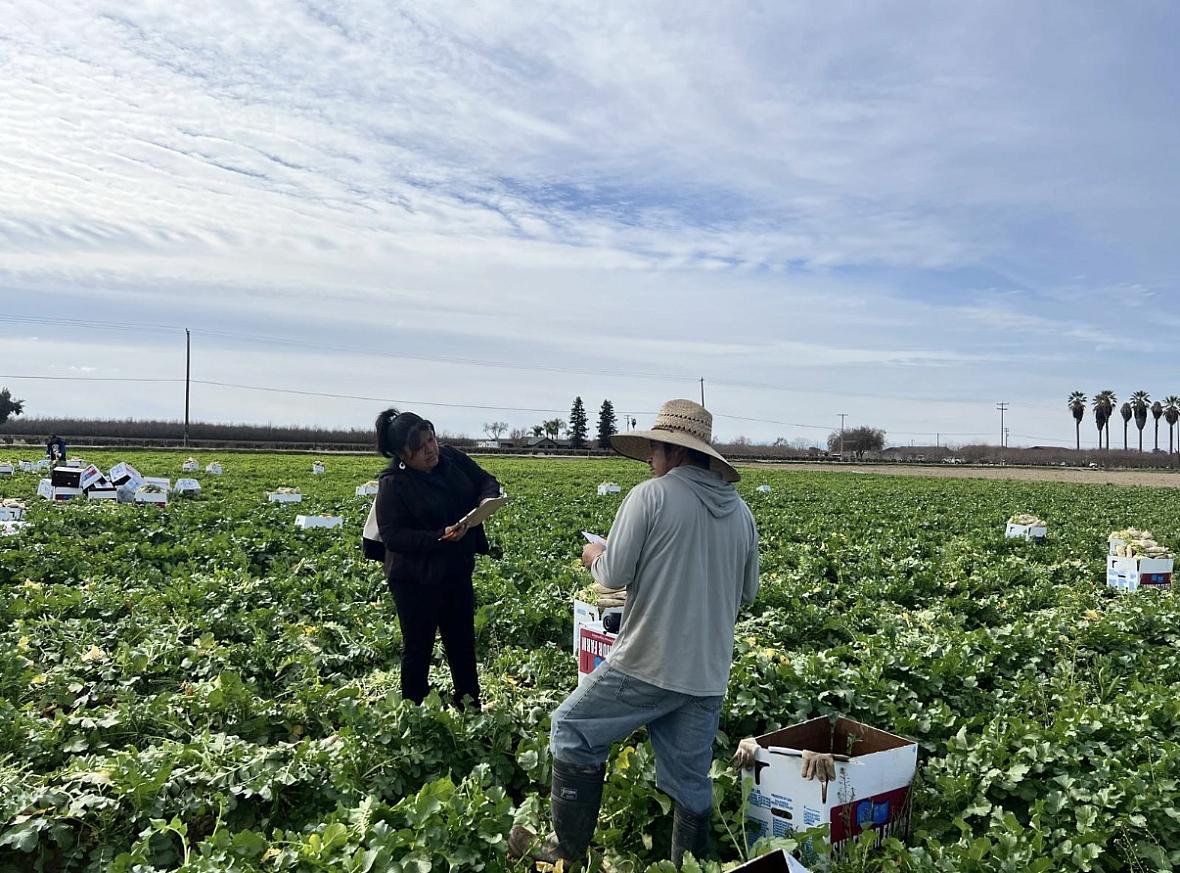
Un organizador del Centro Binacional para el Desarrollo Indígena Oaxaqueño realizando actividades de divulgación entre los trabajadores agrícolas de California.
An organizer from the Centro Binacional para el Desarrollo Indígena Oaxaqueño is conducting outreach among farmworkers in California.
Alicia Acevedo
As we walked down the Oaxacan Corridor on Pico Boulevard in Los Angeles on a recent beautiful Sunday afternoon, the fear was noticeable, but so was the resistance. Looking down the street, it was easy to admire how rich and alive the culture is amid the smell of grilled meats and food stands offering a variety of Oaxacan delights. Amid the chatter of people eating with their friends and families, you could hear some people speaking one of the many Oaxacan-origin languages still alive in the city. When approaching some stands and local businesses that Sunday, many vendors and shoppers politely declined to be interviewed, citing fear of immigration enforcement seen in the city since June of last year.
Some who knew a little Spanish said, “No gracias,” or “No thank you” to photos, while others, like a man tending to a grill on the sidewalk, who did speak Spanish, told me, “Things are too hard right now to be taking risks.” As he shook his head at my request, he smiled and made a joke about how handsome he thinks he is and said that if it were a different time, he would have said yes.
“Ya se que estoy guapo, pero no, mejor cuando se calmen las cosas, puede regresar,” he said. “I know I’m handsome, but no, it’s better to wait for things to calm down, then you can come back.”
For many indigenous Angelenos, speaking Zapotec, Mixtec, or K'iche' means being invisible three times over — to a healthcare system built in English, administered in Spanish, and never designed with them in mind.
Those barriers long predate Trump's administration, but the growing immigration raids and the Supreme Court's decision to green-light racial profiling based on how people look and speak have made an already impossible situation more dangerous.
‘They were going to circumcise their son’
The indigenous and women-led non-profit, Comunidades Indígenas en Liderazgo (CIELO), a human rights organization dedicated to language access, cultural preservation, and social justice, recalls many instances in which they had to advocate for a patient who spoke neither Spanish nor English.
Odilia Romero, CIELO’s co-founder, was once called to interpret for the father of a child patient at a local clinic; the service was to translate to Spanish, but after speaking with the father, she quickly realized he spoke an indigenous Guatemalan language.
“They were gonna do a circumcision on his child that he didn't realize he had approved,” said Romero. “We finally got him a proper interpreter and he immediately said no to the procedure once it was explained to him what it was.”
She explained that in the end, the circumcision was prevented, but situations like this one occur regularly and this disempowerment comes with severe consequences like delayed treatment, distrust of the healthcare system and patients taking wrong dosages of medication given by their doctors.
Romero, who came to L.A. at age 10 from Oaxaca, said that to ensure everyone has proper access to health care and opportunities, it is crucial for clinics and other institutions to have not just an array of language interpreters but also to understand how language continues to be a barrier for many indigenous communities in Los Angeles who are seeking healthcare.
I wouldn't define it as a challenge but a human rights violation, because your rights are linked to language.
Odilia Romero
“For you to take an educated, informed decision, the information has to be in your language. When that isn't done, it is a violation because you don't know what decision you are making, you are guessing based on what you can understand.”
According to a map based on data collected by CIELO and mapped with UCLA researchers, at least 36 distinct Indigenous languages are spoken by migrant communities in the city, representing at least 25 different Indigenous communities, primarily from Mexico and Central America.
There’s also an estimated 180,000 to 200,000 indigenous Oaxacans residing in the city, the largest populations are concentrated, though not limited to, areas like Westlake and Pico Union. Most speak Zapoteco, Mixteco, and Triqui, and in other areas of the city, you will find Indigenous Angelenos from Guatemala speaking languages such as Maya, K’iche’, and Mam.
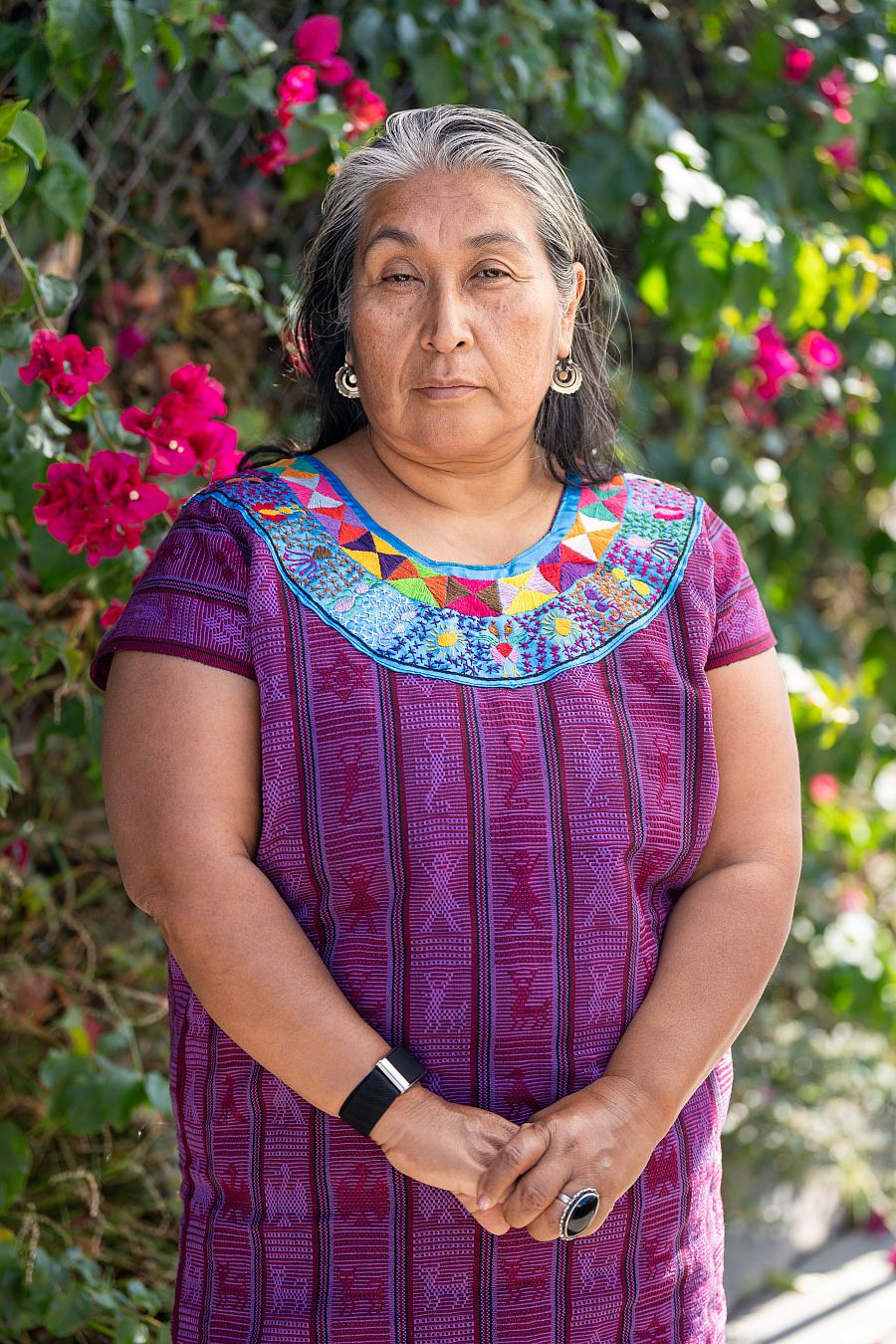
Odilia Romero, líder de la comunidad oaxaqueña en L.A.
Odilia Romero, co-founder and executive director of CIELO in Los Angeles.
CIELO
“As interpreters, we are the bridge of communication,” said Romero. “There are prejudices against indigenous people already, now add what's going on, people are afraid to step foot in a clinic and are afraid to say they speak another language. And they just agree to anything”.
Overall, indigenous populations in the U.S. access healthcare at very low rates, due to factors like their undocumented status, discrimination, language, cultural differences, and unfamiliarity with U.S. medical processes and terms, hindering indigenous migrants' access to health care services.
Discrimination of Indigenous Communities
Angel Cruz, an Indigenous Oaxacan artist from Los Angeles, agrees that there is a lot of discrimination towards indigenous people. When he was younger, he recalls being called “indio” or “paisa” for not speaking Spanish, only Zapoteco, and said many other community members face this as adults, too.
“People know they will be treated differently the moment they speak, and also there’s a lack of education and outreach; people don’t know where to go,” he said. “This stops many from going to a doctor, and instead they rely on home remedies to cure their illness, which sometimes only worsens their conditions.”
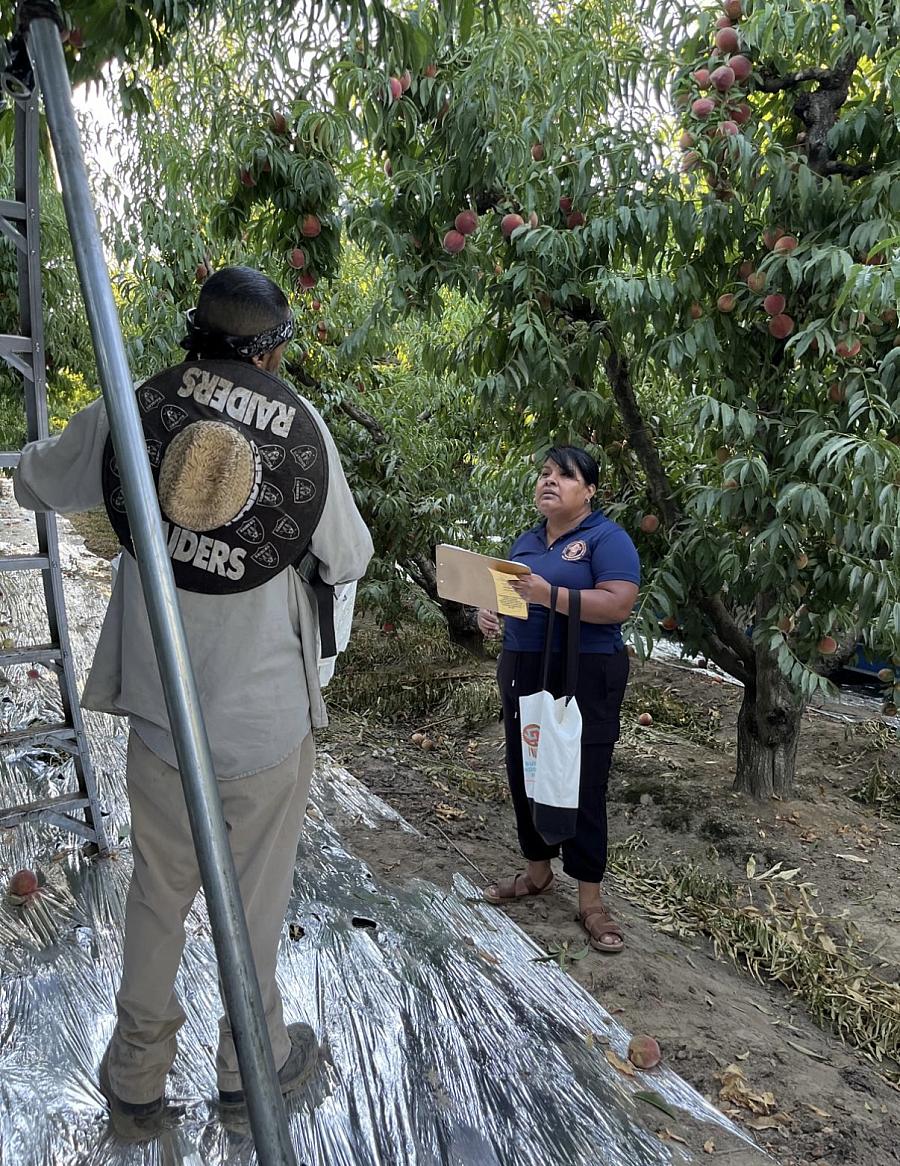
Organizers from Centro Binacional para el Desarrollo Indígena Oaxaqueño are conducting their annual in-person outreach with indigenous farmworkers.
Alicia Acevedo
A study on indigenous farmworkers showed that only 9% of indigenous Mexican immigrants have health insurance; 60% of indigenous migrant women have never seen a doctor in the US. For urban Oaxacans in LA? We don't even have the data—they're aggregated into "Latino" categories, making their needs largely invisible.
“There’s no current official count of which languages are really present; the numbers vary, and many are excluded from those counts when their only options on a form are Latino or Hispanic,” said Teresa Morales, health coordinator for Centro Binacional para el Desarrollo Indígena Oaxaqueño (CBDIO).
“We have seen cases where they go, finally get their interpretation, but the interpreter is not the correct variant, so they have to wait until they get a proper one, which only delays treatment, and the patient's health gets worse by the day. We’ve also seen people who go to an emergency room, and usually at hospitals, they give them a tablet to get an interpreter, but it can sometimes take a long time, and in an emergency setting, that can be life-threatening,” she added.
CBDIO is a California-based non-profit founded in 1993 that focuses on language justice, cultural rights, health equity, and advocacy for indigenous peoples, including Mixteco, Triqui, and Zapotec speakers, among others.
Morales said that through their own on-the-ground outreach, they try to identify the different languages spoken in their region, but she said the task shouldn’t rely on one sole organization.
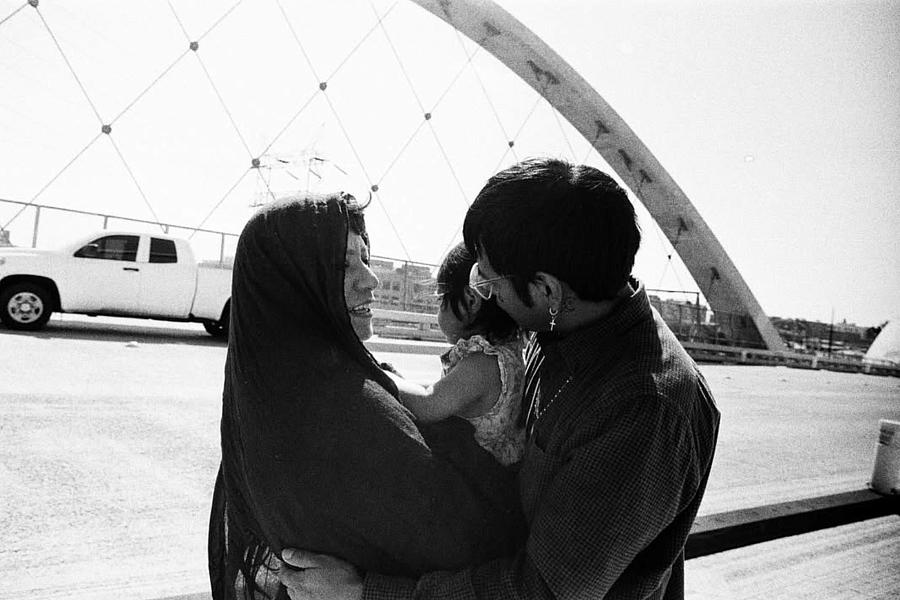
El artista Ángel Cruz, su esposa y su hija posan en el puente de la Sexta Calle de Los Ángeles.
Artist Angel Cruz, his wife, and his daughter pose in L.A.’s Sixth Street Bridge.
@phranks.photography
What’s Lost In Translation with Mental Health
Similar barriers prevent folks seeking mental health services from getting the care they need as well, according to Oaxacan therapist and co-founder of L.A.’s Oaxacali Run Club, Mirna Martinez. They, too, have seen their clients and community members confronted by these language limitations in their field and offices.
While she herself does not speak an indigenous language, she has been an advocate for people seeking help. On one occasion, she recalls the receptionist calling her over to speak to a woman she had assumed was speaking Spanish, but who was in fact speaking Kʼicheʼ, a Guatemalan language.
“I called CIELO, but if it wasn't for me being there and knowing about resources like the ones at CIELO, my co-worker would not have known what to do, and that call would have gone nowhere,” said Martinez. “I soon realized how important it is to have representation in these spaces.”
She explained that when someone is in therapy, language is of utmost importance; it’s how they express their emotions and most clients feel comfortable sharing their life story and struggles in their primary language.
“If I can make someone feel seen and comfortable, that’s where the healing is able to begin for our clients,” said Martinez. “It starts with how we communicate with each other. If they can’t do that, they won't be able to fully take advantage of the resources that are available to them.”
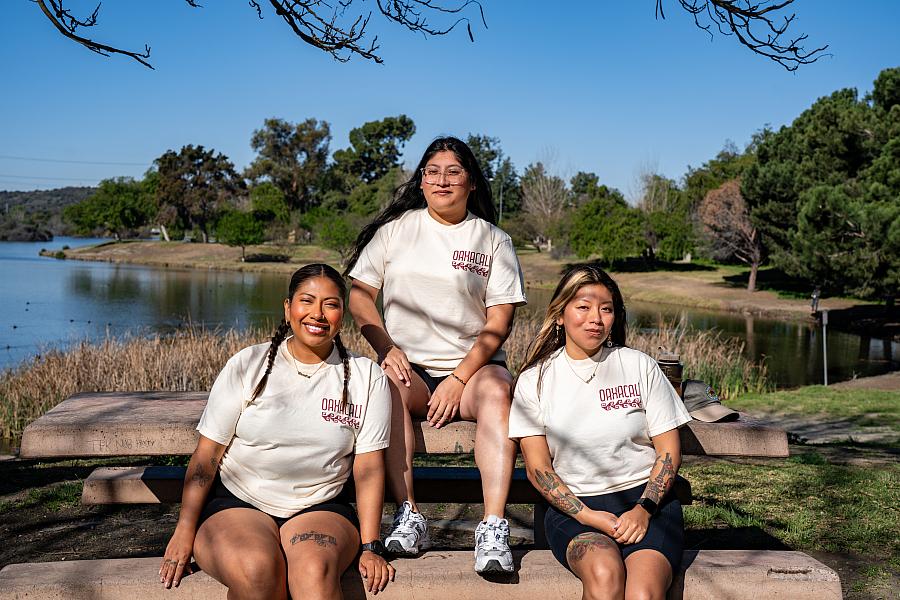
Las cofundadoras del Oaxacali Run Club de Los Ángeles, Mirna Martínez (derecha) y Reyna Chabeli (izquierda), posan con las camisetas recién diseñadas del club de running.
Co-founders Mirna Martinez (right) and Reyna Chabeli (left) of Oaxacali Run Club in L.A. pose with their newly designed run club t-shirts.
Oaxacali Run Club
When Coverage Disappears
Community members are also facing additional barriers due to federal funding freezes, including a lack of funding for secondary services such as translation and the loss of their healthcare.
Dr. Seciah Aquino, executive director for the Latino Coalition for Healthy California, said the freeze is one of the biggest barriers communities are facing right now. Aquino said the community is facing many challenges due to the immigration raids, and while on one hand they have seen a decline in patients coming in for regular checkups due to fear, he is also seeing patients who rely on medication – and have underlying illnesses – seeking out care more than ever.
“We see they are utilizing their coverage more because of the fear of what will happen after they lose access to it,” Aquino said over the phone. “It’s extremely dangerous to lose access; it’s life or death for some. We’re going to see an increase in health disparities.”
The Challenges of Child Interpretation
L.A. County has a language access plan that provides translation services and in-language outreach in multiple languages, and works alongside groups like Comunidades Indígenas en Liderazgo (CIELO), which provides translation services for over 30 indigenous languages to 27 states. Even then, gaps need to be filled in clinical settings — and under the current political climate, those gaps are widening, not closing.
When asked whether translation services for medical assistance for CIELO have increased since Trump took office, Romero told me the opposite has been the case. Fewer people are seeking care, and when they do, language barriers remain.
“There are people saying it's increased to 200%. That is not true because right now, there are institutions that are not providing interpretation to indigenous peoples. I get more calls from LAPD than from a hospital or clinic,” she said.
Oftentimes, the responsibility to translate falls on the shoulders of children of immigrant parents, who have long relied on their children to translate complicated medical and legal terminology.
“As a child interpreter, I have to tell you that's a huge responsibility you are putting on a child because interpretation is an art and a skill where you need to be trained,” said Romero. “There are legal and medical terms particular to the profession that we don't use in everyday life.”
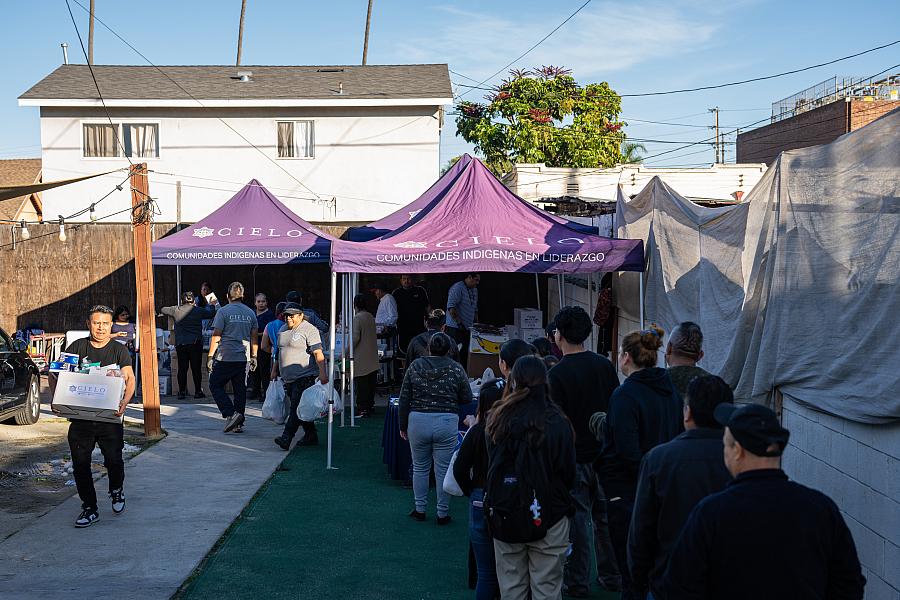
Una de las muchas distribuciones que CIELO realiza con y para las comunidades indígenas de Los Ángeles.
One of the many distributions CIELO does with and for indigenous communities in Los Angeles.
CIELO
One example she gave was the use of the word cholesterol; in Spanish, it's colesterol, but in the many indigenous languages spoken by Oaxacans, that word does not exist. However, she said that’s when interpretation services come into play: a term like "high cholesterol" isn't translated into a single word; its definition is explained in full.
Romero explained that while there has been a decrease, that doesn’t mean there isn’t a need. Therefore, CIELO, in an effort to identify gaps and fill them to provide services more quickly, has been working on an app that they hope will speed services for providers. They’ve been working on the app for the last 3 years, and in the next month or so, they will introduce it, allowing institutions to sign up for interpretation services more quickly and on the go.
We know that the need is there. There are language rights violations all over. There has to be a shift in people's minds that language is a fundamental human right.
Odilia Romero
Policy Coming Down the Pipeline
In the state of California, there have been some strides to improve access to interpretation services and to identify the languages spoken in the state, like the introduction of SB 1016, the Latino and Indigenous Disparities Reduction Act, which requires detailed, specific, and anonymous tracking of ancestry, language, and health outcomes to address disparities for specific communities.
Dr. Aquino said that they have also been working closely with Senator Maria Elena Durazo and have introduced SB1422, which seeks to reverse the enrollment freeze for undocumented Californians.
“The Medi-Cal freeze is one of the largest barriers. It’s something that directly affects access, so we’re asking for that freeze to go away so folks can continue to have access to care,” said Aquino.
When asked how easy it is for a patient to consent to a procedure they don’t understand, Romero said it all starts with the initial check-up. She said that when asked to raise the arm or leg that hurts, patients may only understand that they need to raise something and will often raise the wrong arm. Without proper communication, that could lead to being misdiagnosed.
“This leads to what we call language violence,” she said. “You are going to end up in a surgery that you didn't realize you approved, or where they don’t understand what will be done to them. The process of human rights violation begins from the person at the reception desk, because there is an assumption that anybody who comes from Mexico speaks Spanish.”
As we walked away with a few scoops of leche quemada (burned milk) ice cream from one of the markets along the Oaxacan Corridor, the sweetness couldn't quite mask what lingered — the fear, the uncertainty, and the quiet resilience of a community that knows it has always had to fight to be seen.