

'We're All Connected’: LA's Only Native Health Clinic Opens Its Doors to Immigrants
This story was produced in collaboration with News from Native California as part of the 2026 Ethnic Media Collaborative, Healing California.

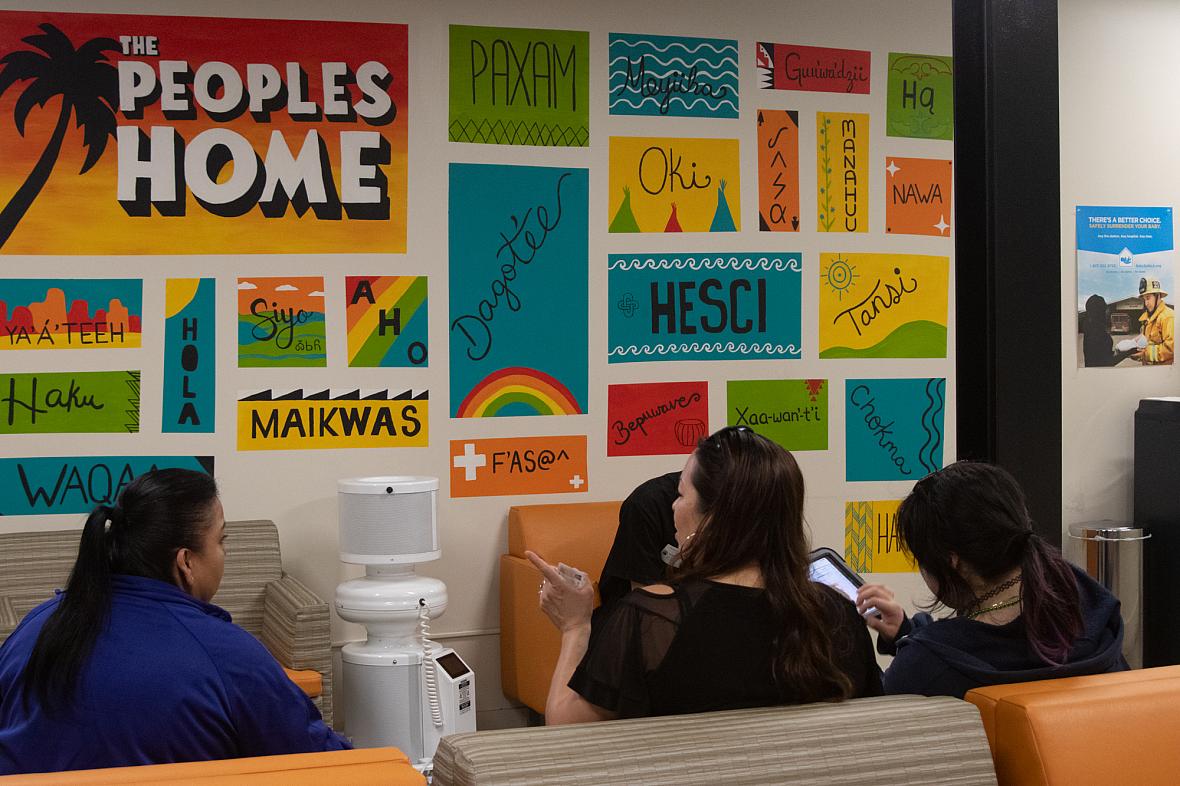
Patients at United American Indian Involvement (UAII) in Echo Park speak with a volunteer health advocate ahead of their appointment in the lobby of the UAII headquarters.
Shaylyn Martos
In 1974, Native Americans recently relocated and in need of help could look for the angel wings painted above the entrance of United American Indian Involvement (UAII) on Indian Alley. Located at 118 Winston Street, near Los Angeles’ Skid Row, people could receive help with substance abuse counseling and workforce assistance, knowing that they were safe in the hands of founders Marian Zucco (Paiute) and Babba Cooper (Lakota).
UAII now operates several healthcare clinics across LA and Southern California — offering comprehensive healthcare, dental and mental health services — with their headquarters in Echo Park. Following crushing cuts to federal funding for Indian Health Services (IHS) and the ongoing supercharge of arrests, kidnappings and deportations of undocumented people, UAII determined it was unsustainable to only serve the urban Native population and in September, opened their clinic doors to everyone.
UAII’s new structure offers two separate divisions: healthcare and community programming. The healthcare division accepts private insurance and MediCal, as well as sliding scale services. The community programming is still exclusively for AI/AN people, offering help with job training, housing, childcare, traditional ceremonies, and more.
“We have had to change the populations that we have served historically,” said Hope Craig-Curlew (Mvskoke), the Board Chairwoman and President of the Community and Outreach Division. “We aren’t going to survive just serving the Indigenous population — we must diversify our revenue to sustain our services.”
How Did We Get Here, Where Are We Going?
What we now know as LA is the occupied land of the Gabrieleno and Tongva tribes of the Los Angeles Basin. But following the Urban Relocation program that launched in 1948 — which evolved into the Indian Relocation Act in 1956 — more than 30,000 of the 155,000 relocation participants chose Los Angeles, solidifying the city as the “urban Indian capital of the United States.”
Currently, Los Angeles County boasts the largest population of Native Americans in the United States but has only one Urban Indian Organization contracted by IHS — UAII — to serve more than 170,000 Native folks who call the City of Angels home. More challenging still is that 75% of the AI/AN population lives in urban areas, but urban AI/AN healthcare receives only 1% of IHS funding.
Clinics funded by IHS are restricted to providing health care to registered AI/AN tribal members, or to people who share a home with registered tribal members. The fact that only 109 tribes in California are federally recognized keeps dozens of non-recognized tribes from receiving care through IHS.
The contracts with IHS are competitive, and not guaranteed for even storied nonprofits like UAII. And while the Native population in Los Angeles is vast, the communities where their clinics are located are majority immigrant populations — like their Echo Park headquarters, mere blocks from the city’s Historic Filipinotown.
With the huge increase in Immigration and Customs Enforcement (ICE) presence and the new administrative requirements and conditions on eligibility for Medicaid, immigrant populations in urban areas are avoiding going to the doctor until it is absolutely necessary.
Under H.R.1, passed in July 2025, Medi-Cal eligibility status will hinge on narrowed definitions of immigration statuses, work and community requirements, and eligibility checks every six months beginning January 2027. Not understanding these changes, as well as their deadlines, could result in a loss of coverage for thousands.
“The immigrant population right now is very timid to come out to the clinics and we're able to provide that transportation for them,” said Danielle Hernandez, UAII clinic manager. “If they do not want to share their information with Medi-Cal or with any government agency, we're able to provide a sliding fee scale here, and they're able to receive services at a reduced cost.”
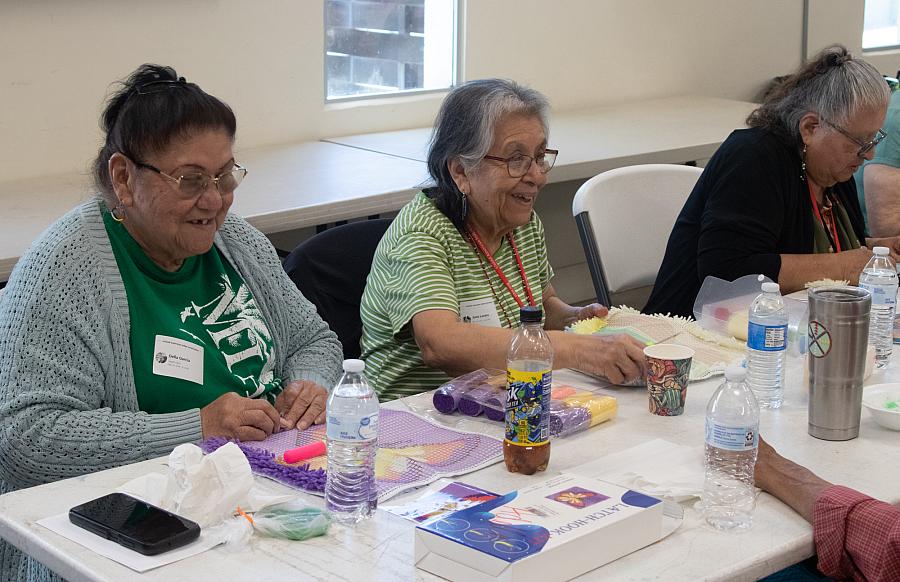
Members of the Elder group at UAII joke while working on their crafts on St. Patrick’s Day at the Echo Park headquarters.
Shaylyn Martos
The team at UAII is in a unique and precarious position; they need more funding to keep their doors open, continue to provide cultural programs and pay their staff fairly. And while their clinics can offer culturally competent care to the AI/AN population, they can also provide a safe space for immigrant Angelenos whose stories mirror those of displaced Natives who relocated to urban areas.
According to Craig-Curlew, since restructuring in September, UAII has seen an increase in their patient population and in the diversity of the patients they see in the clinic.“As Native people, we have a responsibility to take care of our communities,” she said. “Because 70% of us live off our reservations, that means taking care of everyone in the community.”
ICE activity continues to disrupt the daily lives of the patients who come to UAII; to combat the fear and prepare for the worst, the entire team received training in what to do if ICE tries to get into the building.
The first instance the team had to put that training to use was when they received an alert from their sister location, the Boys and Girls Club, that unmarked ICE vehicles were spotted in the area.
“As soon as she came out of her appointment, we mentioned to her that we had an alert,” said Danielle Hernandez. “She immediately was concerned, and she said she didn't want to leave.”
Hernandez, a Spanish speaker, was able to determine that the grandmother had come by bus and that she didn’t have a cell phone. The team contacted her family, but no one was available to pick her up.
“Luckily, we have drivers here at UAII,” Hernandez said. Their driver took the grandmother home and walked her all the way to her door. “We ensured that everything was okay with her, and they were very grateful. The daughter called back and said, ‘Thank you so much for walking her all the way to her house.’”
A Day in the Life at UAII
Darlene Ayala, UAII Director of Community Engagement and Resource Development, took me on a tour through their Echo Park facility on St. Patrick’s Day. Every department had the characteristic white walls and fluorescent lighting, but they were balanced with warm accents and Native-inspired graphic elements, decorated with donated work from Native artists.
Ayala took me through the People’s Store, where anyone, regardless of membership to UAII, could sign in to pick up necessities — from diapers to groceries and used clothing. They also take supplies to Skid Row in Los Angeles to try and reach unhoused folks directly.
“That's where we started, with the streets of Skid Row. And so we're really trying to bring it back to the roots of UAII and how we came about,” Ayala said. UAII also produced a short documentary film that highlights that work addressing the issues caused by the Indian Relocation Act of 1956 called “People’s Home,” which they are showing at college campuses around the area.
“The folks that are within our film, our elders who went through that process, shared their story of what happened and how — and how they met,” said Ayala. “Because they're from two different tribes, but they got married. It's such a great story.”
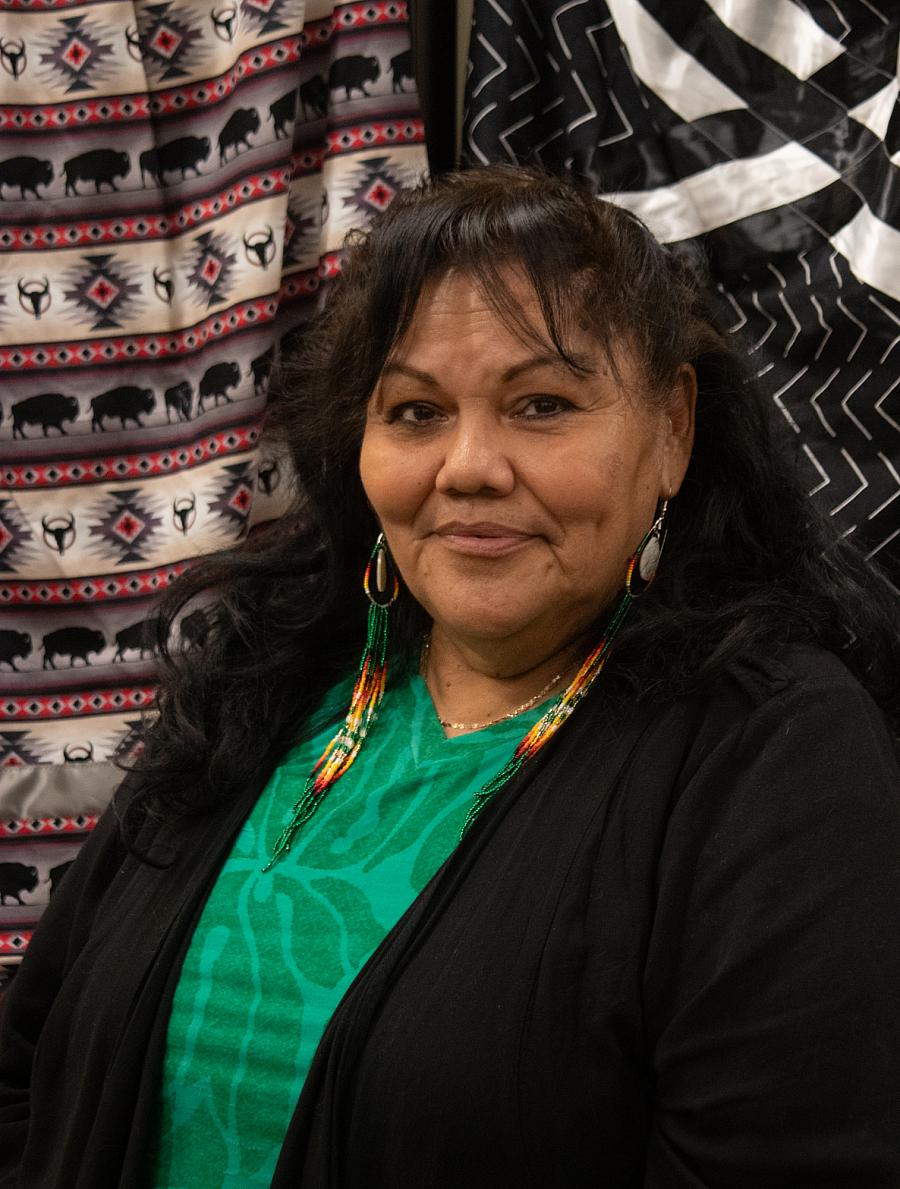
Pearl Dayzi (Navajo) first learned about UAII at 14-years-old, when she used to pick up her uncle from services after her family relocated. She’s been a patient and volunteer for the past 30 years.
Shaylyn Martos
In the community room, the weekly elder’s group was watching “The Irish Wish” while working on their art pieces, most of them decked out in green.
Pearl Dayzi (Navajo) wore a green floral shirt that matched her beaded earrings. Dayzi’s parents moved to Los Angeles in the ‘60s to find work. She first learned about UAII at 14-years-old, when she used to pick up her uncle from Indian Alley when he was receiving care for substance abuse.
“Being 14, hanging around Winston Street and the center, and I see [what] my uncle’s going through because they were relocated,” said Dayzi. “They had no job, and they went through alcohol and drugs. [UAII] provide food for them, provide treatment, help. When my uncle got a job, I'm glad they got him out of the street. That was really a blessing.”
Dayzi has fundraised for UAII through cooking her Native foods for 30 years, and she was a board member from 2019-2021. She left the board when her mother passed, and now she cherishes the moments she shares with members of the elder group that remember her mother from years before.
Dayzi shared that folks who are Native without the proper identification can miss out on services that only registered tribal members can receive. So access to culturally congruent healthcare for non-recognized tribal members mirrors that of immigrant populations looking for safe clinics.
“A lot of the people are Native, but they have to go back to prove that they're Native. Their paperwork, their tribal ID, a lot of them don't have it,” Dayzi said.
You have to go back to your home and try to get a paper, but it's very hard. I’m lucky I registered my kids, so now they have a tribal paper that they're half Native. Pearl Dayzi
Dayzi said that she has noticed some people in her community are troubled by UAII welcoming patients of different ethnicities, but they may not know how to express that. “Maybe that's why they just don't say anything,” she said “And I tell them, ‘You gotta speak up if you feel uncomfortable.’”
This tension is something the clinic’s staff is learning to negotiate. Stephanie Allen (Wailacki Tribe of the Round Valley Indian Tribes), the Nurse Manager at the Echo Park facility, came on board in August just weeks before the restructuring took effect
“Regardless if you are insured, uninsured, we will work with you,” Allen said. “We can refer you to housing if needed, we can refer you to workforces if needed. So regardless of the ability to pay, health care is a human right.”
Providing this care amid consistent cuts to MediCal has not been easy. UAII has drawn down $6 million in discretionary savings over the past six months.
“They just had to shut down seven clinics throughout LA County because of budget cuts. We're no different,” said Hope Craig-Curlew. “Kind of the direction that we are all going into is after private dollars from foundations to help offset some of the financial gaps that we're all experiencing.”
The team recently closed on a lease for a new space in Palmdale where a new child care center is slated to be built. Despite the city’s majority Hispanic population, the childcare center falls under community programming — not healthcare — and Craig-Curlew emphasized the new space will not include immigrant clients, but will serve all Indigenous peoples, not only Native AI/AN tribes.
For those working day in and day out with patients, the restructuring is deepening community ties.
“Most of the time it's kind of funny,” said Stephanie Allen. “We have the division, but when we have patients and clients coming in to see our physician for any reason, immigrants end up using the community services as well. We're still all connected.”