

In an age of fracture, Manuel Pastor makes the case for connection

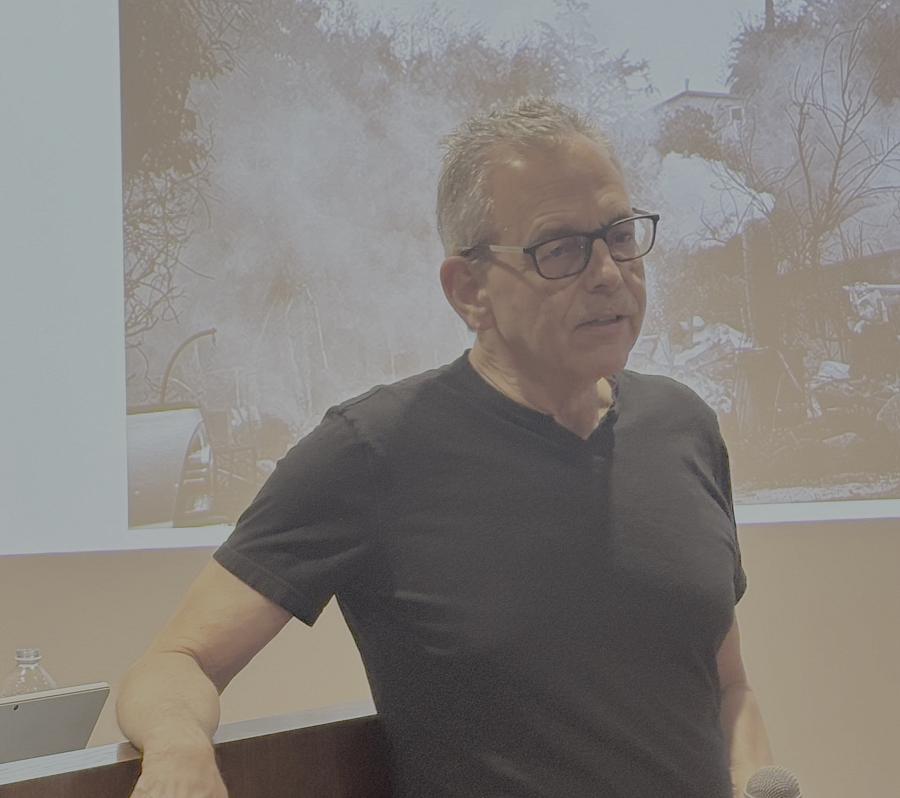
Maneul Pastor, a sociologist and director of the USC Equity Research Institute, spoke last week to Fellows attending the 2026 California Health Equity Fellowship.
(Photo by CHJ)
In Manuel Pastor’s view, America is caught in a “kind of perpetual crisis” that has been building for the past 20 years.
“I try to think about what it’s like to grow up with capitalism being shown to be broken, with racism shown to be rampant, with democracy currently under threat,” he said. “And the fact that people feel any hope at all is, in fact, somewhat surprising.”
This social corrosion, Pastor argues, is also what makes connection more remarkable — and necessary — in times of disaster, literally and existentially.
Pastor, a sociologist and director of the USC Equity Research Institute, spoke last week to Fellows attending the 2026 California Health Equity Fellowship. He offered a diagnosis of our political moment and shared why, despite all the setbacks, he’s not ready to give up on our national project just yet.
When the Eaton Fire was ripping through Altadena and Pasadena in January 2025, Pastor’s daughter sent him a Ring camera video of flames slowly devouring the street where his duplex sat. Suddenly, the video revealed a neighbor, Arturo, who had lost his own home just three hours earlier, crashing through burning fences and brandishing garden hoses to help beat back the flames and protect Pastor’s home. Pastor’s wife soon arrived at the scene, and he followed shortly after. They spent the day running from backyard to backyard, fighting back fires that kept reigniting.
Pastor says he learned three important lessons that day: Sometimes you have to rush toward the fire. It’s better if you bring your neighbors. “And it’s much better,” he added, “if your government is trying to put out the fires rather than fan the flames.”
This instinct toward kindness and mutual aid is a vital strand of our social fabric, Pastor says, even as tribalism, economic insecurity and the enduring fear of others threaten to undermine that impulse.
“What's happened is that we've shifted from an ethos of ‘There but for the grace of God, go I’ when you see someone in worse economic circumstances, to an ethic of, ‘Boy, I’m glad that’s not me.’” The fact that we tolerate so much homelessness is a reflection of our social divide.
Beneath the current moment of political polarization and social unrest, Pastor argues, lies something older than politics or the presence of any particular administration: the fear of a nation becoming unrecognizable. Beginning in 2045, non-Hispanic white Americans are no longer projected to make up a majority of the U.S. population — and for some, that demographic change is not progress, but a loss.
But California, Pastor argues, has already lived this story of change. One in five Los Angeles County residents are either undocumented or live in a mixed-status family. “About 75% of undocumented immigrants in LA County have been here longer than a decade,” he said. “They are deeply rooted. The reaction here to ICE was to be expected.”
Between 1980 and 2000, as the state’s non-Hispanic white population fell from 67% to 47% and its Latino population surged, there was a strong backlash that culminated in Proposition 187 — a measure to deny public services to undocumented immigrants that was later struck down in federal court — the curtailing of bilingual education, three-strikes laws and the mass criminalization of Black and Latino youth.
“California gave a preview to the country of the dislocation that happens when there’s rapid demographic change,” Pastor said.
It’s projected that by 2050, U.S. white residents will have fallen from 80% of the population in 1980 to 48%. In Los Angeles, that future is already here. The county is 48% Latino and projected to hit 56% by 2060.
Despite these sweeping demographic changes, Pastor reminded the fellows that this story is not just about immigration. Current anti-immigrant fears, Pastor argues, are less about immigration policy than about what immigrants represent — a country in the throes of becoming something new.
Statistically, most of America’s demographic evolution is being driven not just by new arrivals but by the U.S.-born children of immigrants already here. “People are not scared of immigrants,” he said. “They’re scared of their kids and scared of the transformation of the country.”
Pastor, for his part, refuses to let those fears have the last word. “All I can think,” he said, “is that the rest of the country will soon know the joy of a Korean taco truck. And there can be little wrong with that.”