

Beyond the Bubble: Finding hidden health stories of Indian immigrants

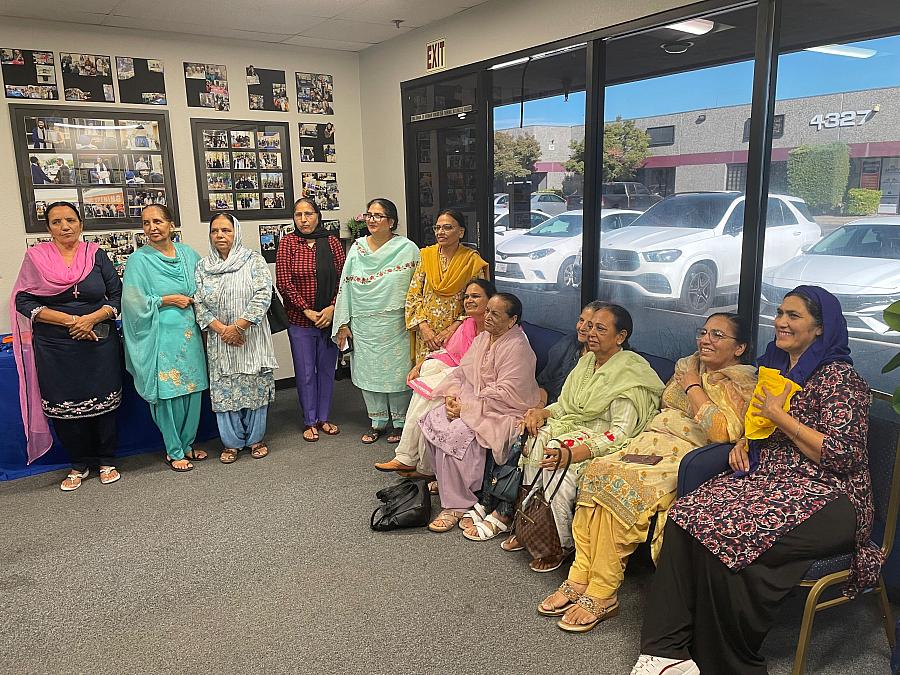
Community members attend a listening circle at the Khalsa Community Center, a Punjabi-Sikh mental health and cultural center in Fresno.
(Photo by Tanay Gokhale)
Last year, I came across a statistic that jumped out at me. In the United States, Indians were the third-largest undocumented immigrant population group, after people from Mexico and El Salvador. I had known that there had been a steady increase in the number of Indians arriving at U.S. borders, but the estimate of 725,000 undocumented immigrants stood out to me.
As a community reporter for Bay Area-based India Currents, I recognized that I lived and worked in a bubble. The Indian diaspora in the Bay Area presents itself as a wealthy, well-educated community that sustains the tech industry and contributes to the cultural heritage of the Bay Area through talented artists, musicians, dancers, and filmmakers. However, just a few hundred miles inland, thousands of undocumented immigrants are working two shifts a day in farms, meat-packing units, corner stores, gas stations, and as truck drivers.
Many of my Latino colleagues at other news outlets were reporting on important stories of undocumented immigrant groups from Latin America, but I had not seen much reporting about Indian undocumented immigrants. That’s why I wanted to focus on the health needs of undocumented Indian immigrants in California for my recent reporting project, supported by the California Health Equity Fellowship. When researching issues to report on, it is helpful to consider elements of your community that, for reasons like geographic separation, lack of advocacy, language barriers, or political forces, have not received their due in mainstream media.
At the fellowship conference, my senior fellow, Ruxandra Guidi, encouraged me to broaden my reporting proposal. She pointed out that framing my health reporting as an “undocumented immigrant issue” from the outset might limit the responses I get from sources, especially given the political climate. Moreover, an individual’s visa status is not the only factor influencing a community’s health issues. Cultural factors like literacy, trust in health care institutions, language barriers, and faith also play an instrumental role. The brief for me was to speak to as many people and follow as many threads as I could, to narrow down my reporting focus.
Back in the Bay Area, I went about reporting my first story, which I’d already decided would be about the role of gurdwaras as resource hubs for Sikh immigrants. Rux’s words rang true as I uncovered health care access gaps among first-generation Sikhs. Conversations with community leaders confirmed my hunch that among this community, problems in accessing health care stemmed primarily from language barriers. I learned that first-generation Punjabi-speaking Sikh immigrants — regardless of their immigration status — hesitated to seek care from English-speaking medical practitioners operating in a medical system that was completely different from South Asian health care systems. This revelation emerged as my north star to shape reporting for my second story.
The ability to remain open to changing my original reporting proposal — from reporting on undocumented Indian immigrants to first-generation Sikh immigrants — proved crucial. I reckon most fellows go through a similar process, and in hindsight, though it felt daunting to chase multiple threads without hammering down a clear focus, I think it was the right approach to take. But reporters do need guardrails within which they can explore, and I found that my senior fellow was a great resource in that department, acting as an objective voice of reason and keeping me on track.
Rux wasn’t the only senior fellow I relied on, either; veteran health care reporter Emily Bazaar was kind enough to speak with me when I ran into a problem reporting on the second story about language barriers. I was hearing from Sikh doctors running community clinics that the community’s health needs were rising, and there were not enough culturally competent resources to meet those needs. But I was looking for data to back that up. Emily recommended I look at the Department of Health Care Access and Information (HCAI) databases, and sure enough, they delivered.
I found a datapoint that showed that in California health facilities, Punjabi was not only the most requested South Asian language, it was requested three times more than Hindi, the next-most requested South Asian language. Another helpful tip was Emily’s suggestion that I speak to the folks at HCAI to understand the data. They helped contextualize the data for me and pointed me to other datasets, which I used in my second story. Apart from the datasets, the people who collect and maintain those datasets are a great resource that I encourage all reporters to use.

Journalist Tanay Gokhale attends a tabling event at the West Sacramento Gurdwara on June 1, 2025.
(Photo by Prachi Singh)
My third story, about a Sikh activist who delivers articles of faith to detainees in ICE detention facilities, was intended to be a profile. However, when I started reporting on it, the focus of my story changed again. Instead of focusing on this one individual, I realized that a more powerful way to tell the story would be to use him as a conduit to tell the story of Sikh detainees in detention centers and the role of faith in their lives.
Finally, a word about the value of showing up in person and putting in the hard yards up front. I am Indian, but not Sikh. I speak Hindi, but not Punjabi. I had reservations about how far I’d be able to get in my reporting because, technically, I was still an outsider in this community. Both Rux and Teena Apeles — the Center’s engagement editor — agreed that validation from the gurdwara would be crucial.
Through multiple in-person trips to the West Sacramento gurdwara, the gurdwara's managing committee warmed up to me and supported my work. That stamp of approval helped break down walls when speaking with other gurdwaras, Sikh community members, and organizations. With Teena’s guidance, I tabled at the gurdwaras to speak to sangat (congregation) members and conducted a listening circle at a community health organization, which became an important aspect of my reporting.
The ripple effect of turning up regularly and keeping in touch with my sources throughout was that, towards the end, my sources would reach out to me unsolicited with tips and suggestions for people I should speak to, making my job much easier.
Looking back at my project, my reporting stands as a testament to the age-old journalism axiom: “To tell the community’s story, you need to go where the community is.”