

Community engagement helped this reporter tell a deeper story about what transportation means for health

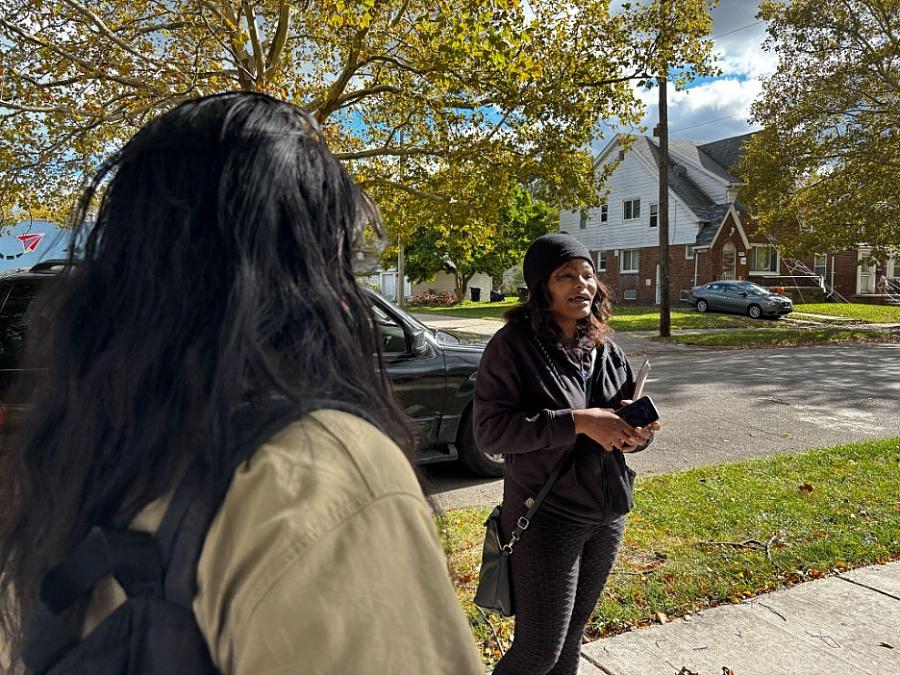
Residents raised key issues about transportation barriers and health care access.
Photo by Teena Apeles/Center for Health Journalism
On a frigid night in November 2024, I watched a handful of transit activists huddle outside the entrance of the Northwest Activities Center in Detroit. I was there to write about the activists’ continued demands for the city to improve its bus services.
As the cars cruised into the parking lot, I approached Rochella Stewart, a retired Detroiter and transit activist living with chronic lung disease. That night, Rochella told me about her challenges with public transportation. She worried about waiting too long at a bus stop in chilly weather. Exposure to cold air could lead to breathing problems.
I knew access to transportation was a social determinant of health, or a non-medical factor that can shape a person’s health and well-being. That night in the Detroit cold turned an abstract concept in my mind into a troubling reality. I’d later find echoes of Rochella’s predicament across the city.
How many Detroiters like her struggled to reach hospitals, clinics or pharmacies because of unreliable transportation? How did this chronic problem affect their ability to achieve better health, be active in their communities and thrive?
Transportation barriers create hardships
Over the last few months, I documented how transportation barriers, from not having access to a working car to inconvenient public transit, affect Detroiters’ access to health care. I spoke to multiple patients and clinicians from different corners of the city, who told me these barriers create problems that go well beyond missing medical appointments.
“Everything I do in my life revolves around, ‘How am I going to get there?’ That creates anxiety in every facet of your life,” said Fallon Wilson, a 43-year-old childcare worker from the city’s east side, who struggles to get to health care appointments without a car.
“It's super hard. I am not married. I don't have kids yet, so I'm, like, my sole provider,” said Deanne Austin, a 39-year-old political organizer from the city about the transportation struggles she faces. She lives with polycystic ovary syndrome and anemia and doesn’t drive. She used to rely on her grandmother to take her to doctor’s appointments before she passed away and now pays for rides to get to her doctors in the suburbs.
Unable to drive, 35-year-old Britian Jemison faces constant hurdles getting to a clinic on Detroit’s east side and a pharmacy in nearby Hazel Park to help manage the discomfort he feels from a spinal cord injury. He said he doesn’t want to ride a city bus either, after falling out of his wheelchair when a driver hit bumps in the road. He’ll use money from his Social Security payments to pay for rideshares, which adds up to $70 to $160 a month. That’s a financial burden.
“I try to make sure I keep enough money to make it to my doctor's appointments. But that's hard,” Jemison told me. If he can’t retrieve his medications, his chronic pain and anxiety flares up.
Symone Wilkes, a 34-year-old mother from Detroit’s west side, needed her car to take her sons to primary care, immunizations, or the dentist, but it kept breaking down. She also drove to see a therapist for her anxiety. Wilkes tried to get her car repaired using a $700 grant, which she received after completing a financial literacy program, but struggled to find a mechanic who would accept the grant as a form of payment. “It has caused me so much hardship,” Wilkes said of her car troubles. Last month, her car broke down for good, and she’s trying to save up to buy another with the modest income she has.
Creative strategies to connect
I wouldn’t have been able to tell all these stories without using community engagement as one of my primary reporting methods. I was one of the center’s engagement grantees, and their support, along with Nina Ignaczak, Planet Detroit’s founder and editor, helped me find more creative ways to meet residents.
Deanne and Fallon responded to an online survey, which Nina helped design and build. The survey specifically asked for resident perspectives on how transportation barriers had affected their health care access. Their thoughtful responses led me to contact them.
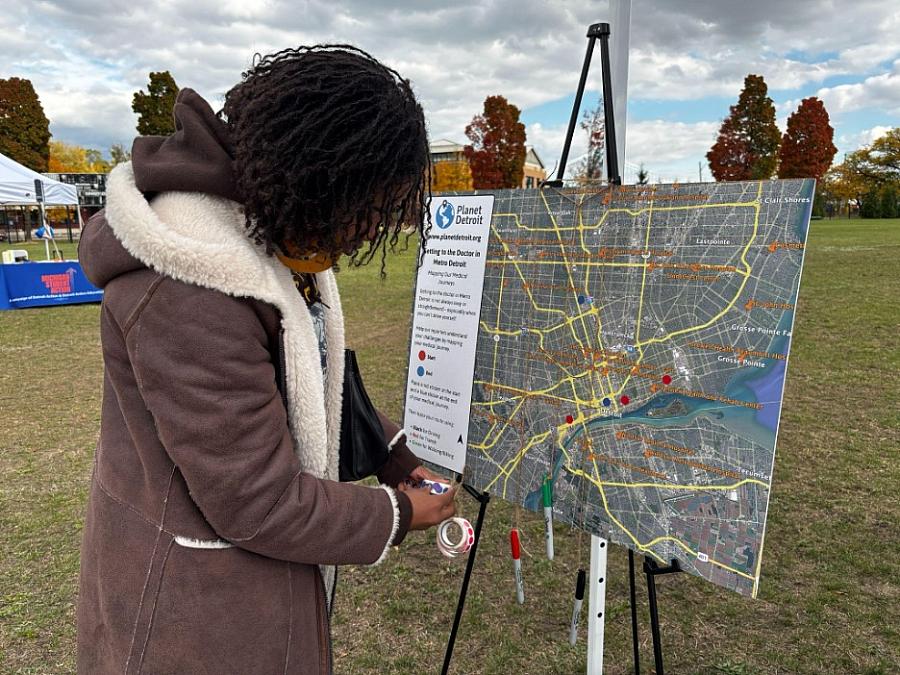
Residents mark on a map of Detroit how far their commutes to health care destinations are.
Photo by Teena Apeles/Center for Health Journalism
I met Symone at a community festival in Detroit’s Clark Park.. That day, two colleagues, Teena Apeles, USC’s national engagement editor, and reporter Isabelle Tavares joined me to set up a table at the festival with the goal of talking to residents about transportation and health, what issues they faced and solutions they wanted. We passed out business cards that detailed specifics about the project and paper forms of the surveys for people to complete. We also told residents about Planet Detroit, the nonprofit news organization that published the fellowship project.
Symone walked up to our table, and I had a short interview with her that afternoon. While we talked, her sons scooped up and ate some candy from the plastic pumpkin I placed in the middle of the table. A few weeks later, I followed up with Symone three more times over the phone. That’s when I learned her car problems had gotten worse. She was overwhelmed but stressed to me how much she wanted her story to be told.
I met Britian during a reporting trip to JAR Primary Care and Wellness in Detroit. Our meeting was not planned; he happened to be there the same day I had interviews scheduled with the staff. In this case, serendipity worked its magic. Being intentional about meeting people in the community was a key guiding principle throughout the reporting process. I remembered Britian said something similar to what Symone had told me; he wanted people to know his story and how serious transportation barriers in the city are.
Deanne, Fallon, Symone and Britian provided crucial details and insights about their experiences that surprised and challenged my initial thinking. It’s clear a more robust and reliable public transportation system could certainly benefit the city overall, but it’s not an all-encompassing solution. Some people cannot or will not ride the bus, whether it’s because of physical limitations or safety concerns. Future reporting on this issue should account for individual needs and preferences for transportation and its implications for achieving health equity goals.
The residents also helped outline some other key issues related to transportation and health care access, including the limited number of transportation benefits offered in health insurance plans and the need for more programs that provide transportation support beyond older adults.
For me, effective community engagement is not transactional, extractive or quick. It is about entering conversations with humility and treating folks with dignity and a sense that they are the best experts when it comes to the issues impacting their lives.
Community engagement helped define some of the main issues within this emerging beat. My hope is these stories will help advance the public’s understanding of transportation barriers to health care access and provide a blueprint for reporters to replicate a similar project in the communities they serve. Centering the voices and perspectives of community members brings light to issues that are truly underreported.