

‘Follow the dollars, follow the impact’: APHA’s Georges Benjamin on the crisis afflicting US public health

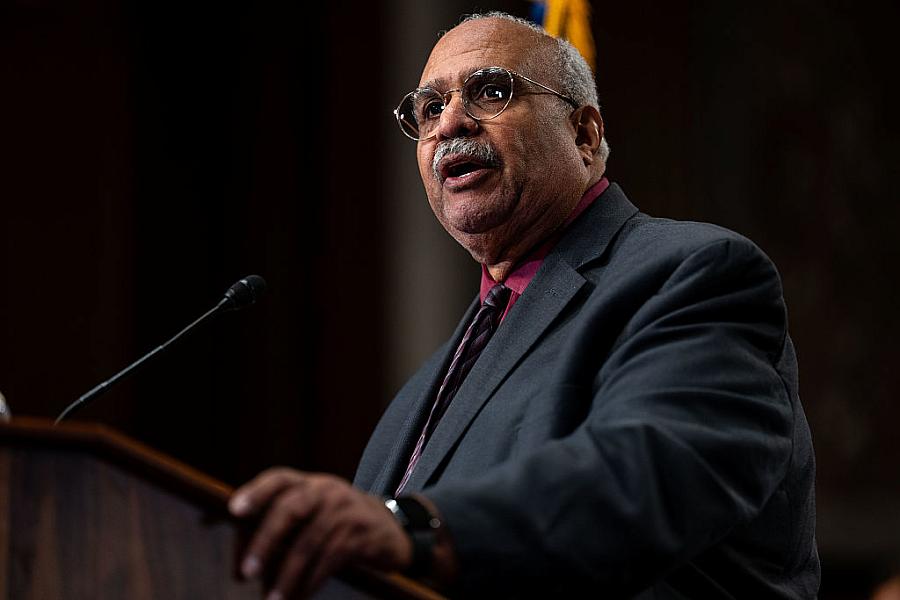
Dr. Georges Benjamin.
(Photo by Kent Nishimura/Getty Images)
Given that the United States spends more on health care than any nation in the world — around $5 trillion annually — Dr. Georges Benjamin asked a simple question to a room of journalists earlier this week: Why are Americans sicker than their peers?
“We spend twice as much as other industrialized nations and we’re at the bottom [on health care outcomes],” said Benjamin, executive director of the American Public Health Association, while delivering the keynote at the 2026 California Health Equity Fellowship, a program of the USC Center for Health Journalism.
In a wide-ranging and at times deeply personal talk, Benjamin laid out a sweeping critique of the U.S. health system, reflecting on decades of experience as an emergency physician and public health official.
He spoke about the inequities and discrimination he observed and experienced as a Black physician working in D.C. emergency rooms. He shared why he feels compelled to stand up to the Trump administration’s attacks on public health programs as the leader of the nation’s largest public health organization. And he emphasized that understanding public health today requires following not just policy debates in Washington, but their ripple effects in local communities.
So why does America spend so much on health care but remain deeply unwell in return? Benjamin pointed to a couple obvious factors: America lacks a universal health care system and underinvests in core social services such as paid leave, child care and housing, he said.
Our health care system is also deeply fragmented. Care, delivery, insurance payments and data are disconnected, driving up administrative costs and creating barriers for patients.
“We spend thousands of dollars just figuring out who to bill,” he said.
There’s also the fact that the U.S. spends notably less on primary care than other industrialized nations, often resulting in problems becoming an acute crisis before patients get treatment. With long delays for appointments, high costs and insurance barriers to accessing a specialist, many Americans use the emergency room as their primary care system.
“You crash your Chevy, we can fix that,” he said, referring to the emergency department. “But we can’t fix a little bit of high blood pressure, a little bit of diabetes, a little bit of mental health problems.”
Benjamin also acknowledged the importance of social factors shaping health, pointing to influences like education, transportation, environmental exposure and systemic racism in determining people’s health and well-being.
“Eighty percent of what makes you healthy occurs outside the doctor’s office,” Benjamin said.
The more fundamental issue, he concluded, is that America does not consider access to medical care a human right. The Constitution promises Americans the right to free speech, religion, press, assembly, due process and equal protection under the law. It does not promise the right to visit the doctor.
While liberals have traditionally seen the government as central to ensuring health care access, conservatives emphasize individual responsibility for health and freedom over medical decisions, said Benjamin. Programs like the Affordable Care Act have expanded coverage in recent decades, but major gaps remain, particularly in Southern states that chose not to expand Medicaid, he noted.
Access to care is deeply influenced by racial and economic divisions. And the legacy of segregation is still reflected in hospital staffing, training pathways and access to medical care.
This was something Benjamin noticed early on in his career in Washington, D.C.
He observed that residents were split up along racial lines at the two main medical centers in the city, he said, with white residents typically working at Georgetown University’s center and Black residents treating patients at Howard University’s center.
He also saw stark differences among membership in the city’s two main medical societies. The American Medical Association was made up of predominantly white physicians, while the National Medical Association was composed of Black and Latino physicians, he said.
The NMA was founded in 1895 because the AMA denied membership to doctors of color, but a century later the racial split between the two groups remained, he said.
While Benjamin did not pull any punches in describing the failures of our public health system, he was also keen to point out the successes he has witnessed over the course of his career.
Advances in treatments for cancer and cardiovascular disease, improved infectious disease control and interventions in the opioid epidemic, for example, have saved millions of lives, he said.
But he argued that progress has been uneven and often undermined by political incentives.
The average public health officer is in their position for only 18 months, he noted. People often come in with a fixed agenda of two to three goals they can reasonably accomplish in that timeframe and tack onto their résumé, decreasing the incentive to invest efforts in long-term solutions.
He pointed to hepatitis C as a missed bipartisan opportunity. With effective treatments available, the disease could be nearly eliminated through universal screening, yet the country has failed to implement such a strategy at scale.
Other challenges, such as the gun violence epidemic and health consequences of climate change, have been largely ignored by Republican administrations as addressing them would run counter to the party’s platform, Benjamin said.
He’s also critical of bipartisan failures on public health communication, such as during the COVID-19 pandemic, when shifting guidance led to mass confusion and mistrust among the American people. He pointed to masking as a prime example, which was initially reserved for health care workers but later became a recommendation for everyone in public spaces.
Communication around public health recommendations remains a major problem, especially with the Trump administration’s backtracking of established guidance on topics such as vaccines, he noted.
As director of the American Public Health Association, Benjamin has spearheaded several recent lawsuits against the administration, challenging cuts to public health research funding, rollbacks of climate and emissions regulations and efforts to freeze federal aid programs. Across these cases, APHA argues that the administration violated federal law by ignoring scientific evidence and undermining the government’s duty to protect public health.
When federal officials moved to cut funding to diversity, equity and inclusion (DEI) programs, Benjamin said his organization felt no choice but to challenge those actions in court.
“If you’re not for diversity, you’re for uniformity. If you’re not for equity, you’re for inequity. If you’re not for inclusion, you’re for exclusion,” he said.
APHA has secured notable court victories to restore funding, but many cases remain ongoing or have faced setbacks on appeal, so the long-term outcomes are still unresolved.
And Benjamin warned that the broader impact of disruptions to research and workforce funding will be both immediate and long-lasting. The administration’s budget cuts have immediate effects, he said, from layoffs of local health workers to disruptions in disease response efforts. He cited an example in which federal funding cuts recently led to health care workers being sent home from a measles outbreak in Texas.
Benjamin closed with a call to action for journalists.
Public health, he noted, was once a niche topic, often relegated to the back pages of newspapers. Today, it’s more likely to be front-page news, but coverage still often misses the deeper structural inequities driving disparate health outcomes.
He encouraged reporters to build trust in their communities and look at how federal policies affect real people. He urged journalists to try to uncover the local consequences of D.C.-level funding cuts.
“Follow the dollars,” he urged. “Follow the impact.”