

The Health Divide: Utilities are turning off the water to struggling homes, but the issue gets little attention

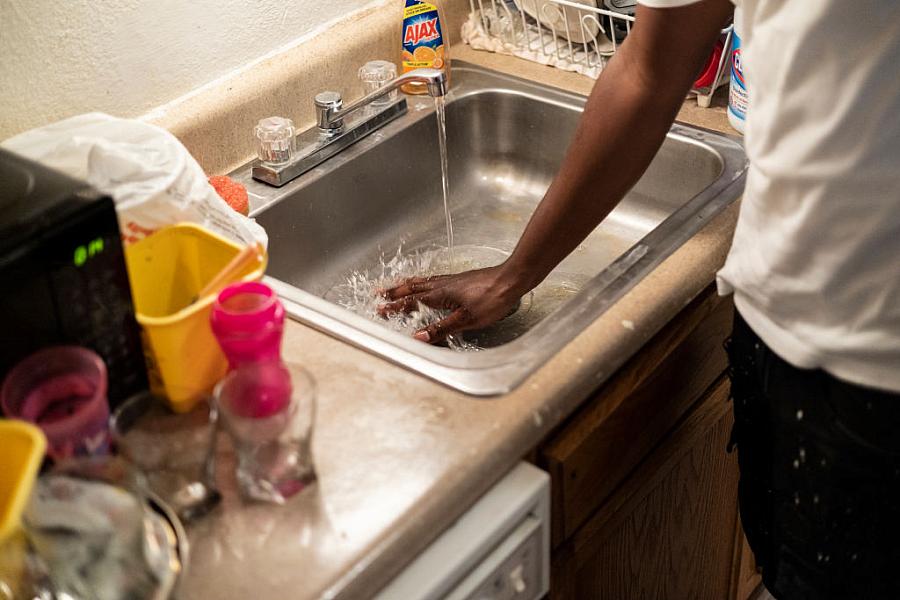
(Photo by Brad Vest/Getty Images)
The Environmental Protection Agency estimates that 12 to 19 million households struggle to afford water. But there are no federal or state programs to help low-income people pay their bills.
“To state the obvious, water is essential to daily life, essential to health, and it's a real public health threat having people shut off from drinking water,” said Larry Levine, director of water infrastructure and a senior attorney at the Natural Resources Defense Council (NRDC).
In New Jersey, more than 57,000 water shutoffs were reported over four years ending in 2024, an NRDC analysis showed. And that number vastly understates the magnitude of the problem.
Although the state has the nation’s strongest oversight, requiring utilities to report shutoffs and other affordability data monthly by ZIP code, New Jersey’s hundreds of publicly owned water systems were spotty about complying. NRDC found comprehensive data only from the four main private water utilities that collectively serve 35% to 40% of the state’s population.
That data showed shutoffs were concentrated in a small number of ZIP codes, which are disproportionately lower-income neighborhoods with large Black and Latino populations.
Camden, the state’s poorest city and only its 15th largest, experienced the most shutoffs: 2,627 over the four years studied, or 45% of the city’s residential accounts. And the problem is growing. New Jersey American Water, the state’s largest water system and Camden’s provider, more than doubled shutoffs across the state in 2025, according to NRDC.
In Kentucky, Appalachian Citizens’ Law Center found that 114 water utilities reported 57,000 water shutoffs in 2024. Those utilities represent less than one-third of water companies across the state. As in New Jersey, the data suggest a much more widespread problem. Most of the utilities studied cut off households for overdue bills of less than $50, then slapped on penalties that customers have to pay to get the water turned back on.
“We think it unnecessarily harsh, especially given that shutoffs can then hugely increase the amount that customer owes through late fees, disconnect fees, and reconnect fees,” said Rebecca Shelton, the report’s lead author and the law center’s director of policy.
Drinking water nationwide has been cheap historically. But federal investments in water infrastructure have steadily declined — from 63% of all capital spending in 1977 to 9% in 2017, according to the American Society of Civil Engineers.
To state the obvious, water is essential to daily life, essential to health, and it's a real public health threat having people shut off from drinking water. — Larry Levine, director of water infrastructure and a senior attorney, Natural Resources Defense Council
That has left states and municipalities to bear most of the cost of maintaining, repairing and updating pipes and treatment plants, many of which are 80 to 100 years old. And in recent years, state and local governments and water systems have scrambled to protect water sources and develop reuse strategies in the face of drought and extreme storms driven by climate change.
Ultimately, mounting expenses are passed on to customers. Water rates have been climbing for the past five years, and from 2024 to 2025 alone jumped an average of 6% according to Bluefield Research, a water sector consultancy. Rates vary significantly across regions, depending on infrastructure age, climate risks, state policies and other factors, so price hikes hit some communities much harder than others. Average monthly water bills in 2024, for example, ranged from $22 in Phoenix to $122 in San Francisco.
Without running water, a home may be deemed uninhabitable. Families may face eviction or liens on their property. Even if service is restored before the situation becomes ruinous, it’s extraordinarily difficult, not to mention unhealthy, to find yourself without a way to wash hands, bathe or clean the dishes.
During COVID, Congress created a temporary program to help low-income people manage their water bills. In a video made by the program, Barry Swift, an Iowa resident who relies on a wheelchair, tearfully described the experience of returning home from the hospital, turning on the tap, and seeing only drip, drip, drip.
“If you don’t have water, you basically don’t have nothing,” he said. “It was very devastating to me.”
There is no water-service equivalent to the 2023 federal law requiring utilities to report shutoffs of gas and electricity. That law revealed that utilities turned off electricity more than 13 million times in 2024, and shut off gas nearly 2 million times, according to The Washington Post.
Someone who can’t pay an electric bill is probably also hard-pressed to pay for water. In fact, the Kentucky study found that water and electricity shutoffs peak at the same times of the year, in early spring and early fall.
A bill introduced in the House would build on COVID-era federal relief by authorizing a new financial assistance program, prohibit water shutoffs and associated fees, and require utilities to disclose affordability data. But the legislation has yet to gain traction.
Several cities including Chicago, Baltimore and Philadelphia, have programs to help households with water payments. Philadelphia’s program, considered a model, caps water bills at a percentage of household income and automatically enrolls many eligible residents through data-sharing with other public assistance programs. Some water utilities around the country also offer help with payments.
Journalists can find out whether such help is available in their communities, and how effective it is. And if no aid is available, it’s worth exploring the consequences. Are there protections against shutoffs if there’s an elderly, disabled or very sick person in the household? Or during extreme heat or a winter freeze?
Only a few states, including Illinois, California and Wisconsin in addition to New Jersey, collect shutoff data. In states that don’t, journalists can utilize sunshine laws and open records acts to request data from publicly owned utilities such as municipal water systems. Privately owned water utilities aren’t subject to such laws but they are regulated by state public utility commissions, which can be a source of information.
Small states have hundreds of drinking water systems, and larger states have thousands, so it’s no small task to unearth enough data to identify patterns. But it’s doable, as the reports from New Jersey and Kentucky show.
And it’s an opportunity for journalists to shine the light on a vital public health issue that has been hidden too long.
Subscribe to THE HEALTH DIVIDE: Get fresh updates on health equity in your inbox every Monday