

How I adapted my reporting and interviewing strategies for series on mental health in LA’s Thai community

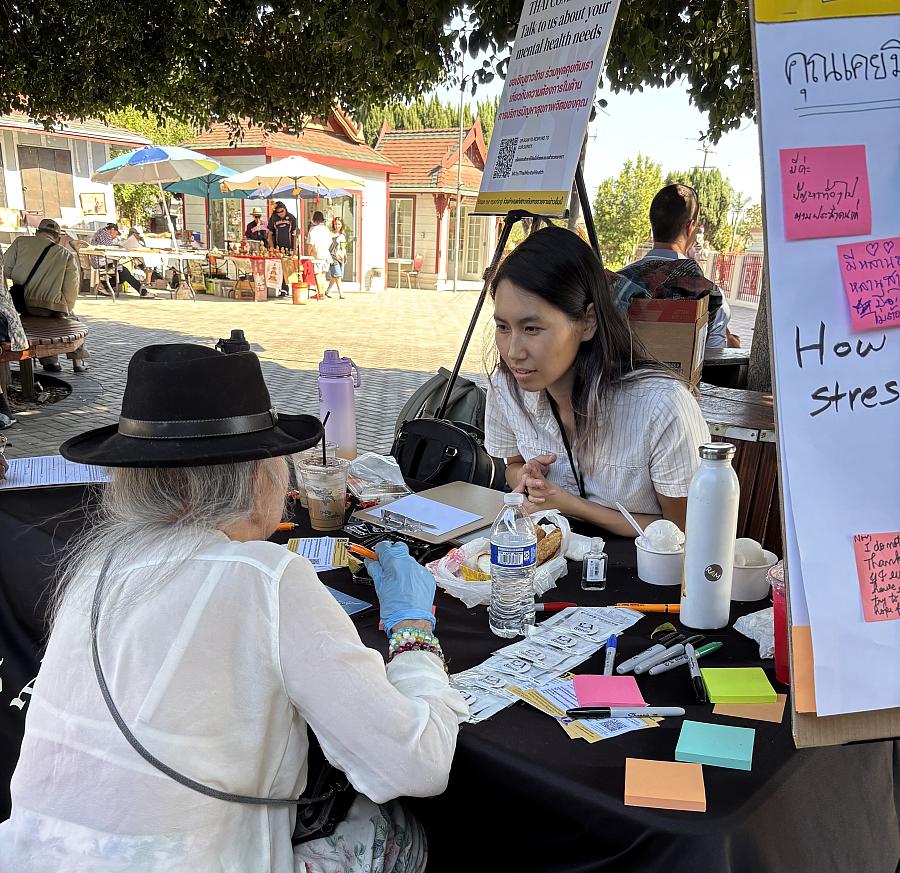
Los Angeles Times reporter Phi Do talks to a community member at a tabling event at the Wat Thai temple in LA.
(Photo by Teena Apeles/Center for Health Journalism)
During my time covering mental health in Asian American communities, I connected with a psychiatric social worker named Wanda Pathomrit, who shared with me her experience in helping her clients navigate Los Angeles’s complex mental health care system. Because most of her clients are first-generation Thai immigrants with limited English proficiency, many of them experience long delays in accessing care or are forced to find alternate ways to seek treatment.
For my Impact Fund project, I set out to investigate how well mental health programs addressed the needs of Los Angeles’s Thai community. The result is a four-part series illustrating how the Thai community finds ways to care for one another despite gaps and barriers in the current mental health care system. Thanks to the mentorship and support from the Impact Fund Impact Fund for Reporting on Health Equity and Health Systems and the engagement grant, I was able to conduct a variety of community engagement events and initiatives, which were vital for my reporting process. Here’s what I learned from the experience.
Data is important, but the lack of data is also part of the story. As a data and graphics journalist, my first instinct in approaching stories is to analyze relevant datasets to identify significant outliers or patterns. But I found few studies on how Thai Americans utilized mental health and social services. L.A.’s Thai diaspora is smaller compared to other Asian American communities, and Thai people are often coded under broader categories like “Other Asian/Pacific Islander” in census surveys, making their needs harder to track. It’s a challenge many case workers and health providers are familiar with, and why it was so key to connect with local organizations doing the work of tracking their communities’ needs and ensuring they are visible in county and health systems.
Pull up extra seating when tabling. When I tabled at the Wat Thai temple with Teena Apeles, the Center’s national engagement editor, we pulled up empty chairs around our table for people to fill out our surveys. An unexpected side effect was that people would continue to sit and chat with us after turning in their responses. Some stayed for over an hour. While we talked, they would wave over their friends passing by and encourage them to fill out our survey and join our side conversations. During these informal chats, we talked about everything from mental health to the temple’s history to favorite recipes (it didn’t hurt that our table was placed right next to the food court). I got to share more about myself outside of being a reporter while learning more about the community’s close connections with the temple and with each other.
Find the community leaders. I initially set out to write only three stories. My fourth story, about Thai massage therapists, I pitched to my editor after learning about a self-defense class for massage students in Thai Town, an area which had historically experienced high rates of hate crimes. Not only did Pathomrit get permission from the massage school’s teacher to let me observe the self-defense class, but she also introduced me to Jaroenporn Hacker, president of the Nuad Thai and Spa Association of America, which supports massage therapists in their field. Hacker helped me and Apeles organize an in-person listening session in Thai and English with members of the Association to discuss common challenges massage therapists faced on the job, from financial strains to sexual harassment and assault. Because organization leaders like Pathomrit and Hacker had the trust of their communities and were attuned to their needs, they could immediately connect me with people willing to share their experiences and pointed me to reporting directions I had not considered before.
Community interpreters can help provide a safe space. Both of my interpreters — Supakit Art Pattarateranon and Lena Deesomlert — were deeply connected with the Thai community. Pattarateranon is a local reporter in Los Angeles, so when we tabled together at Wat Thai temple, several people approached us because they recognized him and his work. Deesomlert had previously provided interpretation services for the Nuad Thai and Spa Association of America, so she was knowledgeable about the organization’s work and some of its members during our listening session. Not only did they both provide Thai and English translation during the course of my reporting, but their familiar presence in the community became a connecting bridge between me and the people I was interviewing.
Interviewing people in pairs or small groups can open new conversations. I learned from my reporting that Western-based approaches to therapy, which tend to focus on individual reflection, often fail Asian Americans from collectivist cultures where wellness is intertwined with family and group harmony. Academics and community advocates thus recommend involving family and community in clients’ care and treatment plans. Looking back, I realize I had inadvertently replicated that recommendation in my interviewing process.
I rarely interviewed anyone one-on-one for this series. A listening session with mental health providers, case workers, and outreach leaders spurred discussions about how community members activated their connections with each other to find help for their clients. A group of three volunteer teachers coordinating Thai-language lessons and cultural programs at the Wat Thai Buddhist temple validated each other’s experiences about common conflicts they’ve observed between parents and their children and shared how they enjoyed seeing parents share advice with each other while cooking meals together at the temple.
My very last interview was an unplanned pairing. I had been speaking with Pathomrit and Pranom, featured in the series’ mainbar, about Pranom’s experience as a survivor of human trafficking, and during our initial conversations she mentioned an anonymous friend who pushed her to get the help she needed. I had asked if said friend, who also survived human trafficking, would be interested in sharing their story and was told no, which I understood and accepted. Later, I was asked if I would consider interviewing Pranom and her friend together, and I agreed.
Sitting in Pathomrit’s office, I listened as Pranom and her friend reflected on their hard-fought journeys together and how they leaned on each other for strength and support. I watched Pathomrit swell with pride as she commended their courage in reclaiming their stories. At the end of the conversation, the three of them shared how they hope their experiences can encourage and help uplift others in similar situations.
Of course, it’s not always possible to interview people in groups due to scheduling or when someone prefers to disclose their experiences privately, particularly with vulnerable topics like mental health. And there were many opportunities I missed to group interviews together (what might a conversation between a therapist, a researcher, and a county worker look like?). But because many of the people I spoke with were closely connected with other community members with shared experiences, interviewing them together helped create a space where they could build on each other’s stories and reveal new insights and reflections.