

Support from colleagues and working smarter powered this series on Missouri's rural EMS services

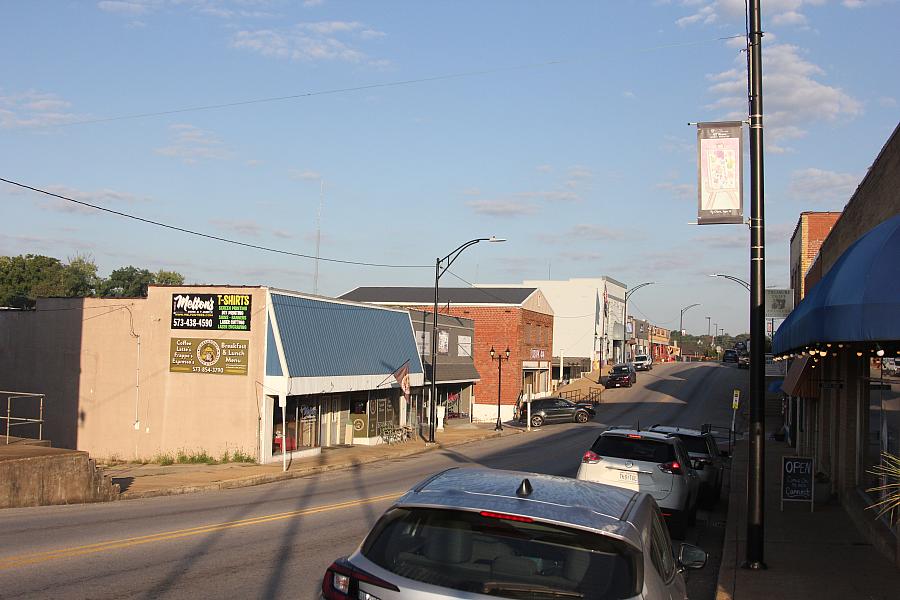
Cars line High Street in Potosi, Missouri, early in the morning on Sept. 29, 2025, where the author was able to take a two-day reporting trip for her project on rural emergency medical services, thanks to help from her colleagues.
Photo by Susan Szuch/Springfield News-Leader
From the beginning, I knew there were a plethora stories to be told about rural emergency medical services. And once I connected with folks, there was no question that they were willing to share these stories.
My project for USC Annenberg’s Center for Health Journalism National Fellowship focused on rural emergency medical services. I introduced two stations with my first story that portrayed a day in the life; the second story focused on challenges unique to rural stations; the third was a look at Springfield’s history of EMS services; and the fourth outlined the solutions stations were trying to implement to address challenges.
I ended up adding an additional story to my project outline because of the information I learned while reporting in Potosi, Missouri — namely, the idea that rural communities can improve their health outcomes by having knowledge of measures like CPR and how to stop bleeding. I had to simplify or cut certain sections in my stories because of the breadth of information and experience shared with me.
I know, it’s like the meme where someone complains about their steak being too juicy and their lobster being too buttery — a non-problem and something you should be grateful for, especially as a journalist in a time when there is low trust in the media.
But as a member of a small newsroom — three reporters strong up until this January, when our education reporter took a position with another area newsroom — sifting through the words, photos and experiences took precious time. While my grant funding helped supplement travel, research and expenses I otherwise would have struggled to cover, what I needed most of all was time.
Here is how I made the most of the eight to 12 hours a week I budgeted to work on this project. As newsrooms continue to downsize and reporters are asked to do more and more, I hope that these methods might help other reporters on ambitious projects.
- I made sure my editor had bought in on the project before I pitched it.
My editor, Amos Bridges, has lived in the Ozarks his whole life and celebrated two decades with the Springfield News-Leader in 2024. He has a wealth of knowledge on its culture, history and characters. Getting his buy-in for this story wasn’t just important, it was essential to its success.
He and I discussed the angles that I could explore for the project: Challenges, solutions, a look at how our own hospital systems chose to address EMS in Springfield and beyond. We came to the conclusion that even if I was not chosen as a fellow, this was still an important story that needed to be told, and that it would be something I would pursue, though it might take a little longer without USC’s support.
I welcomed Bridges into the brainstorming phase, letting him know what days I’d be working on the project and keeping him up to date on my progress weekly. We also built a publication schedule that culminated in the project running in print and online during a week when content was needed, something that was helpful for the newsroom, as well.
By engaging him and making sure I had his buy-in, I knew I would be able to work uninterrupted on certain days and to even take two-day reporting trips to Potosi, Missouri, and Kansas City, Missouri.
- I turned to my colleagues for support, and pitched in to support them.
I am so lucky to have colleagues that contribute to a collaborative, positive newsroom culture.
As noted before, I did have to be absent from the newsroom for two two-day reporting trips during the six-month stretch I was working on this project. While I felt guilty for leaving my colleagues with an increased workload, their vocal support and enthusiasm for this project helped assuage the guilt.
During times when I knew I would be occupied with the project, I tried to make sure that my weekly obligations — an article outlining the past week’s food inspections and an article about food and drink news in the area — were fulfilled ahead of time so my colleagues did not have to deal with it.
As someone who has spent most of their career in a small newsroom, I’m no stranger to jumping in to cover news that is not on my beat. Already having that mindset in place was beneficial before and after trips where my colleagues had to cover for me. They already trusted me and knew that they could leave for professional development, sick time or personal time off, and not have to worry about our newsroom missing breaking news.
Knowing that I had a safety net, and that I could be that safety net for my colleagues, allowed me to focus on reporting the important stories I encountered in rural Missouri.
- I made the most of what I had and looked for ways to repurpose evergreen content.
There are a few rules when it comes to emergency medical services, ones that you may have heard if you work in any sort of business that responds to peoples' crises: First, there is no such thing as a typical day. Second, if you want something to happen or if you have someone who needs a certain thing to happen, it probably won't.
Both were the case when I visited Washington County Ambulance District’s headquarters at the end of September 2025. While I was given the chance to ride along and write about their mobile integrated health program, I was also hoping to ride along on 911 response calls.
That didn’t end up happening. But that doesn’t mean there wasn’t a story here.
When I worked in North Platte, Nebraska, the news editor told me a story: A new sports reporter had gone out to cover a game, but he came back early with nothing to file. When the sports editor asked the reporter why he returned so early and empty handed, the reporter told him the game had been cancelled because the gym flooded. Well, the editor said, there’s your story.
I think I got insight that was more valuable than witnessing a 911 response or several. Instead, I got to see the reality of EMS work — the waiting, the jokes and arguments between coworkers, the attempts at snagging some shut eye or some snacks when you can. It allowed me to add a very human element to my series and reminded me a lot of our own newsroom.
When I contrasted it with the other rural ambulance service I’d visited across the state, it echoed what others had told me in a very literal as well as metaphorical way. Rural EMS sees everything from birth to death, so it makes sense that their days range the gamut from non-stop to silent.
Reporting that I did for this project also helped inform other articles I wrote. That was especially useful during the lead-up to Thanksgiving, when our newsroom works to produce useful stories on an early deadline. One of the articles we write yearly for Thanksgiving lists resources for all sorts of emergencies, from accidental poisoning to frozen pipes.
This year, I was able to include hands-only CPR and bleed control thanks to interviews I’d conducted with the American Red Cross and the American College of Surgeons.
Our producer Sam Foster was also able to use information from this article to create a video outlining steps for hands-only CPR, which could then be added to other stories across the USA TODAY network.