

Ohio wouldn’t release its test results on radon, so our newsroom did our own testing on the dangerous gas

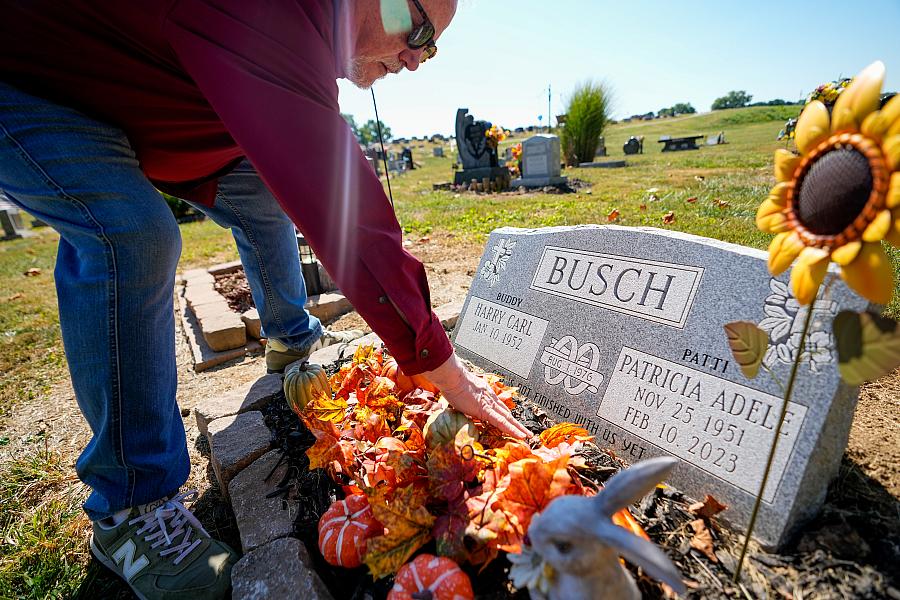
Ohio resident Buddy Busch visits the grave of his wife, Patricia Adele Busch, who died of radon-induced lung cancer in 2023.
Photo by Samantha Madar/Columbus Dispatch
Central Ohio residents live in ground zero for the second leading cause of lung cancer. But until recently, many didn’t realize it.
When I began work on “Invisible Killer,” I already knew that radon — a naturally occurring, odorless, colorless and radioactive gas — was seeping into millions of homes, schools and workplaces across Ohio.
I first heard about radon while reporting on high levels of lung cancer in Ohio in 2019. At the time, a source told me that high concentrations of the gas and little awareness in Ohio were bigger problems than most people realized. Like many Ohioans, I hadn't heard much about radon. But I knew it was a story that needed to be told and I began to look into the issue.
But a few months later, my plans were put on hold when the COVID-19 pandemic began. As the public health reporter for The Columbus Dispatch at the time, coronavirus coverage became my sole priority.
Years would pass but I still held onto the radon idea with the hope of one day coming back to it.
In early 2025, now in an investigative role at The Dispatch, I submitted a public records request to the Ohio Department of Health seeking decades of anonymous test result data. To my surprise, the state refused my records request, claiming it didn’t have to provide whole databases and that the software it used was so outdated that it couldn’t even produce the data I was asking for in the first place.
I knew then that to report “Invisible Killer” the way it needed to be done, I needed to do my own testing. I pitched the idea to my editors who gave me the greenlight to apply for grants to fund the testing idea.
Realizing I needed some help to accomplish what I pitched, I recruited fellow reporters Danae King and Samantha Hendrickson along with photojournalist Samantha Madar to help me chronicle our own testing and the lives that radon was cutting short.
With a grant from Dennis A. Hunt Fund at the USC Annenberg Center for Health Journalism and another grant from the National Press Foundation, we were able to test nearly 70 homes for radon.
Tests showed 54 of those homes, or nearly 80%, had results above the Environmental Protection Agency’s recommended mitigation threshold of 4 picocuries per liter. The results were far higher than the 50% of homes the Ohio Department of Health estimates have dangerous levels of radon.
Reporting on radon, I learned to be prepared for anything and to not be afraid to change course if needed. The testing experience, for example, taught me to always have a back-up plan. Despite meticulous planning, some participants had last minute obligations or ended up not being home during their testing appointment. Luckily, I was able to squeeze in one more round of testing in early October to get to everyone who wasn’t available the first go around.
From pitch to publication, it became clear that I needed to expand the scope of the project. There were so many potential story angles, for example, that I realized I couldn’t do everything on my own and knew I needed to do even more reporting than I’d planned on.
I recruited fellow reporters Danae King and Samantha Hendrickson along with photojournalist Samantha Madar to help me chronicle our own testing and the lives that radon was cutting short. And instead of including a section on radon in public housing in the main story, we took the interviews and data we obtained and wrote an entire standalone story.
Each of these lessons and real-time changes helped us adjust and keep moving forward to achieve our end goal — crafting stories that held public agencies accountable on radon.
We found residents in public housing who were living in units with potentially dangerous levels of radon. We discovered few school districts test for radon, despite recommendations they do so every five years. And we found that Newark, Ohio’s 43055 ZIP code has the highest concentration of radon of any city in the United States.
In the days after the series was published, the Ohio Department of Health ran out of free radon tests it offers to residents. Gov. Mike DeWine called on all schools to test for the gas. And the Columbus City Council announced plans to pursue radon legislation in 2026.
None of this reporting would have been possible without the support of USC Annenberg’s National Fellowship program and grant funding, which kept us on pace and provided valuable insight into completing a wide-ranging project of this magnitude.
While the response has been incredible, I keep finding myself coming back to the story of one couple I met who lived in the nation’s radon epicenter of Newark. Buddy Busch and his wife Patti never smoked. But a 2016 visit to an urgent care revealed Patti had stage 4 lung cancer.
The couple tested their home for radon and found high levels of the gas. Patti died in 2023.
Though it’s been years, Buddy said he’s still puzzled that more isn’t being done to protect people like his late wife from an early, preventable demise.
“Require radon testing to save somebody’s life,” he told me. “You could save a lot of pain and agony and misery for a lot of people.”