

There’s something dangerous in the water in California’s Stanislaus County

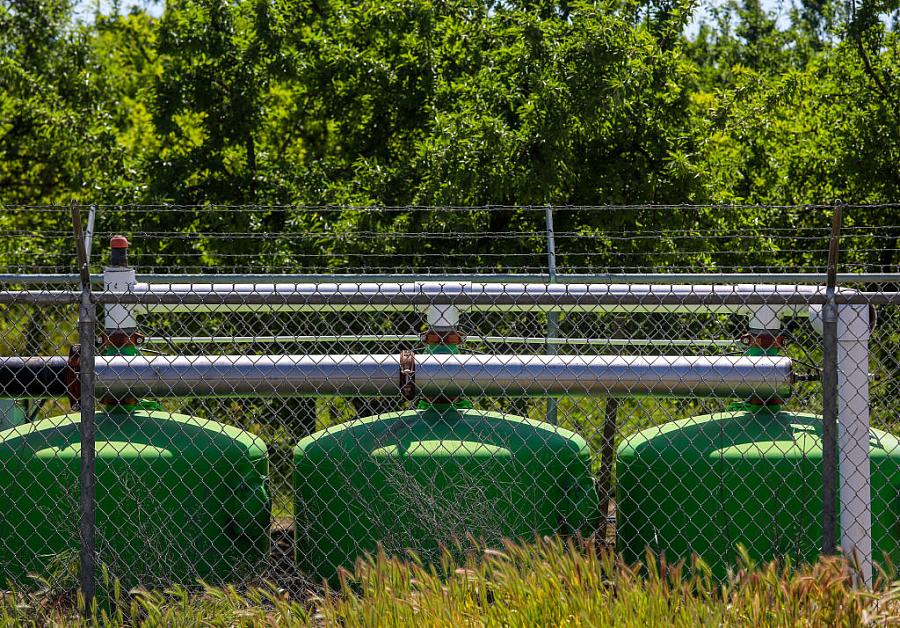
An irrigation system runs next to an almond orchard in Stanislaus County.
(Photo by Yolanda M. James / The San Francisco Chronicle via Getty Images)
It's more than just “bad water.”
In Stanislaus County, an area nestled in the northern section of California’s San Joaquin Valley, many people access water through wells or small water systems that aren’t equipped to meet safe drinking water standards.
Common complaints about water in the county include a funky smell, cloudy or muddy water or an “off taste.” But the most common unsafe drinking water contaminants in the Central Valley are odorless, tasteless and invisible to the naked eye. People drinking straight from their tap don’t know that what they’re drinking may harm them or their family.
My pitch for my project for the 2025 California Health Equity Fellowship was to write specifically about nitrate contamination, a common pollutant that seeps into underground aquifers and is often caused by poor farming practices or failing septic tanks. I knew the levels for nitrate were over state standards in many regions of the county, especially in more rural areas, and that it could lead to serious health outcomes like “blue baby syndrome,” a condition that prevents oxygen from circulating in the blood, leading to trouble breathing, bluish or purple-tinted skin and even death.
As I learned more about nitrate levels in the region, I realized that some communities were not just over the state’s limits for nitrate, but also for other contaminants such as arsenic, uranium and chromium hexavalent, all with their own host of potential health impacts.
I tried to balance explaining the specific situation I was reporting on with practical steps and information that was actually useful. For example, when people think something is wrong with their water, they often boil it. But unlike contaminants like bacteria, boiling nitrate-contaminated water not only doesn’t help, it makes it significantly more dangerous by concentrating it.
To address these issues, residents need sophisticated filtration systems like ion exchange or reverse osmosis systems, which are financially out of reach for many residents, or the improvements required infrastructure that hadn’t yet been built.
Isolated communities were often overlooked because of their size. I wrote about the Gold Rush-era town of Knights Ferry whose small water system was challenged with near-constant leaks.
I learned that small water systems often rely on grants to keep themselves afloat, which can lead to delays in needed repairs and frequent shutoffs. This isn’t just an issue in Stanislaus County; there are stories just like this one happening all over California.
A mobile home park near the Tuolumne River was a stone’s throw away from a nearby brand new water treatment plant, and yet plans to consolidate their ground-well system with another local city was taking so long that residents were offered water bottles as a replacement for their uranium contaminated water. A year later, the wells tested over the limit for nitrate and their water became not just a long-term health risk but an immediate danger to their family.
I needed to contact someone who knew the community and would give me a better understanding of what was going on, so I teamed up with a local community partner to knock on doors with me. This helped me make connections with people who may have otherwise not felt comfortable talking with me and the story was richer and more grounded as a result.
Writing about environmental health impacts is difficult, and in some cases it's impossible to track a contaminant directly to the health impacts people have experienced. But one frustration I had while reporting is that some of the data that should be there just isn’t. Nitrate’s health impacts on babies and small children are a distinct problem, but untracked by the state of California or local public health agencies.
The state-mandated notifications sent to residents about their drinking water are often written in English with a vague blurb at the top that instructs residents to call a number for more information. The notices themselves can be hard to parse, and many of the residents I spoke with didn’t know what the contaminant was even after reading the notice. I didn’t want my articles to repeat that mistake, so I made sure the stories were translated into Spanish and written in plain language.
The last story in my series was about the small but rapidly growing city of Patterson on the west side of Stanislaus County. The area has had high levels of hexavalent chromium in its drinking water for decades, and there were concerns that this was leading to health impacts in the community. Additionally, residents felt that the city had been dismissive of their concerns and had little interest in taking action on the issue without threat of legal action.
This community, like all of the communities I wrote about, had multiple compounding problems. A string of towns and cities on the west side of Stanislaus County have what’s known as “subsidence” — when groundwater basins sink due to depleted aquifers. This can further concentrate contaminants.
In this case too, it was hard to show the direct link between health impacts of the drinking water because of multiple carcinogens that could be contributing to poorer health and the relatively small sample size of residents. But that does not mean that these stories are not worth reporting on.
Many times during this project I felt like I was threading a needle between being too technical or not thorough enough. Gaining the language to understand what I was looking at and then trying to distill that into digestible stories was one of the biggest challenges I had.
The stories in my series used California public records coupled with the lived experiences of the communities covered. Building trust with my sources was the most successful part of making sure I wrote something that accurately reflected what I was seeing on the ground.