

What it takes to report on Chinese immigrant mothers and their most private struggles


At a friend’s daughter’s first birthday party, the cake collapsed—one of many small things that can go wrong in a day of motherhood.
Photo by Ziwei Liu
Two years ago, motherhood was an abstract idea to me. That changed when two of my closest friends in Los Angeles gave birth. What struck me most was not how hard those first months were, but how little space there seemed to be to talk about them.
These were women with stable, upper-middle-class family incomes and professional jobs. Even so, their days were shaped by sleepless nights, anxiety, and mounting financial pressure. They rarely described their struggles as something worth naming. Much of what they endured was framed by those close to them as expected — almost inevitable.
In Chinese culture, motherhood is often spoken of in terms of praise and sacrifice. There is a familiar saying: 报喜不报忧 — share good news, not hardship. Pain is something to be absorbed, endured quietly. Challenges such as health care access, the cost of care, or the isolation of mothers rarely enter the conversation. The burden remains personal, even when the causes are not.
That silence became the starting point of my reporting on Chinese immigrant mothers in Southern California. The project resulted in two long-form articles examining postpartum life, childcare costs, mental health stigma, and the experience of navigating the U.S. health care system as an immigrant. Alongside the reporting, I created “Mom Support LA,” a Mandarin-language guide to maternity resources and public programs in Southern California.
Reporting Where Trust Is Fragile
I assumed that motherhood, a shared experience widely discussed in my friend circle, would make reporting easier. It did not.
The greatest challenge was persuading mothers to speak at all. To talk about childbirth and early parenting is to talk about the body, money, family relationships, and emotional health. For many Chinese immigrant women, these are deeply private subjects. Public visibility — especially through media — can feel risky, even threatening.
My friends were open to talking about these challenges because trust had been built over years. With new sources, that trust did not exist. Some mothers agreed to interviews and later withdrew. Others wanted to speak but asked to remain anonymous or declined to share photos. Nonprofits were supportive but could not directly connect me with clients. Surveys and social media outreach revealed patterns, but rarely led to deeper conversations.
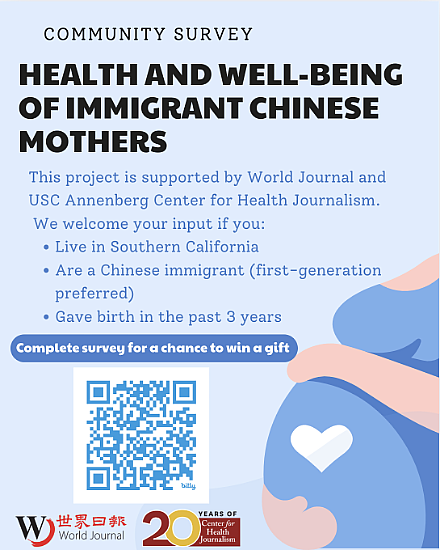
A survey designed to understand the health and well-being of Chinese immigrant mothers. Responses were limited, reminding me that trust is built through people, not forms.
Survey provided by Ziwei Liu
What worked most consistently was word of mouth. Introductions through teachers, friends, and community networks carried weight. Trust moved through people, not platforms. I learned to slow down, to begin with listening rather than explanation. Many mothers had never been asked to reflect on their experiences this way, let alone speak them aloud.
Small adjustments mattered. Allowing sources to use English names rather than their Chinese legal names gave some a sense of safety. It was a reminder that ethical reporting sometimes requires flexibility — especially when asking people to share stories they have long been taught to carry alone.
Seeing the System Through Mothers’ Eyes
Before this project, my understanding of the U.S. health care system was limited. Through reporting, I saw how many hurdles it throws up precisely at the moment when patients are least able to navigate it.
Pregnancy and childbirth involve a maze of providers, insurers and administrative steps. Mothers are expected to be alert, informed, and proactive at a time when they are physically depleted. One doula described childbirth to me as the moment when a person is most vulnerable — and yet still expected to advocate for herself.
One finding that surprised me was the contrast between private insurance and public coverage. Several mothers using Medi-Cal, California’s Medicaid program, described more continuity and fewer billing disputes than those with employer-based private insurance, who spent months negotiating unclear charges and unexpected bills. The difference reflected how profit incentives shape patient experience.

Art supplies on the floor and a child’s footprints below. Everyday life, quietly held together.
Photo by Ada Teng
Many mothers internalized these difficulties rather than questioning them. Even undocumented mothers who endured traumatic births described their experiences as something to get through quietly. This tendency — to absorb rather than challenge — contributes to invisibility. When communities do not complain, gaps remain hard to document, let alone address.
As the project progressed, it became clear that many mothers were struggling not because resources did not exist, but because information was scattered, untranslated, or difficult to understand.
That realization led to Mom Support LA, a site I built independently to organize maternity, mental health, and public assistance resources in Mandarin, using plain language. The goal was modest but urgent: to reduce the burden of figuring everything out alone. Journalism can surface problems, but it can also help people navigate what already exists.
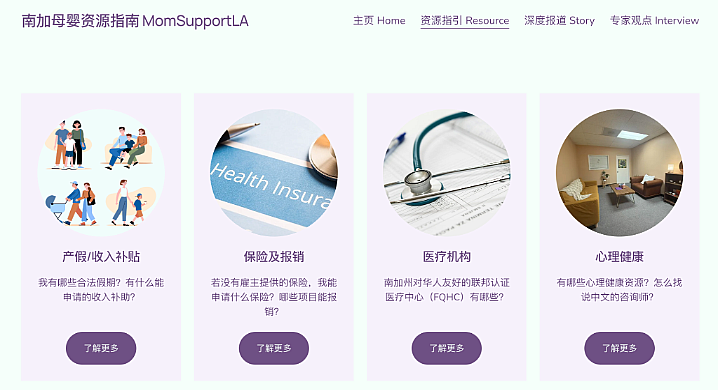
Mom Support LA brings together information on maternity leave, insurance, medical care, mental health, and other resources often scattered across systems.
I still believe deeply in the value of long-form reporting. At the same time, I recognize that those with the time and energy to read it are often already well-resourced. Creating a practical tool alongside the reporting felt like a way to extend the work beyond the page.
Rethinking Health Journalism, and My Role
This project reshaped how I think about health journalism. It is not only about reporting on illness or policy, but about the conditions that shape everyday life. It also reshaped how I see my role as a journalist working in a language-specific newsroom.
I once felt limited by reporting in Chinese within an English-dominant media landscape. This work showed me that language is not a constraint, but a way to access stories that might otherwise remain undocumented. I began to see my role as a bridge — connecting immigrant experiences to broader public understanding.
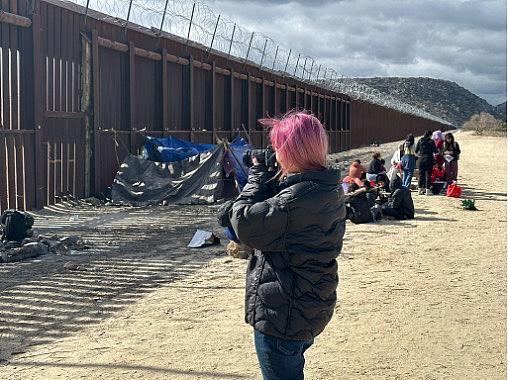
The U.S.–Mexico border in San Diego, 2023, where I interviewed undocumented Chinese immigrants who had recently crossed.
For journalists working on similar topics, several lessons stand out: build relationships before you need interviews; allow flexibility in how sources are identified and protected; work through trusted intermediaries; and pay attention to what sources normalize or leave unsaid.
If I were to begin again, I would reach out earlier, without immediately framing my conversations as reporting or interviews. Trust takes time, especially when asking people to speak about experiences they have been taught to endure quietly.
After publication, a Chinese immigrant who was six-months pregnant reached out. She told me that reading the stories made her feel less alone, and that the resource guide helped ease the weight of what felt like too much to navigate.
This project may not lead to structural or policy change, but it offered companionship to someone at a vulnerable moment. For me, that is enough of an impact.