

Mobile Clinics Under Threat: Gaps in Rural Healthcare in California’s Central Valley
This story was produced in partnership with Radio Bilingüe as part of the 2026 Ethnic Media Collaborative, Healing California.

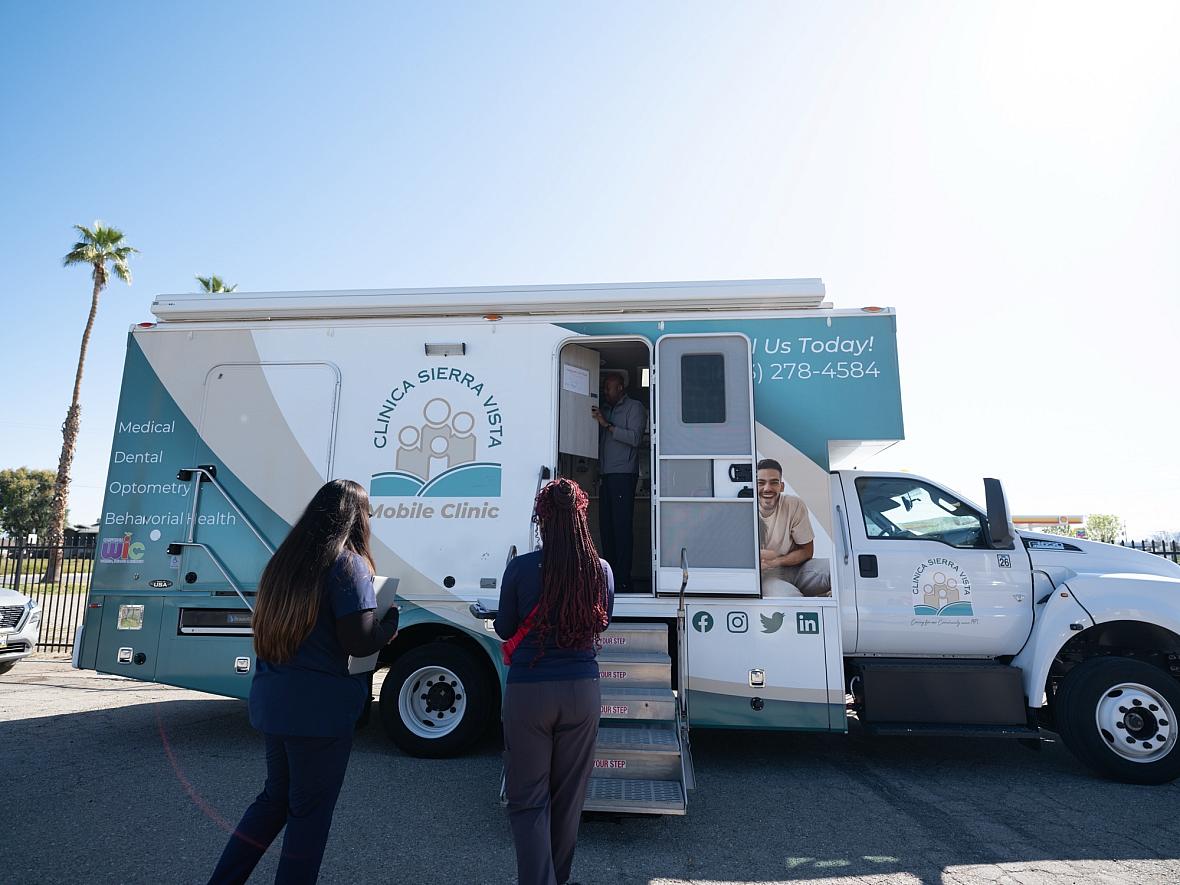
Doctors and community organizations warn that access to services like mobile clinics—bringing health care directly to farm fields and rural areas of California’s Central Valley—could be at risk due to immigration enforcement measures instilling fear in communities.
Courtesy of Clinica Sierra Vista
For more than 20 years, Adela León, originally from Putla in Oaxaca, Mexico, has worked in agricultural fields across Washington State and California’s Central Valley.
“In grapes, peaches, apricots, plums — everything that’s agricultural.”
As a single mother and farmworker, she says she sometimes doesn’t have time to go to the doctor.
“It’s something we farmworkers struggle with a lot because we want to prioritize work, and our health too, but we can’t. At some point, you have to sacrifice something.”
That’s why, even though Adela has Medi-Cal, California's low-income health insurance program, she often takes advantage of mobile clinics set up near her work in the fields. Her last visit was in July, during grape harvest season.
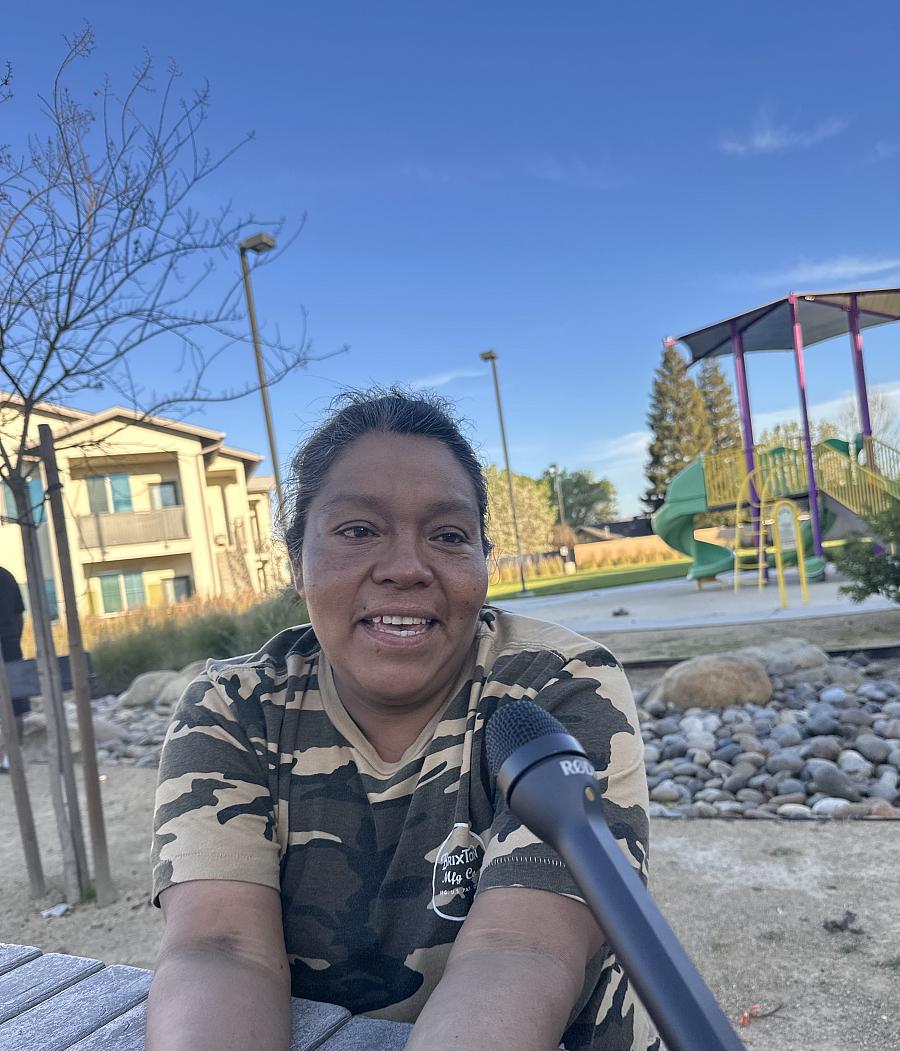
Adela Leon
Adela Leon often takes advantage of mobile clinics set up near her work in the fields.
“The Sierra Vista clinic came to my crew, and that day I got my blood pressure, my blood sugar, and my iron levels checked.”
What once felt routine is now under threat. Doctors and community organizations warn that access to services like mobile clinics — which bring health care directly to agricultural fields and rural areas in the Central Valley — are at risk. This is something Adela, who is also part of the United Farm Workers Foundation, has heard from coworkers.
“A lot of people were saying that clinics would report those without papers. That if you go to an appointment, immigration will come. And because of that, people don’t go. They’d rather buy any pill and self-medicate.”
Clinics and hospitals are required to protect patient privacy, and immigration status is not shared as part of routine medical care.Still, fear persists — and has intensified in recent months following federal policy changes that allow certain Medicaid enrollment data to be shared with immigration authorities — discouraging many from seeking care, including across the Central Valley, where an estimated 332,000 undocumented immigrants live.
Although these mobile clinics continue to reach rural communities, Dr. Kenny Banh, Professor of Clinical emergency medicine, and creator of UCSF Fresno’s Mobile HeaL Clinic says visits have dropped.
"We were doing large health fairs, seeing 50, 100 people at most events. Now it's shriveled up. We dropped more than a third in our visits. This is all change — political changes, threats to Medi-Cal enrollment, threats of ICE raids."
Given these changes, Dr. Banh explains they have had to adapt their outreach strategies due to fear and meet people where they are.
"We used to go to a lot of these events at large health fairs with community centers where people are having big community fairs. That wasn't working anymore because people weren't gathering in large places.”
According to a written statement from the Fresno County Department of Public Health, the county’s mobile health program shifted from federal pandemic funding to money that comes through Medi-Cal health plans in late 2025 — funding set to expire in December 2026.
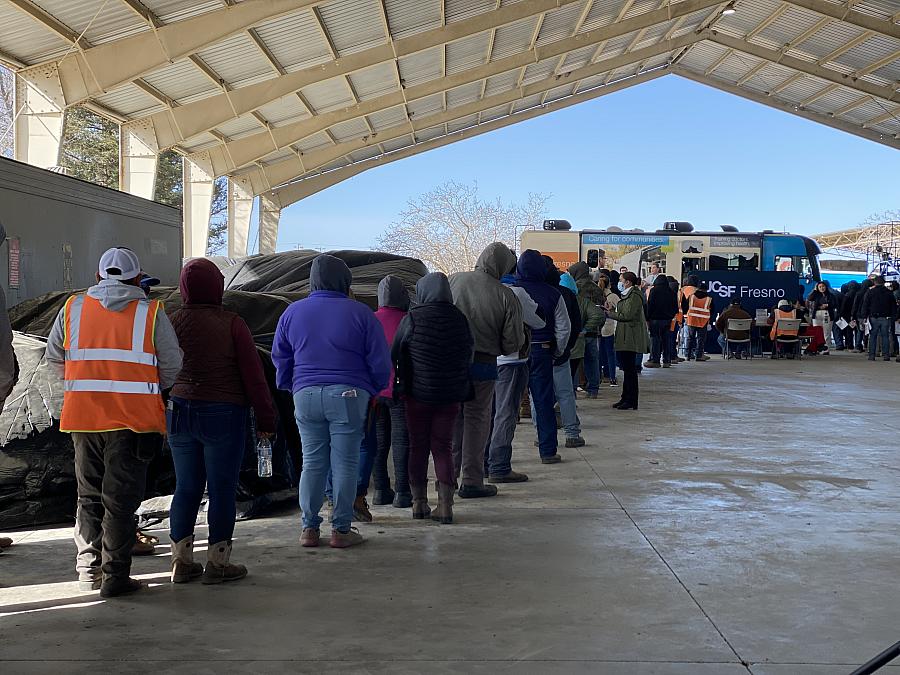
Farmworkers line up for medical care at UCSF Fresno's mobile clinic.
Courtesy of UCSF Fresno
Officials say mobile clinics require significant coordination, from medical staff to follow-up care, and without new resources, it may be difficult to maintain the same level of service and reach.
The county is exploring options to sustain the program, including opioid settlement funds and potential state and federal support.
But the impact is already being felt, with some staffing and provider shortfalls at certain events.
For farmworkers, losing access to these clinics has a major impact, Adela says..
“There are many people who need it, and if it’s not there, they can’t get checked.”
Federal cuts to healthcare funding are threatening rural mobile clinics, one of the most vital and precarious safety nets available to a population already unserved and overlooked. Many of these programs depend on Medi-Cal and support from community hospitals, both of which are facing huge financial pressures.
For example, currently, today more than 1.7 million Medi-Cal enrollees — about 11% — are estimated to be undocumented, and have comprehensive coverage.
Under current California policy, undocumented adults can no longer enroll in full-scope Medi-Cal, but those already enrolled can keep their coverage. This means that if someone loses coverage — even for administrative reasons like failing to complete renewal paperwork — they cannot re-enroll, except children under 19 and pregnant people, they remain eligible regardless of immigration status.
This could increase reliance on mobile clinics, which already serve many uninsured patients in rural areas.
To make things even more urgent, funding from the American Rescue Plan funding — which expired in 2025 — is running out. And many counties have been using that pot of money to support rural clinics. The ending of this funding will make it harder for clinics to continue operating at the same level and serve patients like Adela, who lives with high blood pressure and diabetes. But between early mornings and long workdays, finding time to see a doctor isn’t always easy.
“Sometimes I’m due for my three-month checkup, and I don’t go because I don’t have time.”
These mobile clinics work in collaboration with community organizations, clinics, and hospitals to bring medical care and preventive services to different parts of the Central Valley, especially rural areas where Indigenous communities from Oaxaca live and work, many of them in agriculture.
One of these organizations is the Binational Center for the Development of Indigenous Oaxacan Communities. Community health worker Virginia Sixto says they collaborate with mobile clinics from UCSF Fresno, St. Agnes, and Fresno County.
“The help that mobile clinics provide is very important because they go to the closest location. That way, people don’t have to look for transportation to get to a clinic.”
Indigenous people from Oaxaca make up a significant portion of the agricultural workforce in the Valley. About 350,000 Indigenous people — including Mixtec, Zapotec, and Purépecha communities — live in this region and parts of Southern California.
Historically, these communities have faced major barriers to accessing health care.
“Language. Not being able to express their health problems, transportation, and medical costs…”
Including access to insurance, Virginia explains.
“Access to Medi-Cal — that’s what affects the community the most.”
These disparities are worsening as a result of federal and state cuts and policy changes, including a large federal budget package signed last year. All of this has created uncertainty.
“Many people are losing Medi-Cal because they now have less time to submit renewal documents.”
According to Virginia, these cuts are also affecting how often mobile clinics can visit communities.
“Before, we went twice a month — now we’re only going once a month to rural areas. There have been many cuts.”
On top of that, many people are afraid to leave their homes.
“They’ve said they prefer not to go out because they’re afraid of being detained and deported.”
Today, more than 3,600 mobile clinics operate across the United States, an 80% increase since 2013, according to a Harvard Medical School study.
Of those clinics, 90% serve low-income communities, 84% serve uninsured patients, and more than 30% focus on farmworkers.
According to the report, mobile clinics prevent more than 55,000 emergency room visits each year and help people live longer — adding up to more than 20,000 years of life across the communities they serve.
Kait Guild, deputy director of Mobile Health Map at Harvard Medical School, says the role of mobile clinics is becoming more critical as rural healthcare gaps grow.
“This is truly a crisis, and it’s already happening. It’s not a future problem. Thinking about innovative ways to deliver care and bring care to the community is crucial — and that’s where mobile health can play an important role.”
Despite their importance, rural mobile clinics are not included in most states’ Rural Health Transformation Fund plans. This is a $50 billion federal investment over five years aimed at offsetting Medicaid cuts and strengthening health care systems in rural areas.
Of the $10 billion allocated for fiscal year 2026, California is expected to receive about $234 million. However, the state’s proposal does not include funding specifically designated for rural mobile clinics.
Guild says this reflects a broader misunderstanding of how mobile clinics operate — and how they should be funded.
“It’s not just a pilot program; it’s really its own model of health care delivery… and it’s a critical piece of public health infrastructure.”
Guild adds that while many states mention mobile health in their plans, they often lack a long-term strategy to sustain it.
“We really need to think carefully about how that money is spent… and build sustainable systems. It’s crucial that funding doesn’t just go toward new infrastructure, but toward building sustainable systems… and integrating communities into the development of these programs.”
Guild also emphasizes that mobile clinics are not a one-size solution, but part of a broader system of care.
“I don’t think mobile health is the solution to health care access… I think it’s part of the solution.”
According to California’s own Rural Health Proposal the funding the state receives through the federal $50 billion fund will be used to create networks connecting central hospitals with local clinics and telemedicine services, expanding access to specialists and improving care coordination.
The proposal also includes training for rural health care professionals, upgrades for struggling hospitals, and support for real-time telemedicine, virtual consultations, and remote patient monitoring.
Although California’s plan emphasizes telemedicine, Guild says technology alone cannot solve gaps in rural health care.
“Many people living in rural areas may not have access to broadband internet or even a cellphone.”
She adds that telemedicine should work alongside mobile clinics — not replace them. One of the greatest strengths of mobile clinics is trust, by bringing care directly into communities.
“Providing accessible, culturally relevant care in the places where people live, work, learn, or worship helps serve as a bridge to the healthcare system.”
This is especially important in communities where trust in the healthcare system has been damaged, and where policy gaps still remain.
“There’s still a lot of work to be done to educate policymakers about the impact of mobile health.”
Meanwhile, local mobile clinics, like Clínica Sierra Vista, continue working to bring care directly to communities — especially farmworkers.
Nurse practitioner Geanne Flores says their clinics provide everything from basic checkups to chronic disease care.
“We offer physical exams, sick visits, vaccines, and connect patients with resources,” she explains.
She adds that many of the patients they see live with conditions like diabetes and high blood pressure — but often struggle to access traditional care.
“A big part of the problem is distance,” Flores says. “They would have to drive and spend a lot of time… and most farmworkers are very busy. They don’t have time.”
She says they haven’t been going out to the fields recently, as they focus on expanding outreach and building partnerships with trusted community organizations.
“Obviously, we’re trying to figure out where we can set up so people can access us more easily. We’re still looking for partnerships.”
Virginia, from the Binational Center, says they continue providing services to the community as well.
“When people need to go to a clinic or schedule an appointment, we help them with those services or find closer locations. If they need a physical, we recruit those patients and take them to the nearest mobile clinic.”
They also provide interpretation in Indigenous languages from Mexico for those who need it during medical visits.
“Here we have Mixtec, Chatino, Zapotec, Triqui, Tlapaneco, and Amuzgo.”
As for Adela, she continues to rely on mobile clinics when she doesn’t have time to see a doctor. She hopes they will return to her work area soon and calls for continued support to keep them accessible for farmworkers.
“There are many of us who don’t have Medi-Cal, who don’t always have a way to get to a clinic. And many people don’t speak Spanish — they only speak an Indigenous language, and it’s very difficult for them to approach a clinic. So if the mobile clinic stops coming to the workplace, it would affect a lot of people. I would ask them to please continue supporting farmworkers in that way, because we really need it.”