Power and Prejudice: Chapter 2: A single incriminating statement seals Shawn’s fate
The story was originally published in MLK50 with support from our 2025 Data Fellowship.


When Shawn remembers jail, he thinks about the noise. “It’s like you’re entering hell on earth,” he said. “A lot of yelling, a lot of hollering, a lot of talking, a lot of nonsense, cursing, swearing, kicking the doors, trying to get the officer’s attention.”
After his brother shot Marcel Mackey, Shawn was placed in a juvenile detention center. Then, once he turned 18, he was sent to 201 Poplar. The jail is six stories tall; Shawn lived on one of the lower levels.
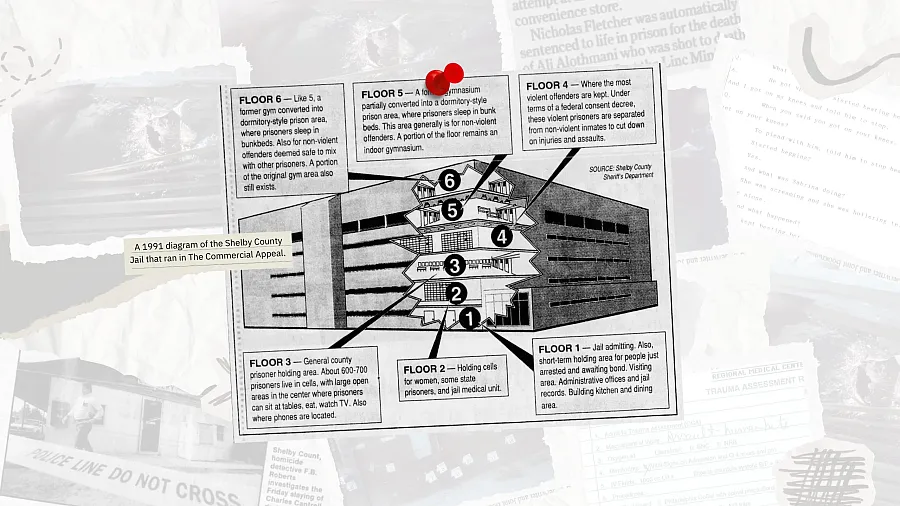
Down there, “men (were) piled on top of men,” Shawn said. “People were screaming obscenities, cursing out officers, cursing out the staff.”
His housing unit had no windows. Shawn saw the sun twice a week, when he was brought to the jail’s roof to exercise for exactly one hour. “It was just enough time to make you remember what you gave up,” he said.
Eight months into Shawn’s incarceration, his attorney approached him with a proposal: If he made a statement to police, a judge would lower his bond. He would be able to leave 201 Poplar and wait for his trial at home.

Shawn had previously refused to speak to law enforcement. The thought of being released changed his mind. “I really wanted out of that place,” he said. “I was so terrified and so sick of it.”
Shawn had a court-appointed attorney, paid by the state to represent people hovering around the poverty line. He couldn’t afford a private lawyer; his stepfather, the only member of the family with a steady income, died several years before Shawn’s arrest.
This lawyer never explained the felony murder rule to him. “I really didn’t understand the seriousness of the situation,” Shawn said.
He was confident that when the police learned he hadn’t killed anyone, they would set him free.
Felony murder is “complicated to explain to adults,” let alone children, said Deaner, the former public defender.
“It is not a widely understood concept in our society that you can be prosecuted for killing someone you never meant to kill, and that the punishment is the same for killing someone you meant to kill,” Deaner said.
The average Tennessee child convicted of felony murder was 16 at the time of the offense, MLK50 found. Some were as young as 12 when charged.
Shawn had no idea that prosecutors could use his statement against him. He told Memphis police officers that he knew his brother intended to kill someone, and that he had walked with him to the scene of the crime. He told them he was carrying a gun.
“Whatever I felt like they wanted to hear, that’s what I told them,” Shawn said.
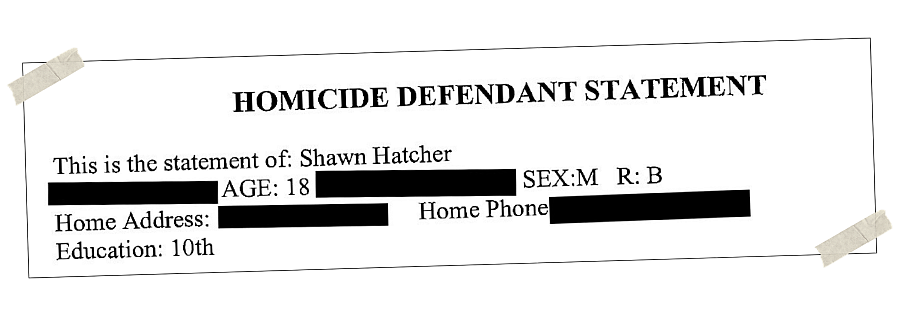
Nobody lowered Shawn’s bond. After he made his statement, he remained in 201 Poplar for over three years. Shawn could only hope that he would finally get out once a jury heard his case.
“[My attorney] just told me they didn’t have anything against me, and I had a great chance of being released,” he said. He discovered the truth in court — by admitting he’d participated in Chris’ crime, he’d secured his conviction.
All they wanted was for me to make an incriminating statement,” he said.
A crime of unluckiness and chance
hawn’s trial began in the winter of 2005. The prosecution opened with an unusual statement for a murder trial: They voluntarily told the jury that Shawn was not a killer.
“We are not going to tell you that [Shawn Hatcher] killed Marcel Mackey,” a Shelby County prosecutor said, according to a transcript of the trial reviewed by MLK50. “We’re here to tell you that he participated in the killing of Marcel Mackey to the point where he should be, under the law, held responsible for that killing.”
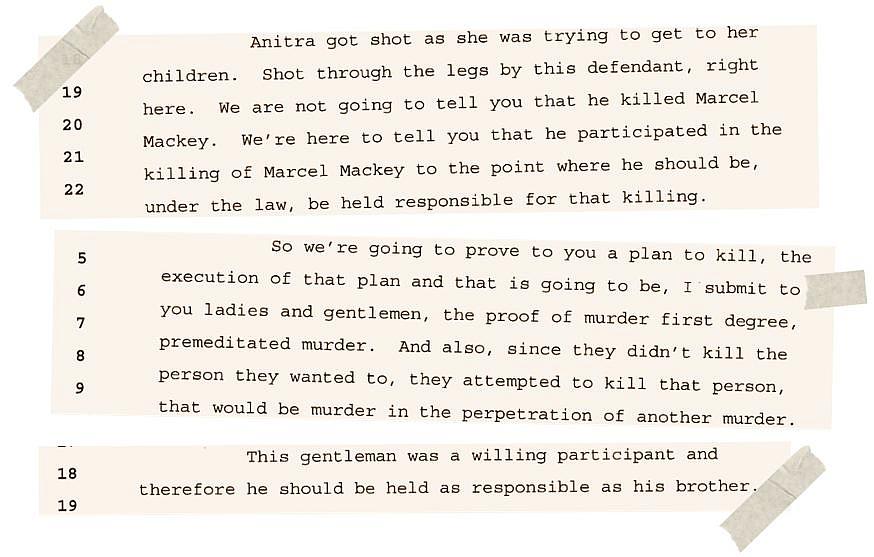
Excerpts from assistant district attorney P. Thomas Hoover’s opening statements at Shawn Hatcher’s January 2005 trial.
Prosecutors never claimed that Shawn wanted to kill Mackey. They didn’t have to — in felony murder cases, participation in a felony is, in itself, considered intent to kill, said Ekow Yankah, a law professor at the University of Michigan.
Felonies can involve the risk that someone will be seriously hurt or killed in the process, said Yankah. As a result, if you commit a felony and someone dies — even if the death was accidental, or caused by someone else — prosecutors will argue that you should have predicted the outcome.
One might say, “Look, you go into a dangerous situation, and it’s not surprising that something bad happened,” said Yankah.
Illustration by Sri Velrajan for MLK50
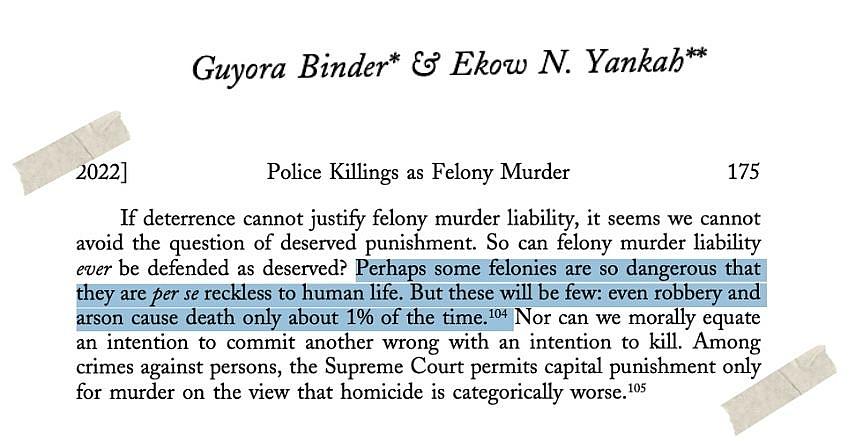
But in reality, few felonies result in someone dying. As Yankah and a co-author wrote in one paper, “robbery and arson cause death only about 1% of the time.” Even crimes like drive-by shootings result in fatalities 5% of the time or less.
Sometimes, felonies have outcomes that are hard to anticipate. In June 2025, two children, along with four young men, shot at each other inside a mall in Savannah, Georgia. They did not kill anyone. But a bystander who ran from the shooting had a heart attack and died.
Georgia, like most states, has a felony murder rule. Prosecutors argued that the heart attack wouldn’t have happened without the shooting, and charged everyone involved with murder.
There are “layers of lack of intent” in many felony murder cases, said Deaner. Some children are charged with felony murder because of crimes they did not know were happening.
In 1995, 17-year-old Ashlee Sellars was living with a friend after running away from her home in Knoxville. For years, Sellars had been physically and sexually abused by her stepfather.
She knew that her friend was involved in criminal activity, but she had few options. “I don’t have anywhere to go,” she recalled thinking. “Right now, there’s nowhere safe for me to go.”
One night, Sellars’ friend asked her to drive him to a church parking lot behind a strip mall. “I thought he was going to do a drug deal,” she said. “He was gone from my car for a period of time. I heard a gunshot. He got back in my car. He had a purse and a moneybag.”
Without Sellars’ knowledge, her friend had robbed, shot and killed someone. A few days later, she was arrested and charged with felony murder. She remained in jail for two years, awaiting trial.
Eventually, prosecutors offered her a deal: plead guilty to facilitation of felony murder, and get 25 years in prison. She took the deal. If she hadn’t, “they probably would have found me guilty,” she said.
Compared to a premeditated murder case, prosecutors need relatively little evidence to convict you of felony murder. “Prosecutors like the felony murder rule precisely because they don’t have to prove that you intended to kill,” said Yankah.
At its core, felony murder is “a crime of unluckiness and chance,” said Deaner. Over the course of her 20-year career, Deaner has represented close to a dozen children charged with felony murder. She says her young clients often wondered — what if they’d aimed slightly differently? What if they’d said no to hanging out with a certain friend? What would have happened if they had made a slightly different choice?
The “slow guilty plea”
From the beginning of Shawn’s trial, Shelby County prosecutors argued he was just as dangerous as his brother. If Shawn didn’t have violent tendencies, they asked, why hadn’t he prevented his brother from shooting Marcel Mackey?
“Did [Shawn] ever try to do anything to try to stop this from happening?” prosecutors asked the jury. “Did he go into the house that night and say, ‘Mom, Chris is talking about killing this guy over in the Raintree Apartments. Do something’?” Did he ever go into the house and call the police himself? [...] No, he didn’t.”
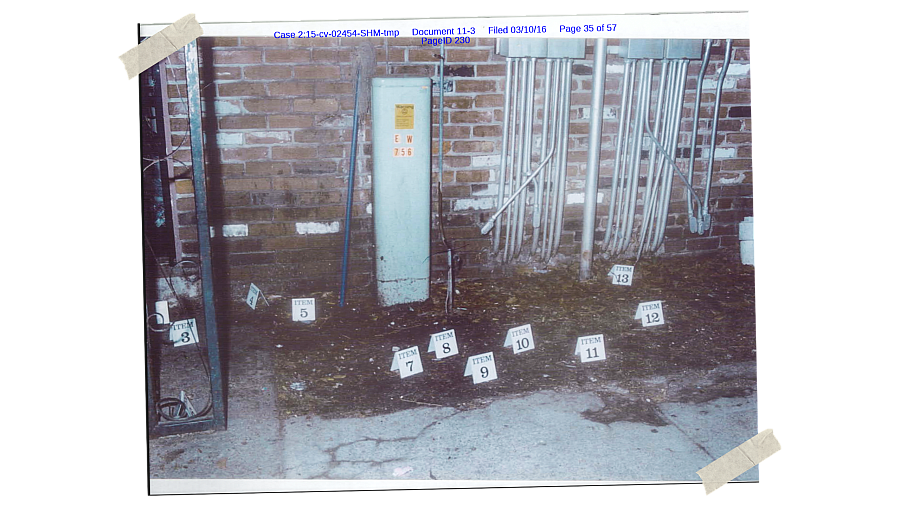
An image from Shawn Hatcher’s case files shows police evidence markers at Raintree Apartments in Whitehaven on April 3, 2001.
The jury never heard Shawn’s side of the story. Shawn’s lawyer told him not to testify. The only time the jury heard from him was when prosecutors presented the incriminating statement he gave to police, which he made at his lawyer’s advice.
Shawn’s mother and sister attempted to present the jury with a different account of Chris and Shawn’s relationship. They said that Shawn was afraid of Chris. They were afraid of him, too.
Chris “would just do things to Shawn where I couldn’t understand it,” his mother testified. “He would say, ‘If you don’t do this, I’m going to beat you.’ And there were many times I’ve seen him beating Shawn.”
Chris “would just tell [Shawn] that he was going to kill him and he was carrying a gun,” she added. “I was scared.”
Prosecutors cast doubt on the idea that a brother could abuse his siblings.
“Brothers fight, wouldn’t you agree with me?” a prosecutor asked his mother. “Don’t brothers tend to fight each other? Isn’t that kind of the way guys are?”
Throughout Shawn’s trial, prosecutors minimized and concealed Chris’ abuse. During a “sidebar” — a private conversation between the prosecution, defense and judge — Shawn’s defense asked to show the jury hospital records of Shawn’s treatment after one of Chris’ attacks. The prosecution objected, arguing they were irrelevant. The judge excluded the records from the trial.
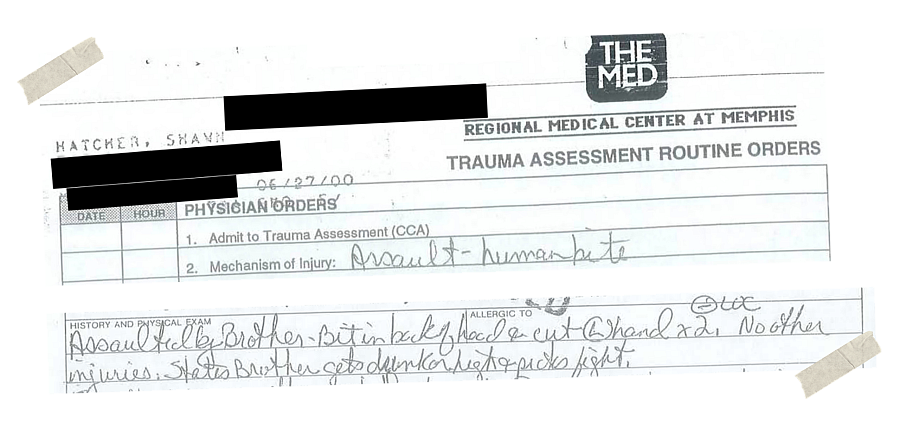
Excerpts of Shawn Hatcher’s trauma assessment form following a fight with Chris. It reads: “Assaulted by brother. Bit in back of head and cut left hand x2. No other injuries. States brother gets drunk or high + picks fight.”
Children who commit crimes are often “in survival,” said Sellars. After serving her 25-year sentence for facilitating felony murder, Sellars joined the Raphah Institute, an organization that develops restorative justice programs in Tennessee. She now works with young offenders and their victims. These children have “so much trauma that [they’re] really focusing out of a part of [their] brain that is fight or flight,” she said. They became involved in the criminal justice system because of “violence, isolation, shame and poverty.”
Consistently, research indicates that traumatic events impact brain development, interfering with emotional regulation and decision-making among young people.
An expert witness could have told jurors how repeated childhood trauma influences a young person’s decision-making. And yet, such witnesses rarely appeared in these cases. Shawn’s lawyer never hired one.
That’s because expert witnesses have to be paid, said Deaner. If a child’s family cannot afford to pay a witness, then the state of Tennessee would have to step in. But this rarely happens.
“Poor people can’t get justice,” Deaner said. “When they try to get the experts that their lawyer knows they need, the court will not approve the funding.”
Even without these expert witnesses, the circumstances that led a 14-year-old to commit an aggravated robbery, a 15-year-old to sell drugs or a 16-year-old to turn to prostitution were almost never mentioned in a child’s trial.
Some youth, like Shawn, told appeals judges that their court-appointed attorneys had met with them only once or twice a year. While there are “no generally accepted standards” for how often a defense attorney should see a client, said Deaner, she recommends they meet monthly.
Often, these children appealed their convictions because they claimed their attorneys had barely defended them. Lawyers call this kind of representation a “slow guilty plea,” said Deaner. Sometimes, court-appointed attorneys will not prepare a real defense for their clients, she said. “It’s just easier for them to sit through a trial and bill the state of Tennessee for their hourly rate.”
Because many of these children did not understand the felony murder rule, they gave incriminating statements to law enforcement without understanding how their words would be used against them.
Some later said they were pressured to make these statements before they’d even been assigned a lawyer. One child said Memphis police told him that he’d get “the electric chair” if he didn’t speak to them, according to his appeal.
Later, many said they hadn’t understood their rights when they made these statements. Some had learning disabilities; they had stopped school in 6th, 7th or 8th grade. A few children said that when they were charged, they could barely read.
One child, whose guilt was determined solely from a confession made to police, submitted a psychological evaluation that showed he “functioned within the mildly mentally retarded range.”
The vast majority of these youth, like Shawn, were found guilty through a jury trial. Some were initially offered plea deals, but rejected them.
In 1995, 14-year-old Christopher Williams was charged with felony murder after he shot and killed a man during what a judge called “a robbery gone wrong.” The prosecution offered Williams a plea deal that would result in 20 years of imprisonment, which Williams rejected. According to documents reviewed by MLK50, Williams thought prosecutors did not have enough evidence to convict him.
He was wrong. A jury found him guilty, and he received a life sentence.