

Rare criminal trial of former Cook County Juvenile Temporary Detention Center employee expected to start Thursday
The article was originally published in the Injustice Watch with support from our National Fellowship and Fund for Reporting on Child Well-being.

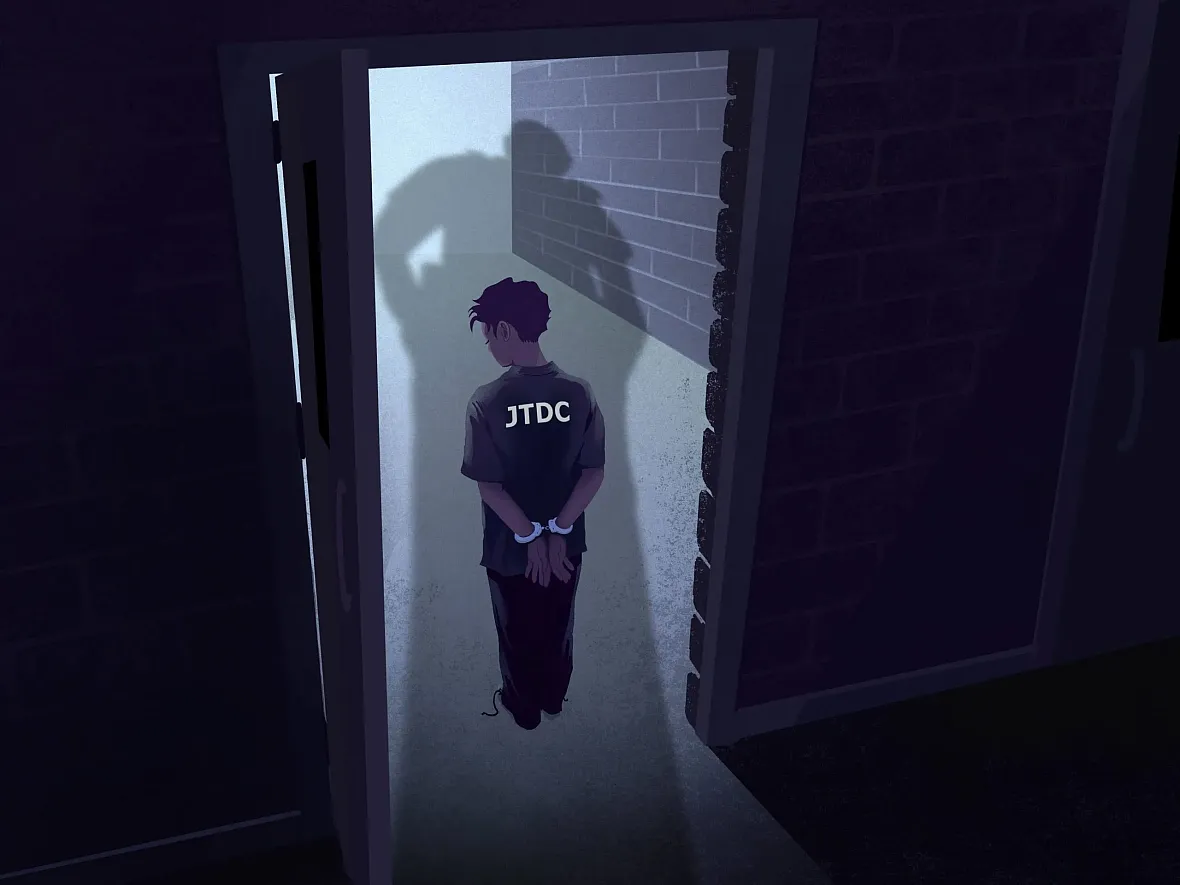
Illustration by Verónica Martinez
For decades, allegations of child abuse and employee misconduct have swirled around Chicago’s juvenile detention center. But on Thursday, a Cook County judge will begin proceedings in a rare trial of a former employee accused of physically harming a child at the facility.
Kevin Walker, 58, a former rapid response team specialist at the Cook County Juvenile Temporary Detention Center, is facing felony charges of aggravated battery and official misconduct for allegedly injuring a child at the facility in December 2023. This is the first time in more than a decade that a current or former employee has been criminally charged with hurting a child at the detention center.
The trial comes on the heels of a class-action lawsuit filed last year by more than 300 former detainees who claim they were sexually and physically abused while at the detention center going back to the early 1990s. In recent years, the facility has also faced scrutiny from outside experts who say staffers use dangerous and excessive restraint practices and are sometimes “entirely inhumane” to the children they oversee.
“It can be really hard to prosecute these cases,” said Candice Jones, former director of the Illinois Department of Juvenile Justice and now president and CEO of the Public Welfare Foundation, a Washington, D.C.-based nonprofit that supports criminal justice reform. “To bring a prosecution, [detention center officials] would have needed to work with the prosecutors’ office to turn over whatever evidence they had. … And as horrible as it sounds, a lot of times, systems won’t do that.”
Walker was first hired to work at the detention center in 1996, according to county payroll records. At the time of the alleged incident, he worked on the rapid response team, whose members deal with behavioral crises and are referred to as “rovers” by children and other staff.
According to internal reports obtained through a public records request, around 7:45 a.m. on Dec. 14, 2023, Walker and another rover, Michael Collins, responded to a call about a 15-year-old boy who was threatening and yelling obscenities at employees and refusing to leave his cell. After multiple attempts to get him to comply, the rovers handcuffed the boy and escorted him to a holding pod, an area that contains several individual cells.
Once there, Walker asked Nsisong Ekanem, an employee assigned to the holding pod, for a room in which to place the boy. According to a report Ekanem wrote later that morning, he jokingly told Walker to place the boy in Room 12, “since he looks like [he’s] 12” years old.
There are conflicting reports about what happened next. In his report, Ekanem said he turned his back to open the cell door and heard what sounded like the boy resisting, “due to rapid response telling the resident to ‘calm down’ repeatedly.”
According to a report Collins wrote later that morning, the boy attempted to run out of the room while still handcuffed but was blocked by the rovers, causing the boy to fall and hit his head on the floor.
According to Walker’s account of the incident, the boy threatened Ekanem and attempted to lunge at him while handcuffed. Walker said he then placed the boy in what he described as a “one-arm restraint” and “took him to the floor.” He said the boy was then placed chest-first on a bed in the cell, at which point his handcuffs were removed. According to Walker, the boy had no visible marks or injuries when rovers left the room. They then notified the facility’s nurse about the incident.
But according to a Chicago police report obtained through a public records request, Walker, who was 6 feet 1 inch tall and weighed 190 pounds, threw the boy to the floor while his hands were cuffed behind his back. The boy, who was 5 feet 5 inches tall and weighed 120 pounds, “had no way to catch his fall and landed head first on the floor,” according to the report, causing the boy to suffer “visible bruising” and swelling to his face and head and to lose consciousness. According to Walker’s arrest report, which was obtained through court records, the boy “became immobile for a period of time.” He was then taken to John H. Stroger Jr. Hospital for treatment and was released that same day back to the detention center, where he was placed in the medical section to monitor his recovery.
Detention center policy allows for the use of force to “subdue violent residents,” to separate participants in a fight, or to prevent children from escaping, injuring others, or damaging property. Physical force can be used only for however long it takes to de-escalate the situation. Physical restraints that place any pressure on or near the neck, restrict the airway, reduce the detainee’s ability to breathe, constrain circulation, or use pain for compliance are prohibited.
State law limits the use of force to situations in which a youth’s behavior is an immediate threat to themselves or others. It also requires employees to use the least restrictive response necessary and only for the period of time necessary for the youth to gain control of themself. The law specifically prohibits restraining youths in a manner that restricts the airway.
“In terms of physical engagement, force should only be used when a youth is a real threat to someone else — another youth or staff in the facility,” said David Muhammad, a juvenile justice expert who is the executive director of the National Institute for Criminal Justice Reform and was previously a federal court-appointed monitor overseeing juvenile justice reforms in Illinois. “It should be a very high bar to use physical force when a young person is already [handcuffed].”
At 4 p.m. on the day of the 2023 incident, Chicago police officers were dispatched to the juvenile detention center for a call of a battery report. According to the police report, officers didn’t arrive until 5:43 p.m. Once there, officers said they couldn’t determine the seriousness of the boy’s injuries because of how much time had passed. The officers also attempted to get more information about Walker but were told it would have to be subpoenaed, according to the report.
According to county payroll records, Walker’s employment was terminated three months after the incident. Three months after that, in June 2024, he turned himself in to police, according to his arrest report. He was initially charged with two misdemeanor counts of child endangerment and reckless conduct. Prosecutors later upgraded the charges.
Walker and his attorney declined to comment for this story.
None of the other employees who allegedly were involved in the incident have been criminally charged. In an email, Ekanem told Injustice Watch that he was not accused of wrongdoing and that he had no involvement beyond performing his standard duties. Injustice Watch could not independently verify his claim.
Collins could not be reached for comment.

The Cook County Juvenile Temporary Detention Center, at 1100 S. Hamilton Ave. on Chicago’s Near West Side, holds about 200 children on average. Children as young as 10 can be held there, but most detained kids are between 14 and 18 years old.
Injustice Watch file photo
Trial could reveal previously withheld records
Surveillance cameras at the facility captured video footage of the incident that was later inventoried by the Chicago Police Department. In April, Injustice Watch filed a public records request for the video. In May, we also requested any additional police reports related to the case.
On June 9, CPD denied the request for the video, saying its release would “jeopardize the fairness of the ongoing trial.”
The following day, Injustice Watch also attempted to get Walker’s personnel file, including any disciplinary records, from Cook County Circuit Court Chief Judge Timothy Evans, whose office oversees the detention center. In Illinois, county-run juvenile detention centers fall under the scope of the judiciary, which is not subject to the state’s public records laws.
On June 27, Cook County Circuit Court Judge Kenneth Wadas, the judge in Walker’s criminal case, signed an order blocking the City of Chicago from releasing any materials while the case is pending in court. CPD subsequently denied Injustice Watch’s request for any additional reports related to the case, citing the judge’s order.
Evans’ office has not provided Walker’s personnel file despite multiple requests. Nor would Evans comment on a detailed list of questions about Walker’s time as a juvenile detention center employee, the allegations against him, or the trial, citing Illinois Supreme Court ethics rules prohibiting members of the judiciary or their staff from commenting on a pending case.
However, previously unreported records obtained by Injustice Watch show that Walker was also accused of harming children at the detention center on at least five prior occasions.
In 2007, the mother of a 14-year-old boy filed a complaint accusing Walker of choking her son three separate times. During one alleged incident, the boy told juvenile jail investigators, Walker also punched him in the abdomen and slammed him into a locker. Investigators determined the allegations were unfounded, citing a lack of evidence.
In 2011, Walker was accused of choking another boy at the facility while breaking up a fight. The boy told detention center investigators Walker also punched him on the head and neck. Investigators determined the allegations were unfounded based on conflicting reports from witnesses and because the boy did not suffer any visible injuries.
In 2014, detention center officials opened an investigation into Walker after a supervisor filed a complaint on behalf of a boy who accused Walker of physical abuse. According to the report, the boy told investigators Walker grabbed him by the neck and threw him to the ground while responding to a group fight. The boy said Walker twisted his arm behind his back while attempting to put him in handcuffs, causing his shoulder to dislocate.
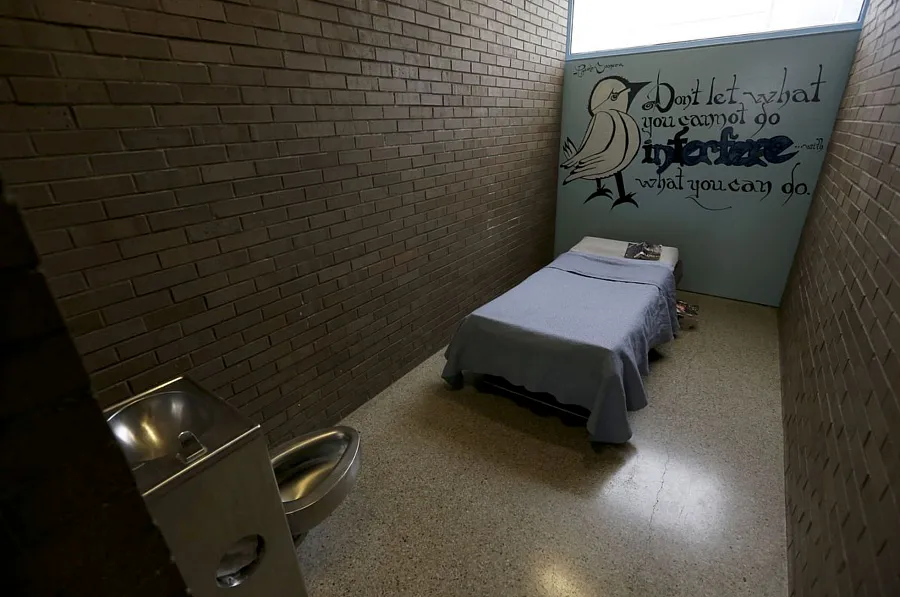
A room at the Cook County Juvenile Temporary Detention Center. A blue ribbon committee convened by Chief Judge Tim Evans found that conditions at the JTDC were “isolating and deprivational.”
Photo from the Blue Ribbon Committee on the JTDC
Though a nurse documented swelling in the boy’s shoulder, investigators determined the use of force by Walker was “justifiable and consistent with policy, procedure, and training” based on witness accounts. Investigators marked the allegation unsustained and closed the case.
This is not the first time Cook County prosecutors have brought criminal charges against a current or former juvenile detention center employee accused of harming a child at the facility. According to news reports from the Chicago Sun-Times and other outlets, in 2014, 27-year-old Michael Lynch was charged with aggravated battery and official misconduct after allegedly body-slamming a 15-year-old boy, knocking him unconscious and giving him a concussion.
Records from the case are not available in the court’s database, and Evans’ office did not respond to questions about the outcome.
Disturbing allegations of physical and sexual abuse by other detention center employees are raised in the class-action lawsuit. In one case, a plaintiff alleged an unknown employee raped and attacked him on at least three different occasions in 2001. The plaintiff recalled being slammed to the ground and restrained to the floor, causing severe injuries to his neck and back.
In a separate case from 2013, another plaintiff reported being groped, fondled and digitally penetrated approximately seven or eight times by one employee while another restrained him and watched the abuse. The plaintiff also reported being fondled by the same two employees during pat-downs and strip searches.
In a 2023 watchdog report by Equip for Equality, a nonprofit disability rights group, youths describe incidents in which they say rovers and other staff used overly aggressive and potentially deadly restraint practices. In one case, several youths reported witnessing a boy experience a seizure after being restrained facedown by multiple employees. In another case, a boy reported being “put on his head” and dropped to the floor by two rovers who then held him on the ground. One climbed atop the boy’s back while the other held his arms and legs for about 30 seconds, the boy said. Youths also reported a range of other injuries, including “busted” eyes, an injured lip, an injured shoulder, bleeding, and dizziness.
Evans’ office has declined to comment publicly on the allegations raised in the lawsuit but has indicated in court documents that it intends to file a motion to have the case dismissed.
In a letter responding to the watchdog report, detention center Superintendent Leonard Dixon denied the use of physical force as punishment. He also said the use of restraint was exercised “if, and only if all other de-escalation techniques fail and the resident continues to present as a physical danger to themselves or others.”
Walker’s bench trial before Judge Wadas is expected to start Thursday.
In 2020, Injustice Watch reported on Wadas’ history of reversals by the Illinois Appellate Court. At the time, the investigation found his rulings had been reversed by the appeals court 25 times in six years, often for disregarding a law that prevents excessive sentencing or incorrectly dismissing prisoners’ postconviction claims. Wadas declined to comment at the time.
Prosecutors have compiled a list of witnesses they may call to testify in Walker’s case, including the teen and other detention center employees. Prosecutors are also expected to show video footage of the incident.
“Whether it be a deterrent, whether it be setting a precedent that we won’t allow young people to be abused in our facilities, the accountability part is key,” Muhammad said of the trial. “Although you want to do everything you can to stop abusive behavior, what is very important is when it happens, for there to be swift and certain accountability.”