

I set out to examine hunger in one of America’s wealthiest states. Then everything got worse.

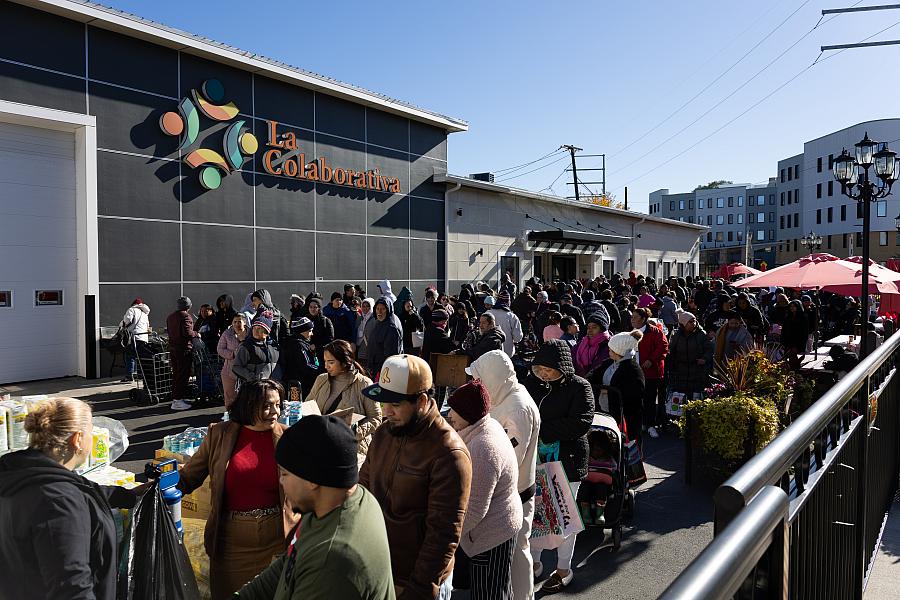
People wait in a long, winding line to pick up food at La Colaborativa, a social services organization in Chelsea, Massachusetts, on Nov. 1, 2025.
(Photo by Natalia Aponte Reyes/La Colaborativa)
Just a few weeks into my investigation into why hunger was increasing in Massachusetts, one of the wealthiest states in the country, the story took a rapid turn.
I began the project after a report from the Greater Boston Food Bank, the region’s largest food aid organization, and Mass General Brigham, its largest health care system, found that more than one in three Massachusetts residents were unable to afford sufficient food at some point during the previous year. Yet the issue seemed invisible to the general public. For something so common, it wasn’t often covered in the news.
I planned to spend several months reporting on the problem before publishing a series of stories in the spring. That plan evaporated when the Trump administration suspended benefits from the nation’s largest food aid program in October 2025 amid a weeks-long federal government shutdown.
President Trump’s move was unprecedented, policy experts said. The Supplemental Nutrition Assistance Program, or SNAP, provides 42 million people nationwide with grocery assistance. The average household relies on it for about $350 each month. At food pantries, lines stretched around the block and food flew off the shelves as families worried whether they would have enough money to last the month.
Suddenly, hunger was no longer undercovered by the news media. The story I planned to spend months researching was now playing out in real time. The community needed information on the issue immediately — not in March, when I originally planned to publish my work. By then, who knew what would change?
While the project continued to focus on understanding how hunger was pervading Massachusetts, I shifted to publishing stories on a rolling basis. With each story, my editor and I considered what I could say about the topic that other news organizations were not covering. We wanted to show how hunger had spread through Massachusetts in ways our readers may not have considered.
In the following months, I reported on the crushing demand food pantries faced even before SNAP disappeared and examined how the escalating cost of living in Massachusetts forces families to make impossible choices between paying for food and other essentials. I reported on the quiet challenges working families face affording food in one of the region’s best-known vacation destinations and on the spread of hunger in some of the state’s wealthiest communities. In each story, I paired traditional reporting with data analysis, allowing us to show, for example, the correlation between the burden of housing costs and SNAP participation, or how vast swings in unemployment contributed to hunger in a seasonal tourist economy.
With SNAP benefits suspended by the Trump administration, I spent early November speaking with food pantry staff across the state and the families they serve. Some of the pantries I contacted were simply too overwhelmed to speak as lines grew and supplies dwindled. But many took the time to explain the unparalleled demand they were facing.
From many pantries, a theme emerged. Yes, they were busier than ever. But even before President Trump suspended SNAP, the pantries were facing demand they never could have foreseen a few years prior.
As we gathered data from multiple pantries, the numbers consistently showed a distinct increase in demand during and after the COVID-19 pandemic. The lockdowns and economic disruptions led many more families to seek food assistance. However, as the pandemic waned, the cost-of-living crisis fueled by inflation continued to push food pantry demand to record highs through 2025.
“While the federal aid cutoff this month was a rogue wave that sent food pantries reeling, the tide was already at their doorsteps,” my story, published the week before Thanksgiving, read.
Reporting the story offered a lesson that proved important throughout the project and in other work covering similar subjects. Many people are hesitant to talk about hunger, a deeply personal and often uncomfortable topic to discuss in public. The result, food pantry staff told me, is that many people suffer in silence, unwilling to let their families, friends or neighbors see their struggle.
Finding people willing to discuss their difficulty affording food took time, care and trust. It required treating them with respect and assuming nothing about their background or circumstances. Often, I explained the focus of my story and why I was interested in hearing firsthand from people who could not afford enough food. I stayed in touch with some people for weeks or months before quoting them in a story.
Our second story delved further into the central question of why more people in Massachusetts were struggling to feed themselves: The cost of living in the state is staggeringly high, forcing families to choose between food and other essential expenses.
For most families, housing absorbs the largest share of the budget. Working with MaryJo Webster, my senior fellow and the data editor of the Minnesota Star Tribune, I used U.S. Census data to show that about one in six households in Massachusetts pays more than half its income on housing. It’s the highest rate in New England and among the highest in the country.
Further, the data showed a correlation between the burden of housing costs and the number of families seeking food assistance. We found that neighborhoods with the highest share of families paying half their income on housing are about 20 times more likely to also have a high concentration of SNAP recipients.
“People are in the red after they pay rent,” one of the state’s most prominent anti-hunger advocates told me. “Food is the tradeoff because you can’t stretch your rent or utilities.”
We didn’t have precise data on hunger at the local level, but we did have the tools to show how burdensome costs of living strain families’ food budgets. My reporting and interviews showed how families cut back on food as other financial constraints arise. The Census data on housing costs as a percentage of household income allowed me to describe just how significantly rents and mortgages can eat into a family’s funds. By merging that data with SNAP participation rates at the census tract level, I was also able to demonstrate how high housing costs are tied to food assistance needs.
In two following stories, we aimed to show further how hunger hides in an affluent state, first by examining the issue on Cape Cod. The Cape has a reputation among outsiders as an affluent summer vacation destination, but many year-round Cape Codders struggle to make ends meet in the winter. I used state data to show how unemployment rates in the most seasonal Cape Cod communities can swing from 3.5% in July to more than 20% by February. In a pricey, highly competitive housing market, year-rounders have limited affordable housing options. This story provided another example of how a data source not explicitly tied to hunger could still help explain why people are struggling to feed themselves.
Both the cost-of-living and Cape Cod stories relied on joining multiple datasets — another lesson in how data often does not arrive in the precise format we want.
In our final story, we focused on how hunger lurks in even the most affluent communities in Massachusetts. In one community we examined, the food pantry was across the street from a row of luxury car dealerships. It was a reminder of the state’s vast economic disparities and a sign that even amid tremendous wealth, some residents are going hungry.
But as the story described, available data can fail to fully capture the scale of hunger at the local level. As I discussed with my senior fellow and editor, sometimes the lack of data itself is the story.
The series would have looked very different had I not pivoted quickly in November to respond to the president's suspension of SNAP. It likely would not have been as timely, nor would it have been as effective at showing readers and policymakers the hidden stories of hunger in their state. But by following the story as it evolved around me, I was able to examine it in ways others were not.