

Clinica Sierra Vista, a Safety Net for the Uninsured
This story was produced in collaboration with the Bakersfield Observer as part of the 2026 Ethnic Media Collaborative, Healing California.


Ana Velasquez, Clinica Sierra Vista's HIAP program manager stands in her East Baskersfield office. "Healthcare is not immigration enforcement. We make that very clear.”
Cecil Egbele
On a chilly February morning in East Bakersfield, a handful of patients waited at Clinica Sierra Vista for routine checkups or to find out whether they still qualify for Medi‑Cal. Some were seated, a few were women with children, others were farmworkers who spoke little or no English.
Maria, an undocumented immigrant from Mexico, had previously received Medi-Cal. The middle-aged woman came to Clinica Sierra Vista to find out whether she still qualified for renewal in the state-federal health insurance program. At the front desk, receptionist Cindy Panduro helped her fill out an intake form with questions about income and family size–but not citizenship status. With the forms in hand, Maria moved to the next stage of verification and enrollment.
For many families, immigrant and citizen alike, access to healthcare is shaped not just by income or employment, but by fear: fear of being cycled through appointments without being attended to, fear of paperwork, fear that seeking care could carry consequences beyond the clinic walls.
These fears are what the Health Insurance Assistance Program (HIAP) at Clinica Sierra Vista confronts daily and aims to solve. Given that Medi-Cal is currently facing major cuts and undocumented adults in California are now locked out of enrollment – consequences range from untreated illness to financial ruin.
A Door Closes
California's budget freeze on new Medi-Cal enrollment for undocumented adults marks a sharp policy reversal in a state that once pledged universal eligibility. Statewide, roughly 1.7 million undocumented immigrants are enrolled in full-scope Medi-Cal, according to the California Legislative Analyst’s Office, but a February 2026 report from the UC Berkeley Labor Center projects combined state and federal cuts will leave 29,000 fewer Kern County residents covered by 2028, part of the 2.98 million losing coverage statewide.
And anyone newly enrolled after January 1, 2026? The door is closed, and they cannot get back in.
Last year, more than 33,500 residents turned to Clinica Sierra Vista's Health Insurance Assistance Program for help securing coverage. For those patients, the clinic’s sliding-fee program is often the only option left.
Clinica Sierra Vista is ground zero for Kern County's worsening healthcare access, and a warning of what awaits California's immigrant communities statewide.
A Program Built on Trust
"At Clinica Sierra Vista, we don't want to know your immigration status," said Ana Velasquez, HIAP program manager. Cheerful and in her early sixties, she has been running this program for more than three decades.
The clinics are open for you. Whether you're here legally or not, whether you're a citizen or not.
Ana Velasquez
Health insurance paperwork, Velasquez added, can easily intimidate those unfamiliar with the system — especially those navigating it in a second language. “A lot of the people who come to our clinics are farmworkers who don't know how to read. So we do it for them."
Maria, the woman from Mexico, waited in Area F, a shared seating space that also serves WIC patients, the Special Supplemental Nutrition Program for Women, Infants, and Children. A mural of monkeys climbing tree houses and an elephant on a bicycle stretches across one wall.
After six minutes, Maria was called in by HIAP supervisor Miriam Asayadi. HIAP staff sit with patients to complete Medi-Cal applications, gather income documents and rent receipts, upload materials to Kern County’s BenefitsCal system, and track each case until a Notice of Action arrives.
With the new Medi-Cal policy in place, every application carries a higher stake; even an income fluctuation by a few hundred dollars can cost Maria her full coverage with no way to get back in.
When the county requests additional verification, such as immigration documents for those who qualify, families return to Clinica Sierra Vista for help deciphering the bureaucratic language.
“I am happy to come here,” Maria said later. “They help me fill out all my forms.”
Leaving the clinic, she hoped her coverage would be secured for another year.
The Three-Tier Safety Net
Martha and Octavio, a mixed-status couple, have been receiving that help firsthand from Clinica for 20 years. Martha is a legal resident, while Octavio is an undocumented farmworker.
"I feel safe coming because I don't know how to read in English," Martha said. “Clinica staff helps to process my insurance or any paperwork that I have to do."
HIAP follows a sequential approach to coverage. First, staff try to enroll patients in Medi-Cal, California’s Medicaid program, which covers most of Clinica Sierra Vista’s patients. If an applicant earns too much for Medi-Cal and has legal status, staff turn to Covered California, the state's insurance marketplace, where subsidies previously helped many Kern County residents dramatically reduce their premiums — in some cases to near zero. With those enhanced subsidies now gone, Covered California projects enrollees in Kern County face average premium increases of 160%.
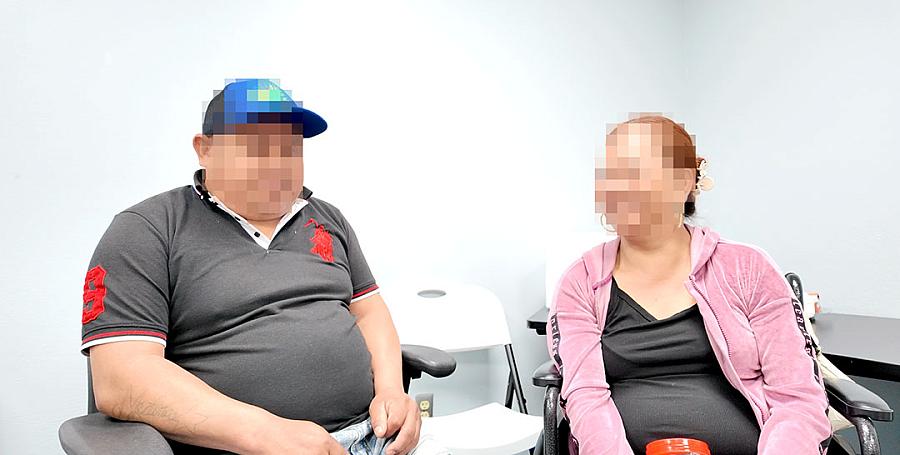
Martha and Octavio, a mixed-status couple, have been receiving help from Clinica for 20 years.
Cecil Egbele
But when neither program is accessible, or immigration status blocks access to Covered California, what then?
“There are a lot of small businesses that don’t provide insurance,” Velasquez said. “So we have what we call Clinica Sierra Vista’s sliding fee scale program.”
In 2025, Velasquez's team helped 33,680 people in Kern County navigate that maze: processing Medi-Cal renewals and new enrollments, signing families up for Covered California plans, completing CalFresh applications, and assisting qualifying patients enroll in their sliding-fee program. Available at community health centers across the country, sliding fee scale programs charge patients based on income — sometimes as little as $20 per visit. It is the safety net beneath the safety net.
At Clinica Sierra Vista, patients with incomes below 200% of the Federal Poverty Level qualify for one of four discount tiers. Those in the deepest tier, "Category A", pay a flat $25 copay per doctor visit.
But Clinica’s safety net catches more than just the uninsured.
Why Patients Stay
Luisa Varnado, 32, a Black U.S. citizen, is not concerned about ICE or being frozen out of Medi-Cal; her story is different. Her journey to Clinica Sierra Vista began after seeing her primary care doctor “on the higher end of town” and getting nowhere.
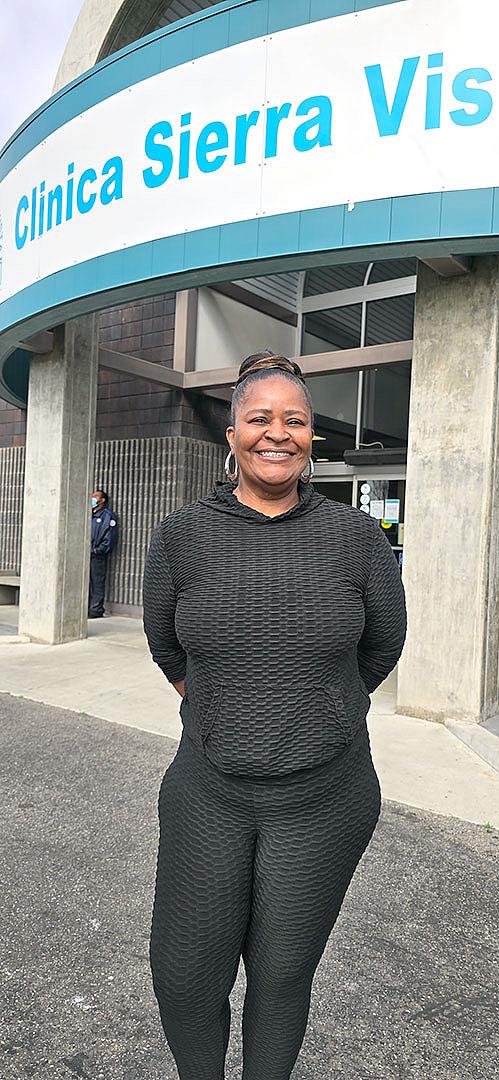
Luisa Varnado stands outside Clinica Sierra Vista in East Bakersfield, where she has been coming for care for nearly a decade.
Cecil Egbele
Then came the diagnoses: two kinds of arthritis — rheumatoid and osteoarthritis — one causing her immune system to attack her joints, and the other slowly grinding away the cartilage cushioning her bones.
At her age, this is an uncommon and devastating diagnosis. Luisa has already replaced both knees. Her shoulders and hips may be next.
"The level of care was just not personal," Varnado said of her previous doctor. "It kind of became, 'Just come in so we can bill your insurance.' That's the way I felt." No one investigated what was wrong until she insisted, based on a friend's suggestion, that they test her for rheumatoid arthritis.
At Clinica Sierra Vista, Luisa says it’s different. "The care that I receive here is personal, is one on one," she said. "Whenever I book an appointment, I'm always able to see my primary care doctor."
She's been here almost 10 years. "I don't want to go anywhere else."
A Decade of Progress, Then a Freeze
The timing of California’s enrollment freeze could not be more jarring.
Those currently enrolled will keep their coverage as they complete their annual renewal – and children under 19 and pregnant people can still newly enroll regardless of immigration status.
But the safety net is already wearing thin. Dental benefits for undocumented adults will end in July 2026, and starting in July 2027, adults ages 19 to 59 – but not seniors 60 and older, who will retain full coverage – will be required to pay a $30 premium to maintain coverage.
"When people lose dental coverage, they don’t stop needing care, they end up in the emergency room with preventable problems, so these so‑called savings just kick the costs down the road," said Ronald Coleman-Baeza, Managing Director of Policy at California Pan-Ethnic Health Network.
On a bright summer morning in July 2021, Governor Gavin Newsom traveled to Clinica Sierra Vista's Elm Community Health Center in Fresno. The clinic was bustling with families getting COVID-19 vaccinations. Nurses moved between rooms, providing routine care. Standing before healthcare workers and community members, Newsom signed AB 133 into law, holding up the bill for cameras as he promised that roughly 235,000 undocumented Californians age 50 and older would finally gain full-scope Medi-Cal.
"It's a point of pride, it's a point of principle, and it's what marks our values here in the state of California," Newsom told the crowd. "We believe in living together, and advancing and prospering together across every conceivable difference."
By 2026, that celebration would feel distant.
After more than a decade of organizing by the Health for All coalition — a network of more than 150 immigrant-rights groups, health advocates, nurses, doctors, and clinics — the state reached a milestone in January 2024, completing a phased expansion that had extended Medi-Cal to undocumented Californians in waves since 2016, finally covering the last remaining group, adults ages 26 to 49.
"We got California to be one of the first states in the country to open its Medicaid program regardless of immigration status," said Carlos Alarcón, a health policy manager at the California Immigrant Policy Center and co-lead of the coalition. Lawmakers celebrated the moment as a national model.
But the ink was barely dry before the reversal began.
Some legislators have argued that the freeze does not technically remove people from Medi-Cal. Advocates say in practice it does. "If someone's income fluctuates, and that's very common, they might not qualify at the start of the year but would later," Alarcón said. "Under the enrollment freeze, they lose the ability to reapply. Functionally, that's a loss of coverage."
"The governor is presenting a false choice," said Ronald Coleman-Baeza, Managing Director of Policy at California Pan-Ethnic Health Network. "The argument is that federal policy forces California's hand. But the state has covered this population before, both before and after federal changes. This is a state decision."
The Race Before the Door Closed
At Clinica Sierra Vista, staff saw the freeze coming.
When California announced the enrollment freeze in mid-2025, community health centers faced a dilemma: how to process thousands of renewals before undocumented adults lost eligibility forever.
Velasquez's team had months to prepare. They called patients individually, set up enrollment events at churches and farmworker camps, and urged people to bring county paperwork to the clinic for help with responses.
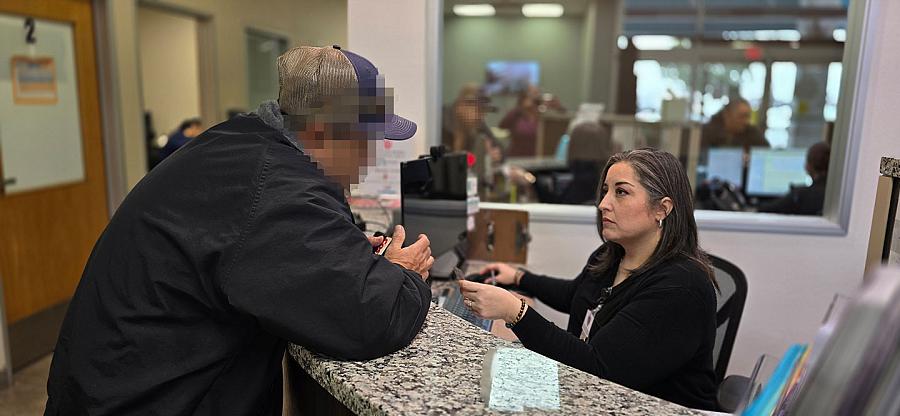
Cindy Panduro, the receptionist at Clinica Sierra Vista's East Bakersfield location, helps a man at the front desk.
Cecil Egbele
"We told people: ‘You have to complete your renewal,'" Velasquez said. "If you don't, and you don't have immigration status, come January 1, you're out.”
For those who managed to renew, even as late as December 31, the effort meant another year of full Medi‑Cal coverage. Those who missed it, or who needed to apply for the first time after January 1, faced a different reality.
"If you don’t have immigration status," Velasquez would now tell first-time applicants, "all you're going to get is emergency Medi-Cal."
A Safe Place Amid Fear
Even for those eligible to renew, fear of data-sharing and immigration enforcement continues to keep many from seeking care until their conditions become emergencies.
That fear spiked after federal agencies shared Medi-Cal data with ICE in July 2025, with a federal court only temporarily blocking it in August (a ruling that could still change). For those considering dropping coverage out of fear, canceling now won't erase data already shared.
"People are afraid of going to hospitals because they think their information may be shared, especially if they are undocumented," said Alarcón, of the California Immigrant Policy Center. "That fear delays care, and delayed care leads to worse outcomes."
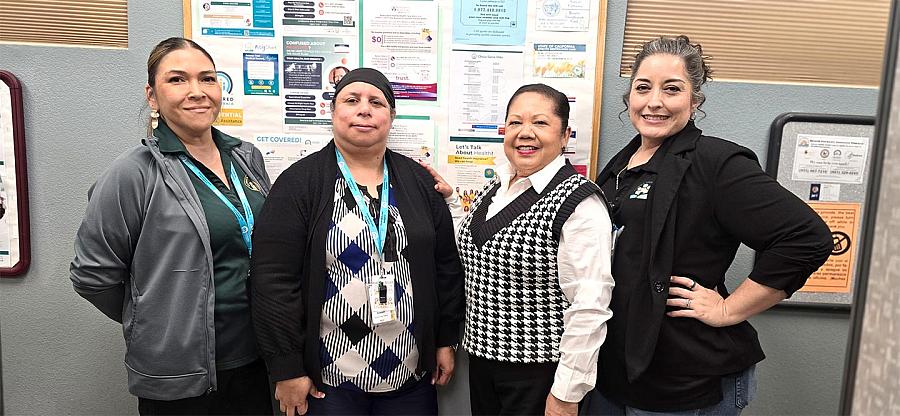
The staff of East Bakersfield's Clinica Sierra Vista from left to right: Eloiza Zuniga, Miriam Asayadi, Ana Velasquez, and Cindy Panduro.
Cecil Egbele
For Martha and Octavio, the couple who've been coming to Clinica for 20 years, that fear is both daily and immediate.
"We are afraid," Martha said. "I am a resident, but he's not. Even though I can provide my immigration status, I am more afraid for him. But we feel safe at Clinica.”
Just recently, Octavio was at work when Martha heard that immigration enforcement was on the road. She called Octavio to warn him. "I’m always afraid," she said. Asked what they would do if Clinica Sierra Vista were not available, they answered in unison: “We would not go to see a doctor.”
Healthcare is not immigration enforcement. We make that very clear.
Ana Velasquez
Trust Built Over Decades
Velasquez's office in Bakersfield maps the territory she covers. Behind her laptop, sticky notes in every color track urgent reminders, staff counts for Kern and Fresno counties, callback times, and case numbers. A bookshelf to her left holds binders organized by program and county, red for HIAP, blue for enrollments, and white for individual locations like Delano and Fresno. On the bottom shelf, manila envelopes stuffed with applications wait their turn.
Born in Honduras and raised in Los Angeles, Velasquez came to Bakersfield in 1992 and built a migrant health project that took food and health information directly to the farmers tending the fields.
It was familiar ground.
When Velasquez joined Clinica Sierra Vista, the organization had already grown well beyond its 1971 beginnings, a single trailer in Lamont serving farmworkers under the name Clinica de Los Campesinos, or “Farmworkers Clinic.”
Almost thirty-four thousand patients in Kern County alone depended on that system last year. Now, barely two months into 2026, Velasquez's team is already fielding new applications, tracking renewals, and managing another year's worth of cases.
"I found what I really enjoy," she said of those early summers visiting the fields in Lamont, south of Bakersfield. "Farmworkers hold a special place in my heart.”
Maria's renewal notice from the county arrived 10 days later, with an approval that keeps her on Medi-Cal for another year. For the thousands of others still waiting, Clinica's sliding fee may be the last option left.