

She Survived Cancer: Now She's Fighting to Keep Her Insurance
This story was co-published with Radio Bilingüe as part of the 2026 Ethnic Media Collaborative, Healing California.

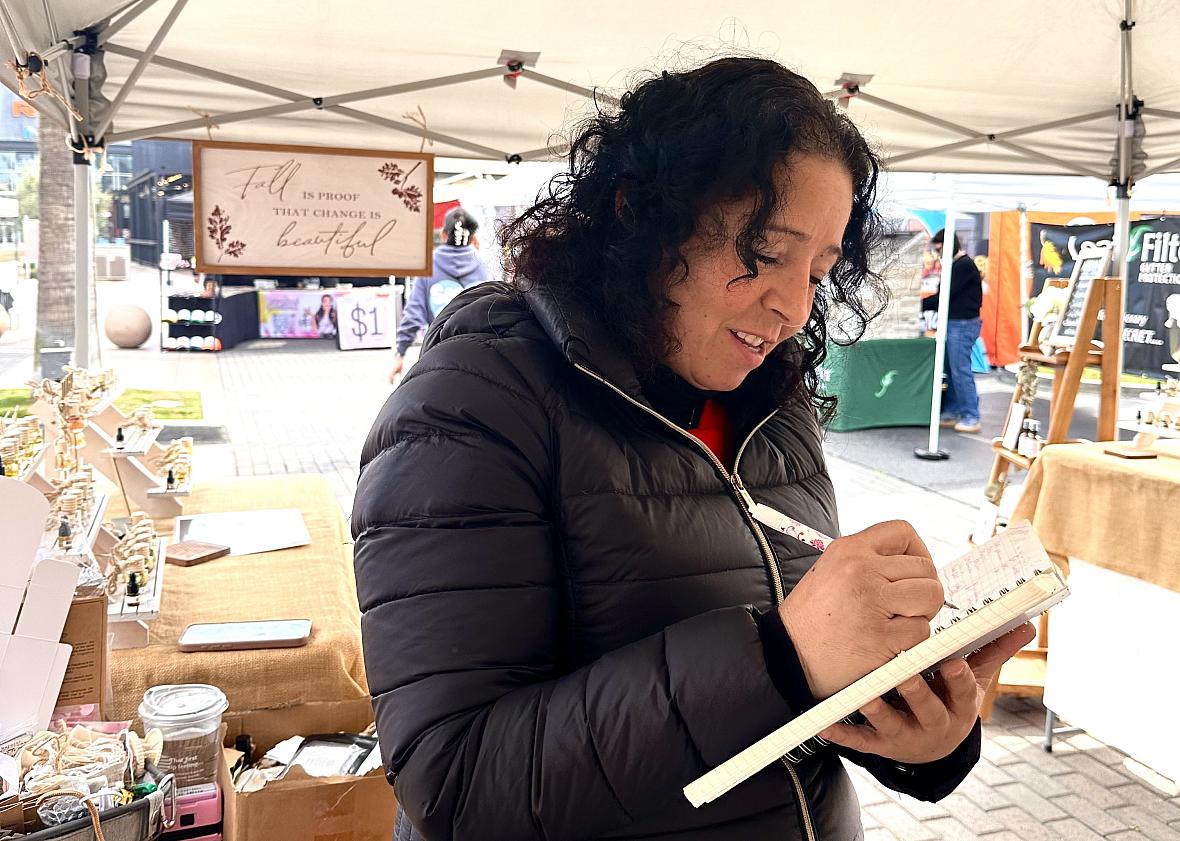
Fresno vendor Ana Barraza of Aroma by Ana writes up a sale for a customer.
Daniela Rodriguez
Until recently, Ana Barraza’s life struck a delicate balance, divided between juggling a part-time job and her small business, where she sells essential oils.
“Here we have car diffusers. I make all of these with essential oils. I dry flowers and put a little detail inside the bottles.”
But all that changed this January, when her health care premium shot up to almost $400 to $200 more than last year. As a breast cancer survivor, the immigrant from Guadalajara, Jalisco knew she couldn't go without being insured. But the skyrocketing cost means she now has to work extra days at local markets just to afford her health insurance.
“If another opportunity comes up, I’m going to do it because it will be some extra money that will help with expenses that have already gone up.”
Ana's family is one of the 160,000 California families who lost access to subsidies through Covered California that made it possible for their family to get insured.
“It’s a really hard hit. I consider myself a very hardworking woman, and I have two jobs because with just one job, I wouldn’t be able to cover my medical expenses, my dental costs, food, gas, all of that. With only one job, I just couldn’t make it!”
Ana has been recovering from surgery, months of infusions, and 16 rounds of radiation.
“It’s just where they remove the part that has the cancer. They don’t remove the whole breast or anything.
She shows me a medical bill on her phone which states that last year in October her insurance covered 76,000 dollars for her surgery, but there were still significant out-of-pocket costs.
“About $7,000, as you can see down here.”
To keep up with her health insurance, and to not feel too tight on money, Ana says that starting in 2026, she knew she had to make an extra $700 each month.
“I think I’ll have to do one more event each week just to not feel so tight with these changes to my health coverage.”
For years, a federal program helped lower the cost of health insurance for millions of Americans buying their own coverage, but at the end of 2025, those subsidies expired — and the massive budget package signed by President Trump last year did not renew them either.
And this year, new Latino sign-ups during Covered California's open enrollment period plummeted in the San Joaquin Valley, from 16,272 in 2025 to 11,405 in 2026 — a drop of nearly 5,000 people.
Alex Hernández is a health insurance agent in the San Joaquin Valley. I visited him at his Covered California office, and he confirmed the sharp drop in enrollments.
“Yes, we have families who did not renew because their price went up a lot. And that’s understandable. There were families here in the Central Valley paying less than $50. There were some paying nothing.”
That was thanks to a pandemic-era boost to federal subsidies that made coverage dramatically more affordable — ensuring no family paid more than roughly 8.5% of their income on premiums, and extending help to middle-income families who hadn't qualified before. But when those enhanced subsidies expired at the end of 2025 and weren't renewed, the families hit hardest were those with slightly higher incomes. People like Ana.
"What we are doing is trying to assess their cases to see if we can help them," Hernández said.
In the San Joaquin Valley, almost one in five people enrolled in Covered California are independent workers. And more than 40% of all enrollees in the region are Latino.
Like Ana, people who work for themselves depend on this system to take care of their health. Aside from her business, Ana also works as a teachers assistant at a local school.
“It’s a job I love, I’m fascinated by it, and they pay me well. But right now, with the economy, a part-time job is not enough. You need something more.”
That’s why she started Aroma by Ana almost three years ago with her sister.
But since her part-time job doesn't offer health coverage, and her income is too high to qualify for Medi-Cal, her only option has been to buy a private plan through Covered California, the state health insurance marketplace.
“I have the blue shield silver PPO plan.”
Then came January…
“That was when I got the surprise that the premium doubled, doubled! So I called the lady who helps me, and I said, ‘hey, what happened here?’ She said, ‘yes, Ana, at the start of the year, insurance rates increased, and Covered California was one of them.’”
When Ana found out about the cancer, she was paying $164 a month in premiums, which gave her access to mammograms, monthly injections, oncologists, and specialists.
“After the operation, my radiation sessions began. Because of the type of cancer I had, that was the recommendation. They gave me sixteen radiation sessions, which finished before December, and now I’m in recovery, and the treatment now is just some pills and some injections that I take every month.”
To cover the surgery, treatments, and medicine, having coverage was critical, especially in Fresno, where the median household income is less than 70,000 a year. Without insurance, the cost of care would devastate most families.
“I was diagnosed with breast cancer in August 2025. In October of the same year, I had surgery.”
In short, health insurance was a matter of life or death.
“At the moment, I thank God, it was very convenient because otherwise, my cancer would have been there.”
At the start of this year, Covered California brought together community leaders and health experts who urged people to stay insured, even though costs have gone up.
Congressman Jim Costa, who attended this gathering and represents parts of the San Joaquin Valley, including parts of Fresno in District 21, spoke about the impact of the end of the subsidies.
“In my congressional district, over 22,000 families, 22,000 families would be directly impacted if we are not able to come to some agreement.””
While the House of Representatives approved a bill to extend the subsidies last month, talks in the Senate have collapsed.
“What we’re seeing is that for that reason, in the Latino community, premiums are rising, increasing 122% per month, which is more than double.”
That’s Dr. Jeffrey Reynoso, and he works at Covered California. He explained to me that, in California, premiums have practically doubled for Latino communities. And the consequences are already starting to be felt.
“What we’re seeing is that this year, during the open enrollment period, people signing up have decreased by 39% in the Latino community compared to last year. So it’s significant.”
And now that the subsidies are gone, people are changing the way they choose their coverage.
“Thirty percent of people renewing their plans are switching from a Silver plan to a Bronze plan. Unfortunately, in Bronze plans, there are still many out-of-pocket costs.”
The Bronze plan is the cheapest Covered California plan. It works as a backup in case of a serious medical emergency.
Silver plans, on the other hand, have higher monthly premiums but cover a larger portion of medical expenses throughout the year. They are usually a better option for people who go to the doctor often, need prescription medications, or have a medical condition requiring constant care.
That’s why Ana cannot change plans.
“It doesn’t make sense for me to downgrade the plan. I take it away to save a few dollars, but it will cost me more later. Right now, every visit I go to with my primary doctor, I pay $50 extra; if they do a test, I pay a percentage of that. If I go to my oncologist, a specialist, I pay 85 or 90 per visit.”
Despite the change in premium costs, Dr. Jeffrey insists on not canceling health insurance and seeing it as a preventive measure.
“Because you never know when an accident could happen, and then it will be very difficult. Those hospital bills cost 20,000 or 30,000, so it’s about prevention and also access to preventive medical care. All plans in California, by law, have to cover preventive services for free.”
In other words, having insurance through Covered California guarantees free access to preventive care, like vaccines, medical check-ups, and screenings to prevent diseases.
Beyond what the law says, in practice, there are still thousands of people in the Central Valley without insurance. At a press conference, Annalisa Perea, Fresno city councilmember, described the situation.
“We know there is still work to be done: an estimated 147,000 people in the Central Valley remain uninsured but are eligible for coverage, including about 61,000 people who qualify for Covered California subsidies."
Although it’s still early for concrete figures on the subsidy expiration impacts, Covered California reported that in the San Joaquin Valley new Latino enrollment fell more than any other group.
Gladys Duron, who works as a Health Insurance Assistance supervisor at Clinica Sierra Vista, a network of community clinics in the Central and San Joaquin Valley says there is still financial help available for people making below the 400% federal poverty level.
“There are people who make a little more than the Medi-Cal limit, and those people are still receiving subsidies. There is still federal money available to help them pay for their insurance, but it depends on meeting a certain income level.”
For example if your income is between 40,000 to 106,000 for a family of three, you still qualify for ACA subsidies, just not as much as when the enhanced subsidies were in place, and there is still out-of-pocket help for lower income households, but only if you enroll in a Silver plan.
For Gladys, the focus right now is keeping people connected to care, even if they are uninsured.
“We have a discount program. It’s based on household size and how much people earn or have earned in the last 30 days. People bring in their most recent pay stubs, and we look at what discount they qualify for here. We also have many clinics where they can go to sign up.”
This sliding fee option can be applied to all services that Clinica Sierra Vista offers, like therapists, labwork, specialists, and more. She encourages community members to remember that help is available and to seek assistance if they need it.
“We can help them over the phone or in person, whatever they feel most comfortable with.”
As for Ana, she will have to continue paying her current health coverage costs.
“I have no choice, because if I don’t pay them, I don’t have coverage. And with my diagnosis or recovery, I need doctor visits and specialist visits. I think in two months I’ll have my first mammogram after the operation, so I’m going to need it, and I pray to God that everything goes well.”
Even so, Ana remains optimistic and continues producing fragrances…
“There are many options, not just one. I feel that there is hope for everything, and only if we are well-informed.”