


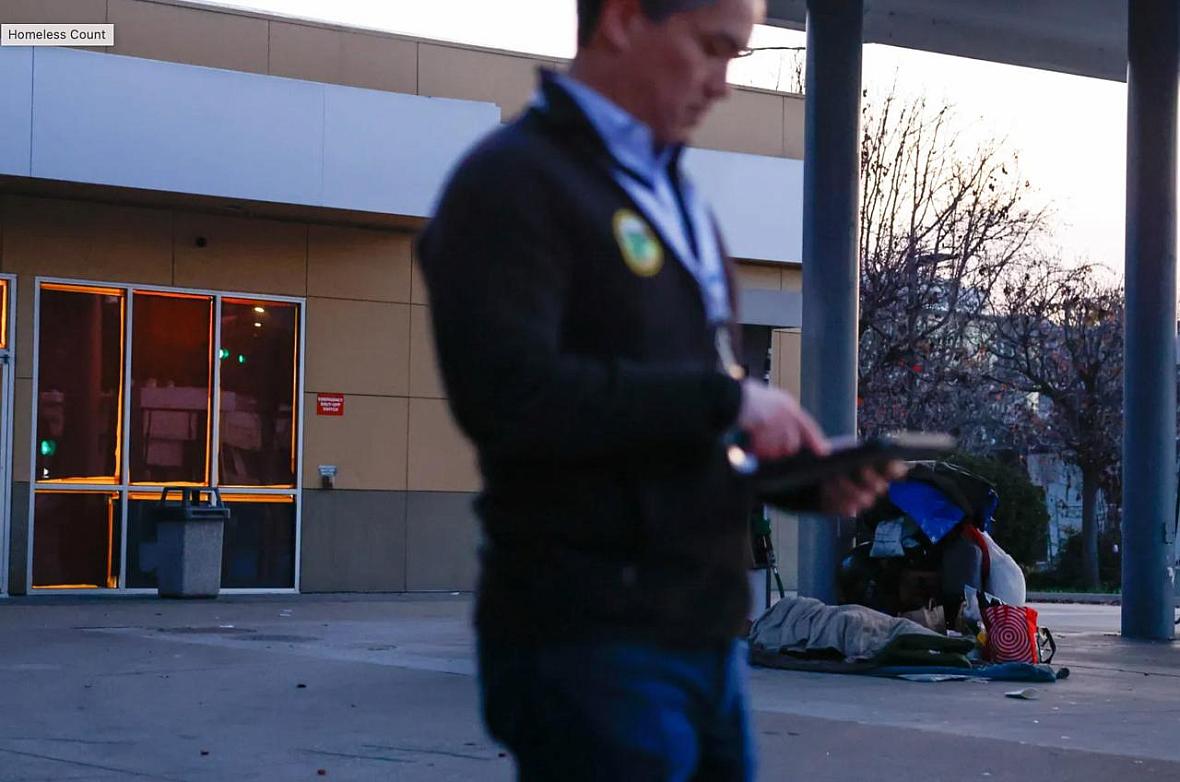
Local counts show that since 2011, the Bay Area’s homeless population has grown by more than 40% to over 38,000 people. A Bay Area News Group analysis of point-in-time count data found the region’s homelessness rate is more than twice the national average, a crisis experts say is likely worsened by the region’s exceptionally high rents.
One of the main limitations of the counts is that volunteers are instructed not to interact with homeless people during the early morning counts. (Following a count, service providers will often conduct interviews with a subset of homeless residents to generate demographic estimates.)
In practice, that means volunteers are unable to identify exactly how many people are staying in each tent, car or RV. In many cases, volunteers log an estimate based on the methodology provided by officials and contractors hired to help conduct the counts. In the 2025 Santa Clara County count, for instance, each RV counted as 2.1 individuals, based on averages from interviews held after the count.
Encampments can also be hidden from view and difficult to spot, especially during predawn hours. Ahead of counts, nonprofit outreach teams sometimes map out encampments along city streets, in parks and in other secluded areas.
Another challenge is determining whether or not someone is actually homeless.
During the count in Redwood City this January, volunteers Mates and Fong would sometimes debate whether a person on the street had enough belongings to indicate they were homeless or whether they were simply spending time on the street. In one instance, they passed a car with its windows covered with blankets and fogged over — signs of someone living inside. But because the vehicle appeared parked on residential property, they skipped it in the count, based on the county’s understanding of federal point-in-time methodology.
Vivian Wan, chief executive of Abode Services, a homelessness nonprofit that helps oversee homelessness counts in the East Bay and South Bay, said those challenges can contribute to fluctuations in population estimates over time.
“Sometimes, the reason for big hiccups in point-in-time counts is because we have changed the methodology or we have more volunteers than a (prior) count,” Wan said.
The counts also smooth over the shifting nature of homelessness, as people fall in and out of homelessness between biannual tallies.
To help account for that variation, counties, including San Mateo and Santa Clara, now regularly track how many people access homelessness services, giving officials a more up-to-date snapshot of the local homeless population.
“It’s a population that by definition is unstable and mobile,” said Mates, who works in the San Mateo County Executive’s Office. “But we supplement (the count), in recognition that once every two years doesn’t give you a full picture.”
Santa Clara County has also begun using a new mobile app to log counts and has placed greater emphasis on survey interviews to gather demographic information. In Alameda County, officials now enlist homeless and formerly homeless people to help locate encampments and lived-in vehicles.
Despite the counts’ limitations, several officials and experts emphasized that they remain essential for apples-to-apples comparisons over time and across jurisdictions.
“There is value in the Point-in-Time Count,” said KJ Kaminski, director of the Santa Clara County Office of Supportive Housing, adding that it should not be used in isolation. “It doesn’t provide all the answers for why people are experiencing homelessness, but it’s a piece of the larger data picture.”