

Community may be key to emergency medical service challenges in rural Ozarks
This article was originally published in the Springfield News-Leader with support from our National Fellowship and the Dennis A. Hunt Fund for Health Journalism.

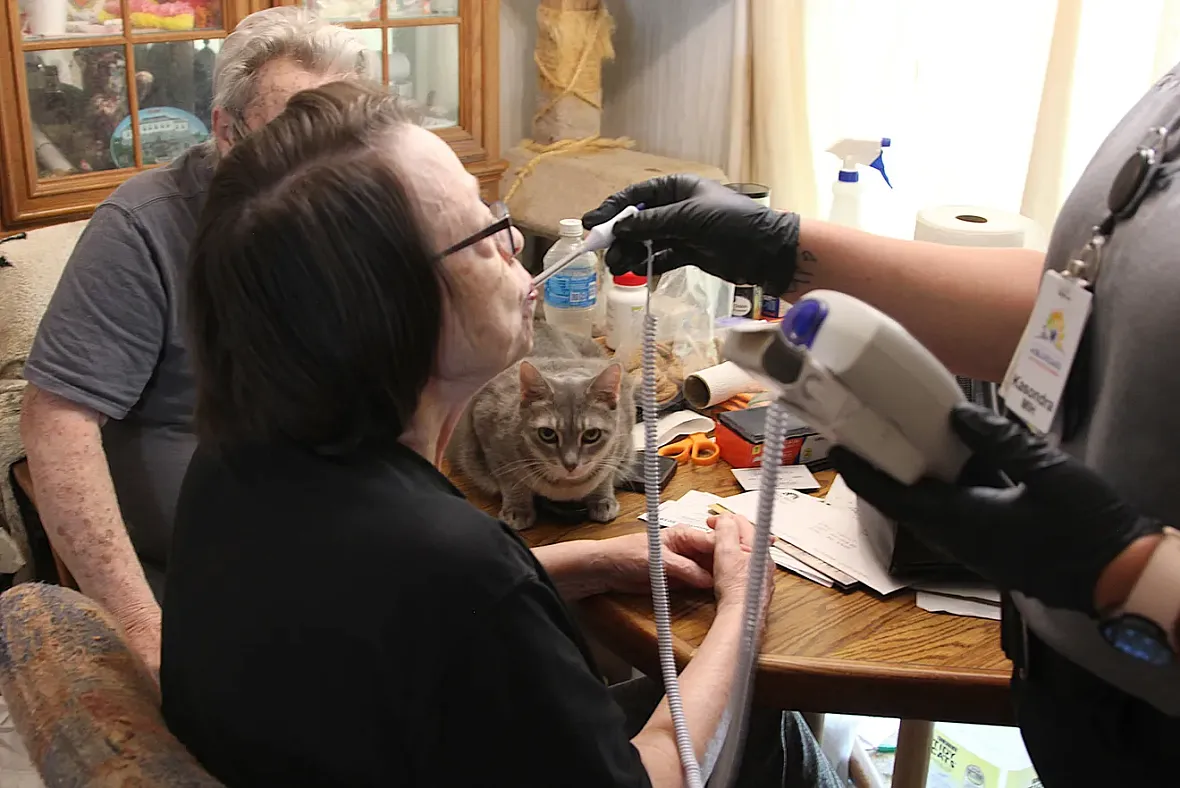
One of Ethel and Gene Carroll's cats, "Itty Bitty Kitty" watches as community paramedic Kasondra Day takes Ethel Carroll's temperature during a Sept. 29, 2025, wellness visit as part of Washington County Ambulance District's Mobile Integrated Healthcare Network.
Susan Szuch/Springfield News-Leader
Outside St. Louis, a rural ambulance district aims to bring care to its patients before they need emergency services. Washington County Ambulance District established its Mobile Integrated Healthcare Network during the COVID-19 pandemic.
Initially, it was a program with the federally qualified health center, Great Mines Health Center, that addressed compliance issues with diabetic patients, said Tony Mingo, paramedic division chief of the district's MIH. It then evolved to become a way for the rural health service to mitigate calls related to chronic conditions, something that WCAD Clinical Chief Doug Anderson thinks it more prevalent in the area due to barriers to health care for a population that is often sicker and poorer than its urban counterpart. The program is currently funded by grants, but leadership is exploring other options that could make it self-sustaining, including innovative billing code strategies.
The MIH program is just one of the ways rural emergency medical service providers are working to better provide care. While access to health care is one barrier, rural EMS providers also face challenges regarding hiring and retaining workforce as well as funding these medical lifelines.
A connection with the community — from reaching out to serve those in need and providing them resources to establishing partnerships and educating residents about the need for financial support — is a common thread in what rural EMS sees as potential solutions for each of those problems.
Mobile integrated health care network brings care, necessities to rural residents
Ethel and Gene Carroll live in a little manufactured home on Gun Club Road in Potosi, Missouri, with their five cats. Itty Bitty Kitty is the only one who greets Kasondra Day, the community paramedic who is doing a wellness check on Ethel Carroll on the afternoon of Sept. 29.
Her husband, Gene, greets Day at the door. The home is dark, with extension cords running along the floor alongside the oxygen line Gene Carroll is tethered to. The smell of the cats will linger in Day's nose for the rest of her shift.
"I'm 84 and she's 77. We've both got ailments and we can't do as much as we used to ... " Gene Carroll said. "The price of everything is just eatin' me up."
Both have been in and out of the hospital due to their health, and have been struggling to pay bills while getting necessary items like food.
Day is one of five MIH providers, supplying Washington County residents with everything from prescriptions to telehealth appointments to blood draws in their own home.
"We see some kids, but not many," Day said. " ... The majority are elderly, but we do have a lot of non-compliant, non-elderly adults, also. Most of them (have) mental health or substance use (issues)."
Gene Carroll clears space from the crowded kitchen table for Day to set down her bag. After a few minutes, Ethel Carroll makes her way into the dining room. Her face lights up in a smile at the sight of Day.
Paramedics, especially community paramedics, have a unique viewpoint that's different than a provider in a clinic, Mingo said.
"The nice part about paramedics is that we have this innate acceptance into the home," he said, adding that by being in the patient's environment, they can identify barriers or see problems, like multiple boxes of medications around the house.
Community paramedics do more than just transport patients and draw blood, Mingo said.
“We truly get patients interested in their own care, to bridge that gap, break things down medically to them to language they truly understand," Mingo said. "That’s been a blessing.”
It takes about a half hour to take Ethel Carroll’s recent history, her vitals and her current medications. Day spends 15 minutes on the phone with an MIH community health worker, cross-checking the medications in Ethel Carroll's chart and setting up an in-person appointment with the Carrolls’ primary care doctor.
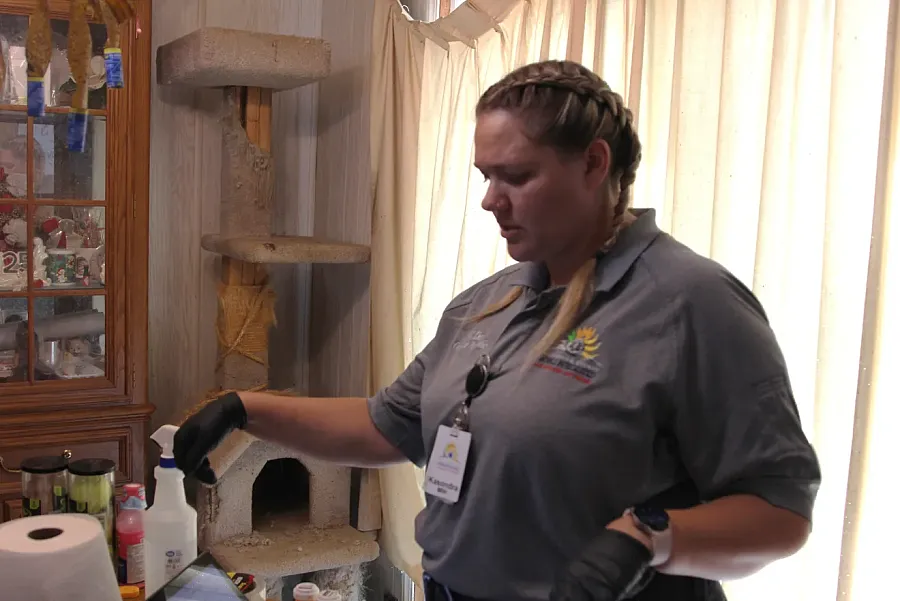
Community paramedic Kasondra Day talks with patient Ethel Carroll and her husband, Gene, during a visit to their Potosi, Missouri, home on Sept. 29, 2025. Day is part of Washington County Ambulance District's Mobile Integrated Healthcare Network team.
Susan Szuch/Springfield News-Leader
Throughout the visit, Itty Bitty Kitty stays on the kitchen table, alternately pawing at Gene Carroll to be petted, watching Day and napping.
Driving away from the little house, Day mentions that community paramedics have tried to convince the couple to move into assisted living or somewhere they can have help with the cats and their health.
The Carrolls have refused, however, and are reluctant to leave their home on Gun Club Road. It's paid for and it's a place they know.
MacKenzie Williams, who is in training to become a paramedic while working as an EMT for the Washington County district, has observed over the past four years how MIH changes outcomes for patients.
"MIH was a big, big change for us. We see people who we used to run all the time who are (now) thriving because of the help they got.”
Partnerships with local schools, therapists help address EMS staff shortages
Health care professions across the board are facing a shortage of workers and are having trouble maintaining the workers they do have, including EMS.
The American Ambulance Association's 2025 study of more than 46,000 EMS employees found that voluntary turnover rates for EMS employees in 2024 were around 15% to 24% — a turnover rate that means "an organization is likely to replace most of its workforce within five years," the study said. The overall turnover rates have remained relatively stable since AAA began doing the survey in 2017, but the study said "the level of turnover remains higher than desirable" for people who on the front lines of delivering service to clients and patients.
Rural EMS, in particular, has issues maintaining employees due to lack of competitive pay and where they're based, according to Anderson with WCAD. The district tries to address those obstacles by providing education and certifications. It also has partnerships with local community colleges, which Mingo finds incredibly helpful.
"I think the college is so vital because we’re able to grow them through (the program)," Mingo said.
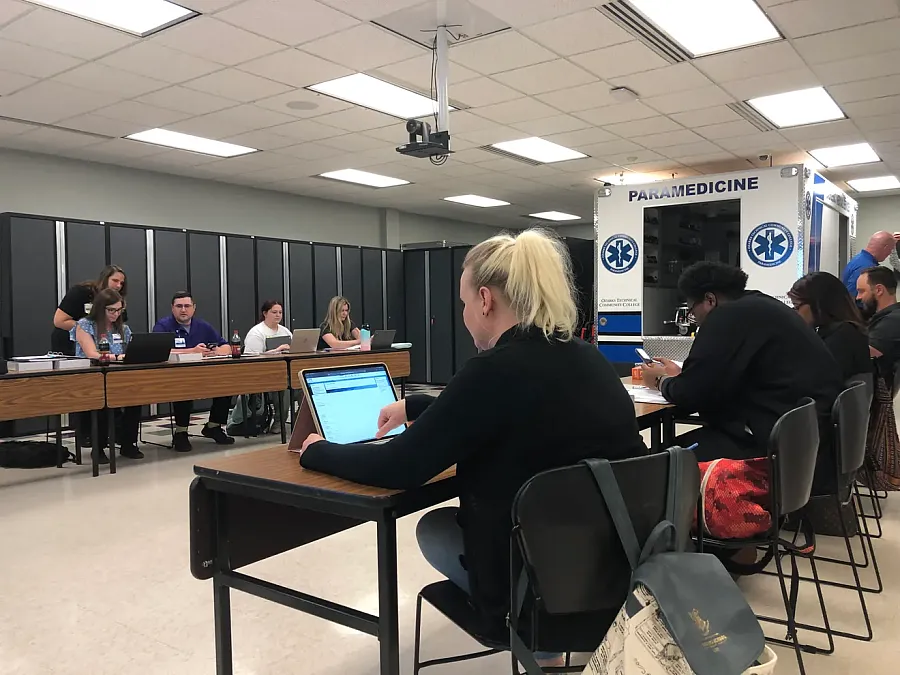
Students attend orientation at Ozarks Technical Community College on May 31, 2022, for the summer session of OTC and CoxHealth's emergency medical technician apprenticeship program.
Susan Szuch
CoxHealth and Mercy both partner with Ozarks Technical Community College. Working with the local college has helped maintain the ranks of Cox's EMS personnel, said Kyle Meadows, the hospital's EMS business manager.
"We had one of the or the first apprentice programs, the first federally funded state-endorsed apprentice programs, for our EMT program," Meadows said. "That and just a good legacy culture has made it to where we don’t have a staffing problem. We still need more people but that’s just because they don’t exist but we’ve been at 90% staff or higher since COVID."
The EMT program hosted its inaugural class in 2022, where students completed curriculum at OTC alongside practical training at Cox, which generally would take place after hiring. Through the OTC partnership, students receive instruction and training free of charge, get paid an hourly wage as Cox employees and will have guaranteed employment with Cox after completing the program. Integrated health programs in high school are also very helpful when it comes to growing their own employees, Meadows said.
Rather than an apprenticeship program, Mercy covers tuition for its employees, said Mercy EMS Executive Director Bob Patterson.
"We’ve taken a little different approach rather than the apprentice program. We will actually pay the tuition for our folks to go to school — so an EMT that wants to go to paramedic school, we’ll pay for their training," Patterson said. “... Many of them want to continue working and we recommend that. It keeps their skills sharp."
Mental health is another contributing factor in retaining full crews, especially in rural areas. Emergency medical service professionals see it all, from scenes where children have been injured to calls involving violence or abuse to responses where they themselves could be injured. All of this contributes to the stress of a job where you have to make quick, life-saving decisions.
Both CoxHealth and Mercy offer support for their EMS providers.
“It’s not a stigma any more, it’s more of we understand that and we need to deal with it so we’re trying to implement ways to do that," Patterson said.
Mercy has an employee assistance program and is setting up a peer support program, something that CoxHealth has seen success with, according Meadows. The program Wellness for Warriors connects CoxHealth employees who are veterans with first responders as well as emergency department nurses and registrars, "the people who see these things but aren't prepared for it."
Having someone to talk to who understands the stress and trauma that comes with EMS is imperative, Meadows said. The hospital has partnered with local psychologists who have training in trauma and EMDR, or eye movement desensitization and reprocessing, a therapy treatment that helps people process traumatic memories.
"(If) you talk about some of the terrible calls you go on and experiences that you have, you try to tell that to some 22-year-old brand-new grad ... you’re going to traumatize them," Meadows said. "It's unfortunately very stunning for a lot of people."
Part of it relies on willingness from leaders to allow EMS providers the space and time to acknowledge how things affect them. Earlier in his career, Meadows was "ridiculed for years" after he asked to take time off after a particularly difficult call. Now, when Cox teams answer similar calls, he checks in on each of the 84 employees he's responsible for.
"All they have to do is say 'hey, this was a bad one,' and we’ll take ‘em out of service so they can decompress. I think everyone wants to be a tough guy, so they don’t do it very often, but I’ve done it for sure," he said.
Traveling back roads to meet patients where they are
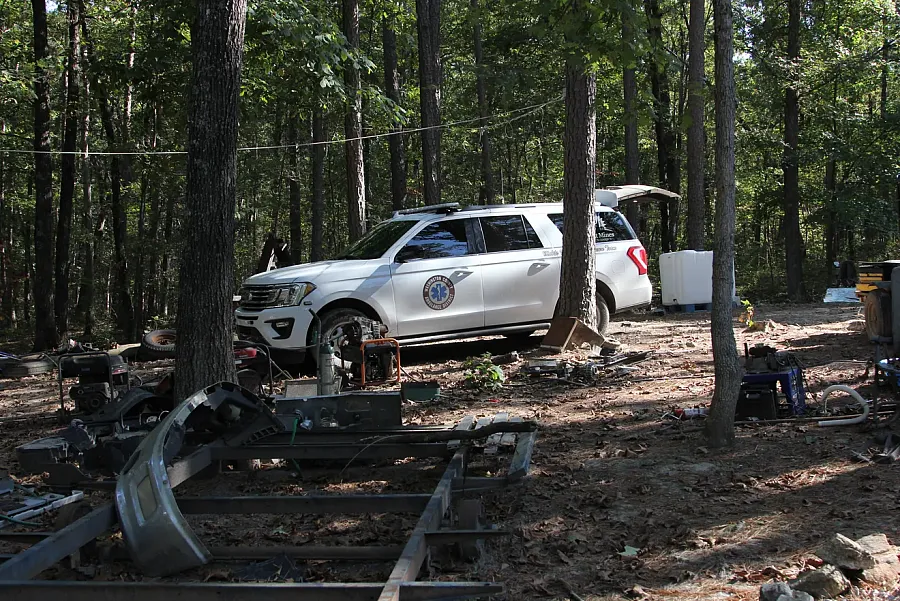
A Washington County Ambulance District Mobile Integrated Healthcare Network truck is parked on Julie Deweese's land in Potosi, Missouri, while community paramedic Bryan "Buck" Buckley checks in with Deweese on Sept. 29, 2025.
Susan Szuch/Springfield News-Leader
Across the highway from the Carrolls are the afternoon’s next patients: A patient who no-called, no-showed for his most recent appointment and Julie Deweese.
Both patients are in a community known as Indian Creek. Paved roads give way to easy-riding gravel, transitioning to red clay with deep ruts and divots, the kind that makes your brain rattle in your skull even when MIH community paramedic Bryan "Buck" Buckley carefully avoids the worst of them.
It takes about 20 minutes to reach the first patient's trailer but no one is home, judging by the cinder block placed in front of the door. It’s not immediate cause for panic, though, Buckley said, since the man might be visiting his son. They’ll check back another time.
“People here don’t leave their homes for long, because stuff tends to get stolen,” Buckley said.
After another 10 minutes of bumping down the trail, and one particularly harrowing downhill stretch that had the SUV at a severe angle, another trailer comes into sight. A kennel with at least six dogs flanks it and a chorus of barking almost drowns out the woman who greets Buckley and tells him she thinks Deweese is around today.
The SUV plods along the dusty road before turning onto Deweese's land, where dogs and the rooster announce the team's arrival before Buckley can honk his horn. Deweese makes her way out from the area that serves as a kennel and coop, greeting Buckley like an old friend. He comes to visit a couple times a year, she said.
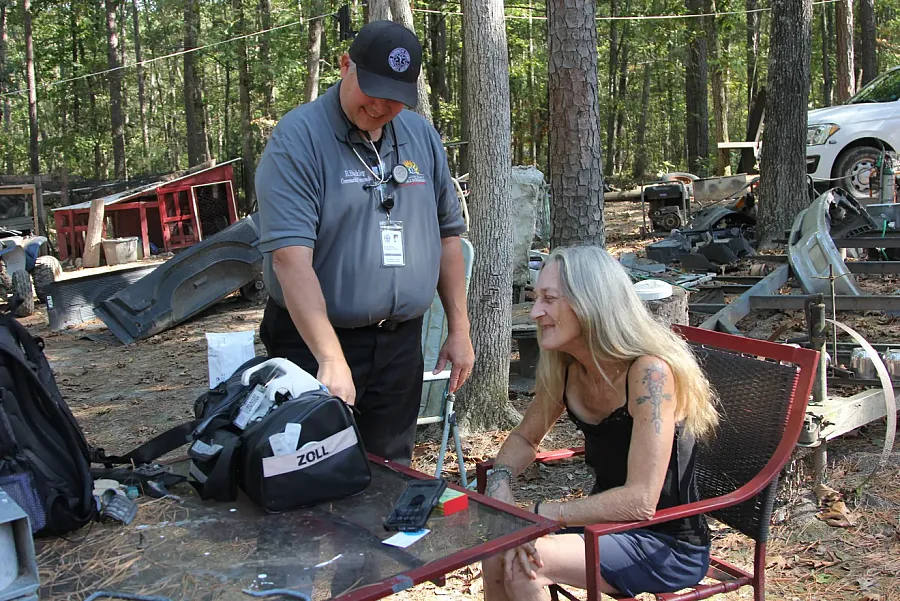
Washington County Ambulance District community paramedic Bryan "Buck" Buckley visits with Julie Deweese on Sept. 29, 2025, in Potosi, Missouri. Deweese's land is in Potosi's Indian Creek community, which has few paved roads and poor cell service.
Susan Szuch/Springfield News-Leader
They do her checkup outside at a red patio table that she clears bolts and scrap metal from so he can put down his bags.
Buckley takes her vitals and sees that her blood pressure is high. Deweese just ran out of her blood pressure medication this week, she tells him; her neighbor with the dogs was going to drive her to the town’s Walmart to pick it up later that week.
Deweese doesn’t have a phone and even if she did, there’s no cell service until you drive up the steep hill and back to the county-maintained gravel road, a trip not easily made on foot.
Despite the isolation, the land is beautiful, which is why she chose to live here, Deweese said.
Before Buckley leaves, she asks if he can also get her fresh water. It’s not an unusual request for the folks who live in the community, Buckley said. City water isn’t in the area and it costs money to dig a well.
MIH has the resources to help address those needs, and others. In addition to community providers setting up transportation, they can connect patients with community navigators at Great Mines Health Center, who ensure that patients get food, insurance or assistance with heating and cooling.
Beyond his role as a paramedic, Buckley is a pastor for Bates Creek Baptist Church in Potosi. He works with his church, as well as others in the area to bring additional resources to patients, from opioid overdose reversal agent Narcan to furnishings for homes. He helped a previous patient apply for food benefits as well as housing, but a local church made sure the patient's house was a home.
"The biggest overlooked resource in communities, honestly, is churches. The churches fully furnished her apartment, including stocking her pantry. When we moved her, all we had to do was get in the vehicle and drive her to her new place," Buckley said. The patient had previously been very hesitant to accept help and was suspicious of the MIH program, but now, he said, "she's thriving. She's compliant with her medicines. She looks forward to her doctor's appointments."
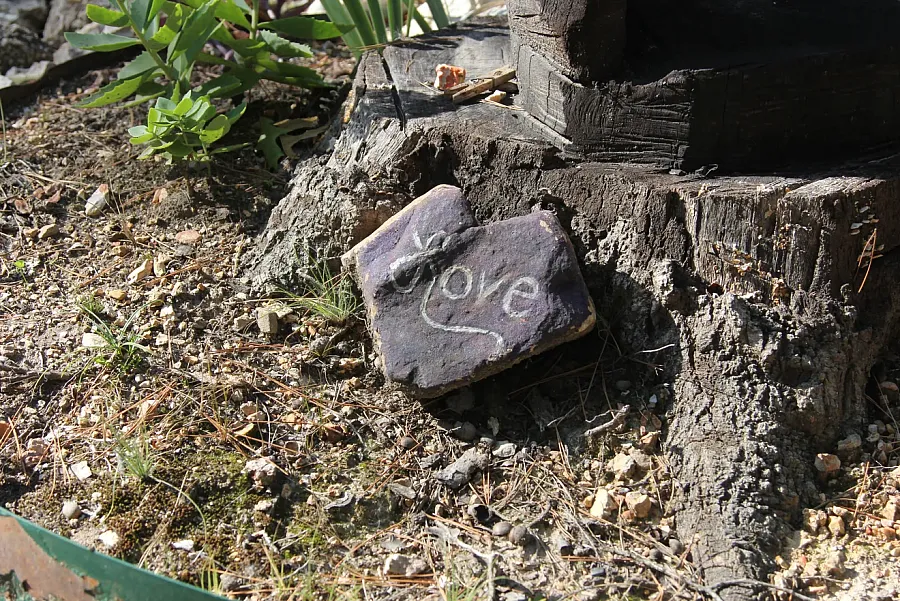
A heart-shaped rock leans against a seat made out of a tree stump that overlooks Julie Deweese's land in Potosi, Missouri, on Sept. 29, 2025. Deweese, who doesn't have a phone or her own transportation, relies on Washington County Ambulance District's Mobile Integrated Healthcare Network for her health care and medications.
Susan Szuch/Springfield News-Leader
As he makes his way out of Indian Creek, Buckley passes an empty RV without wheels and outfitted with TV antennas.
“That was where one of my first MIH clients lived,” he said. “She’s since passed on. Pancreatic cancer.”
The people he visits aren’t just names on a list. Buckley — and Kasondra Day and all the other MIH providers — cultivate a close relationship with their patients.
So close, in fact, that Buckley has preached at some of their funerals.
For sustainable EMS funding, communities may be key
Many EMS providers rely on federal reimbursement or federal funds for grants, according to a 2016 National EMS Advisory Council report, however that source of funding is not always consistent. Many services only see payment from insurers if the patient has been transported to the hospital, which creates another issue for cases where providers render aid but don't take someone to the hospital.
Patterson believes programs like the Stone County Ambulance District, which partner with the community, will be central to maintaining these life-saving services in rural communities.
Both CoxHealth's and Mercy's emergency medical services served Stone County, Missouri, for decades, said Stone County Ambulance District Interim Director Jeff Hawkins. But the county and the services came to a crossroads in 2023 as increasing health care costs and complex insurance reimbursement models combined with the county's rural location and residents' low socio-economic status.
Each service reported losing half a million dollars each year trying to serve Stone County and the community became concerned Cox and Mercy would have to stop providing support to the area. Concerned citizens and stakeholders started a petition drive to put the issue of creating an ambulance district on the April 2024 ballot. They succeeded and county residents voted to approve both creating the district and a half-cent sales tax that would fund it.
The district was officially formed Aug. 22, 2024, Hawkins said. Missouri hasn't seen the creation of an ambulance district in the past 20 years, according to both Hawkins and Patterson. Revenue from the sales tax lets the district purchase and own the assets and infrastructure such as ambulances, equipment and buildings. After a request for proposal process, Mercy was contracted to operate the service and run the calls.
A station is being built in Crane and an existing station in Lampe is being donated to the district by the Southern Stone Betterment Association, which was established in 2004 to improve the community's ambulance resources. Hawkins said the district is in discussions about building its headquarters in the Branson West area as well adding a station in the Galena area.
"Everybody is ecstatic that they will be able to keep ambulance services in the community. They really want us to work on improving response time (and) ambulance availability in those rural areas that previously didn't have as much coverage," which will be a longer term goal, Hawkins said. Currently, "we have to make sure we have our immediate infrastructure established before we start moving out into other areas of the community."
Greene County's emergency medical services are unique in that it's not a tax or ambulance district, but is rather supported by the hospital systems, Meadows said.
"I would love to make sure people realize that Greene County has no ambulance district. There’s no tax money at all that pays for ambulance services in Greene County," Meadows said. "We both have an entire county license but a hand-shake agreement dozens of years ago created those boundaries where, basically, our own hospitals are in our own districts."
However, Meadows wants people to understand that more tax dollars may be what's needed to ensure that when you call 911, someone answers.
"It may not be exactly what citizens want, but a lot of places do not have a tax or have a very low property tax. Unfortunately, post-COVID, to outfit a complete truck is a half a million dollars. And then you add in labor costs just to keep people on the street," Meadows said. "The expectation that we all have when you call 911, no matter where you’re at, we expect somebody to respond but without funding we cannot be there. Funding is what makes the pay that draws (EMS personnel) in, as well."