

Housing instability can be deeply interconnected with Nevada child welfare
This article was originally published in the Nevada Current with support from our National Fellowship and Fund for Reporting on Child Well-Being.

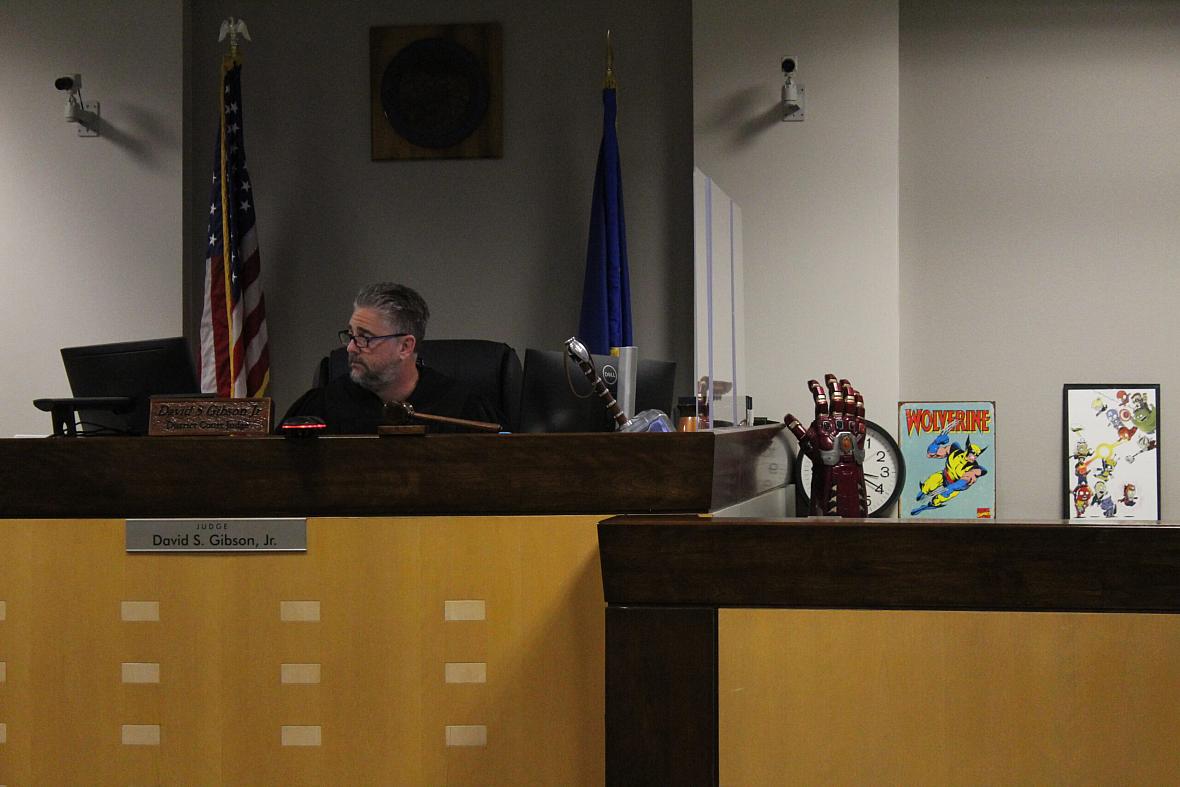
“Before a child is removed from a home, the government’s obligation is to make reasonable efforts to prevent that removal,” says Nevada 8th Judicial District Court Family Division Judge David Gibson.
(Photo: Michael Lyle/Nevada Current)
Homelessness alone is rarely the reason children are removed from their families and placed in the child welfare system throughout the state of Nevada.
Yet in the recent instances where children have been placed in foster care because of homelessness or “inadequate housing,” state and local officials can’t provide firm details as to what made those cases exceptional.
Nevada, like much of the nation, has seen rising homelessness as housing costs have soared.
Whether by compounding the reasons that lead to a child being removed on the front end, or becoming a barrier that delays family reunification, and at multiple points in between, unstable housing takes a deep, and often lasting, toll on children’s well being.
Clark County has tried to bolster resources, including additional rental assistance and opening noncongregate shelter spaces for families to try to catch people on the front end, said Abigail Frierson, Clark County’s deputy county manager who currently serves as the interim director for the county’s Department of Family Services.
“We’ve had in recent years some additional resources come into play that can be accessed at the front end of cases, or even before a case is filed, to try to avoid court oversight of the child,” she said.
Homelessness or inadequate housing is noted as the reason for removal in a little more than 10% of child welfare cases in recent years.
Of the 2,590 families that had children removed statewide in 2024, there were 361 incidents where inadequate housing or homelessness were listed as a reason for removal, according to data from the Nevada Department of Family and Child Services (DFCS). The overwhelming majority had additional reasons attached to the removal.
“Before a child is removed from a home, the government’s obligation is to make reasonable efforts to prevent that removal,” Nevada 8th Judicial District Court Family Division Judge David Gibson said. “Those aren’t the kinds of cases that should, except in the rarest circumstances, ever even come before a judge.”
Child welfare services should intervene and provide the family resources before involving the court, he added.
Statewide there were 30 children removed due to inadequate housing or homelessness with no other additional reason in 2024, according to DFCS data. There have been 26 instances as of July 2025, the most recent available data.
Three children were removed from their family’s supervision due to housing inadequacy alone in rural Nevada, while 27 children were placed in child welfare services in Clark County in 2024.
The three incidents when children were removed for inadequate housing in rural Nevada was from a single family and stemmed from “a filthy house,” said Betsey Crumrine, the Deputy Administrator with the Division of Child and Family Services.
“That house would have needed to pose a safety threat for removal to occur for that reason alone,” she said.
The meaning of inadequate housing varies, she explained. In some instances, it’s the lack of heat or air conditioning. It could also include unsanitary and unsafe conditions that present health risks and hazards for children.
“It could be a dirty house which could look different for the age of the kids,” Crumrine said. “If you have toddlers crawling around the floor and you have animal feces on the floor and they are putting things in their mouths, that could be considered inadequate housing.”
The same scenario wouldn’t necessarily apply to older children or teenagers. “It’s all situational,” she said.
The 27 families in Clark County that had children removed just for homelessness or inadequate housing last year is the highest number in 10 years of data provided by the state.
While still low compared to the number of overall child removals, the figures seemed high, Frierson said.
“I would tend to think that there would be more going on than just homelessness,” Frierson said. “The court would not be very friendly to a homelessness-only removal when the parent is functional in every other way.”
There were four instances of homelessness-only family removals in Washoe as of July this year, but ”due to the confidentiality of the families we serve, we are unable to provide specific details regarding individual cases, outcomes, or circumstances of their involvement,” Tammi Williamson, the Division Director Washoe County Human Services Agency, said in an email.
“It is uncommon for WCHSA to remove children solely on the basis of a parent’s lack of housing resources or homelessness,” she said. “Typically, there are additional contributing factors related to parental circumstances or behaviors.”
The Department of Family and Child Services provided Nevada Current data since 2016 for instances where children were removed for homelessness only or homelessness combined with an additional reason. There were 53 children placed in child welfare services in 2016 due homelessness or inadequate housing statewide. The number of children removed from households plummeted to single digits in 2017 and remained that way through 2022. Statewide it was nine that year. In Clark County it was six.
The number slowly began to increase in 2023.
There have been efforts to get more publicly available data from child welfare agencies on things such as the breakdown on race, said Amanda Haboush-Deloye, the executive director for the Nevada Institute for Children’s Research & Policy.
The last time the state Legislature mandated an independent review of child welfare cases was in 2008, resulting in a study conducted by Nevada Institute for Children’s Research & Policy. Haboush-Deloye couldn’t recall what prompted lawmakers to authorize the review at the time, only that it provided insight into the system.
“We were able to go in and randomly pull cases and read through all of the case notes,” Haboush-Deloye said. “That way we could determine if it seemed like there were any patterns or any issues.”
Haboush-Deloye wasn’t aware of any efforts in Nevada to analyze the child removal cases that dealt with housing to determine underlying causes.
“I do think having external reviews on a regular basis would be helpful,” she said.
Rapidly rising family homelessness
The bulk of the cases where children are removed from their families due to homelessness and the court is needed to intervene include additional reasons, often involving mental health issues.
“Typically, what you’re finding is housing instability is riding on the back of substance abuse, issues of domestic violence in the home, or mental health,” Gibson said. “What you find is if resources are playing a part in a child coming under the court’s formal supervision, there are usually other more important underlying issues that are causing the homelessness.”
Of the 361 statewide cases last year when homelessness was cited in the removal, 331 cases identified additional reasons.
As of July 2025, there have been 275 children removed for homelessness or inadequate housing with 249 including additional reasons.
These numbers coincide with a rising homelessness number at large.
Statewide, homelessness increased by 17% in 2024, according to the U.S. Housing and Urban Development data. The Southern Nevada Point-in-time count – a yearly snapshot of those experiencing homelessness that is considered an undercount – found of the 7,906 experiencing homelessness, roughly 20% — more than 1,500 — were families with children.
That’s nearly double the 794 families identified as homeless in 2023, and that was a 54% increase from 2022.
Nevada, like most states, has long contended with an affordable housing shortage. The pandemic exacerbated that. When eviction protections expired and Covid-era relief assistance began to be scaled back, some families fell through the social safety net.
“We have the same individuals that were evicted, struggling to find affordable rental units,” said Brenda Barnes, the social services manager for Clark County. “We have families that struggle with managing that stress. A lot of it is triggered because of everything spiking, cost of living increasing, … It’s just one thing after another that ends up becoming a negative outcome for a child at times.”
The way a parent reacts during that time of crisis “can make all the difference on whether a referral to child protective services will be opened up or not,” she said.
During times of intense stress, some parents might turn to self-medication to cope.
“If you can’t think of any way that you’re going to get out of this, or see any positive or light at the end of the tunnel, you’re going to get depressed … Then you start using other substances to help you feel better. Then it’s just that rolling pin that goes over and over,” Haboush-Deloye said.
The lack of stable housing might not always be the underlying incident that brings people into the child welfare system.
But for many families who enter the system, the need to find stable housing “becomes more crucial to the family on the back end,” Gibson said.
Once children enter the system and a court begins to monitor cases, social services establish case plans for parents to follow in order to reunify with children which include things like mental health and substance abuse treatment.
The county isn’t able to quantify how many case plans include some sort of housing component, Frierson said. Though nonprofits who work with families that have child welfare cases say it is constantly a barrier for their clients.
“If somebody has literally addressed every other issue in their case plan, and it’s only housing that’s holding up the reunification, most of the judges that are overseeing those cases set them for a fairly rapid set of status checks to try to turn the heat up on everybody involved, to help that family find a place,” Gibson said.
There are only limited housing resources available and whether or not housing is deemed adequate for reunification is determined case by case, Frierson said.
Extended stay or weekly motels, often a last resort for people when no other housing is available, is typically considered stable housing, she added.
Family Promise of Las Vegas, a nonprofit that provides shelter and support services for families and children experiencing homelessness, has run into those issues when helping families reunite.
Before opening a 10-bed facility this year to house families at risk of homelessness, Family Promise of Las Vegas, a nonprofit that provides shelter and support services for families and children experiencing homelessness, would pay for extended stay rooms to serve the sheer volume of clients in need of help and help families reunite.
“There was a situation where we actually tried to take a family where their housing was the last resort and the last step was to need to be reunified with the child,” said Marisa Cervantes, the executive director for the nonprofit. “We placed them in the weekly but then later found out that it did not count as housing because it was not long term,” and the child remained in protective services.
There were times when housing resources became an issue for families, and the family court judges would order welfare services to allocate those resources.
The Nevada Supreme Court ruled last year that district courts can’t order governmental social service agencies to pay for housing assistance.
According to court documents in that case, Clark County Department of Family Services removed children and placed them with a paternal aunt, who lived with their paternal grandmother. Prior to becoming a foster parent, the family asked, and was granted, rental assistance from family services.
After becoming a foster parent to the children the family asked for additional rental assistance for $1,000, but the county’s division declined – the agency noted the family was receiving foster care subsidies. The attorney went to the district court, which ruled the county must pay.
The county then sued.
“We conclude that the district court lacked statutory authority to order DFS to pay rental assistance to a foster parent,” the Nevada Supreme Court ruled Dec. 5, 2024.
A judge’s hands are often tied for how much they can mandate and the courts “can’t tell an agency how to spend their number,” Gibson said.
Delayed reunification
Even for parents going through substance abuse treatment, and successfully complete it as a requirement set out by the court, housing becomes a final barrier to reunifying with their children, said Irma Magrdichian, the director of residential services at WestCare Nevada, which provides substance abuse treatment.
The result, she said, has led to delayed reunifications because of the lack of stable housing.
The organization has about 20 women who are reunified with children who had previously been removed to foster care while still in treatment, said Leo Magrdichian, WestCare’s vice president of operations.
“We’re able to allow mom to participate in treatment, reunify with her children, and then begin the process of really learning how to balance motherhood or parenting and treatment,” he said.
The organization provides a 30-bed facility at its Women and Children’s Campus where women can participate in treatment while they have their children.
Challenges to paying for treatment and cost of living are adding more obstacles to families with child welfare cases
In previous years, Medicaid had paid for up to six months of treatment. During the time, “a lot of DFS caseworkers were okay with placing children while in residential treatment,” said Irma Magrdichian.
The courts “considered that to be ample time for mom to gain employment and, you know, secure, more stable housing after treatment,” she added.
More recently, the amount Medicaid paid for treatment was reduced to 90 days, just as rents began to increase and affordable housing became even more out of reach for people.
Ninety days is not nearly enough time for a person to save enough money and secure housing, said Leo Magrdichian.
“We’re looking at women that have had evictions or ladies that have been out of the workforce for a long time,” he said.
Shorter treatment timeframes combined with fewer affordable housing options to make welfare services “a little bit more reluctant to place” children with mothers until they find more stable living, Irma Magrdichian said.
Using extended stay motels often isn’t an option, as it puts women back in environments that could jeopardize sobriety, Leo Magrdichian said.
“What do you do when you’re at risk? You stop thinking clearly, and you go back to doing some of the things that you did before,” he added.
The organization is in the process of completing an 84-unit apartment complex for women and children to transition to after they complete treatment, which is expected to begin housing women in January.
“Just based on need and funding, this campus will be for women or women and children only,” he said. “We will have the opportunity in the future to expand, because the reality of it is, you need to treat the entire family at the same time if you really want to see good success.”
Residents won’t be required to pay rent, giving them an opportunity to save up for when they eventually transition to their own apartment down the road once they are ready.
Opening the complex will complete a long time goal, and fill a growing need among women they serve,” Irma Magrdichian said.
“I can tell you right now, when it’s done, it will not be enough,” she said.