

Black ER Doctor Kara Toles Confronts Bias In Care
The story was originally published in The Observer with support from our 2026 California Health Equity Fellowship.

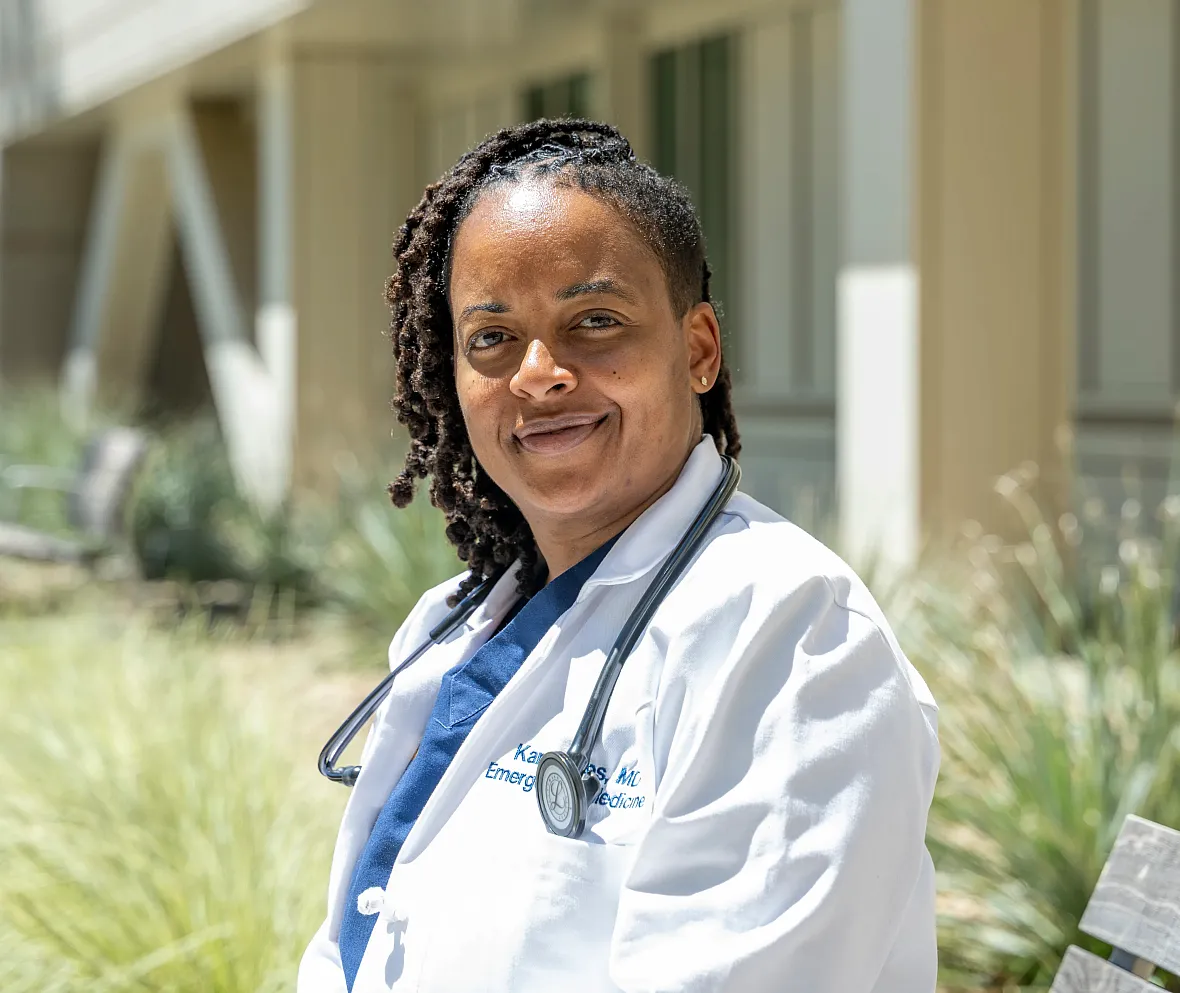
To bridge the gaps, Dr.Kara Toles also serves as the emergency department's director of equity and inclusion.
Russell Stiger Jr., OBSERVER
Her patient was moments from death, suffering from a severe brain infection, yet adamant that he’d rather leave the emergency room than be treated by a Black doctor. By her.
Dr. Kara Toles recognized his resistance not just as bigotry, but as a symptom of his illness. Rather than engaging with his racism, she focused entirely on the medical urgency that left him unable to see reason. As an emergency medicine physician at UC Davis Medical Center (UCDMC), this life-or-death encounter, while extreme, serves as a stark illustration of the reality physicians of color often face.
Navigating the emergency room as a Black woman involves a complex negotiation of prejudices, both overt and implicit. Toles characterizes this experience as an “extra toll,” a constant and exhausting demand managed alongside the high-pressure clinical decisions that define her practice.
“I’m not happy, but I’m grateful when people make their biases so overt like that because it lets me know how to keep myself safe,” she says.
Rooted In Purpose
Toles grew up in a small southeast Texas town in a middle-class family, the daughter of an engineer and a teacher. Money was tight enough that she learned early the value of hard work and set her sights on medicine as a path to stability.
Toles admits she didn’t grow up in a household where she was taught to love herself as a young Black woman.
“We just didn’t talk about race,” she recalls. “My parents did the best they could, but those weren’t the conversations we were having.”
As a young, Black queer woman in Texas, she’d soon experience her “first tastes of racism” and “all of those systems of oppressions that are baked into our history as a society, as a nation.”
She left the South for Southern California, attending Pomona College, where she majored in Black studies. She completed her pre‑med work and began to see medicine as a space for social justice. Toles sought out rotations and training that exposed her to health disparities and the ways structural inequities show up in clinical care, looking for a path in medicine where she could directly confront those injustices. At UCDMC she ultimately gravitated to the emergency department and its fast-paced, team-based dynamic.
“I get to use my hands and do procedures,” Toles says. “I get to truly see the impact that I make in people’s lives right in front of me.”
A Seat At The Table
Toles finds profound meaning in her role.
“When I walk into the room of an older Black patient and I say, ‘Hey, my name is Dr. Toles, I’ll be taking care of you today,’ and they just look at me and sigh really loudly … and they say, ‘I’m so proud of you.’”
These are affirming moments for Toles.
“It’s super powerful to see people in roles of leadership and influence,” she says. “When you see someone who looks like you, it can make you believe that you can do that too.”
That sentiment is underscored by the scarcity of Black physicians in the field. Nationally, Black doctors make up approximately 5% of the total physician workforce, a figure that drops to roughly 3% to 4% within emergency medicine. Against that backdrop, the reality remains that Toles most often will interact with patients and colleagues who do not look like her. At UCDMC — a university hospital situated in one of the country’s most racially and ethnically diverse cities — the patient demographic is vast and global, often requiring use of video interpreting services for Russian, Dari (Afghanistan), Spanish, and more.
To bridge the gaps, Toles serves as the emergency department’s director of equity and inclusion. She is deeply involved in training faculty to recognize and address biases. She remains realistic about the limits of such efforts. With department-wide DEI training, she acknowledges that while many want to learn, genuine participation cannot be forced. True investment depends on the individual.
“If someone is curious and motivated and wants to learn and push themselves, then if you provide an opportunity, people like that will take advantage of it,” Toles says.
Principled Practice
Toles views her career as a deliberate effort to counter broader systemic failures.
“I very much chose to be in medicine to do everything that I possibly can to push up against health inequities and health disparities,” she says.
This philosophy informs how she handles the “eclectic” nature of her department. While some physicians are deeply invested in addressing social determinants of health, others are drawn to the field primarily for the adrenaline of trauma and high-stakes procedures. For those doctors, social factors are often viewed as “outside their lane,” a mindset that can create friction with advocacy-driven colleagues.
This internal clashing among colleagues is only part of the challenge. Being mistaken for a nurse or intern because people don’t think of a Black woman as an ER doctor could also chafe, but Toles tries “not to take it too personally.”
“There is implicit bias baked into all of us,” she says. “I’m here to do my job, be a professional, rule them out for any emergent thing going on, and once I’ve done that, I can discharge them and move on to the next patient. … That is my role here.”
By doubling down on her authority as the attending physician, she refuses to let racism or sexism divert her from the healing work at hand.
For patients who rely on the ER as their primary source of care, Toles embraces her role as an advocate.
“I kind of like sometimes having those patients who are completely fine from a medical standpoint, but they just need a prescription or some feedback on something going on in their body,” she explains. “I’m happy to lend my expertise to help them navigate that.”
While some would argue such cases are a drain on ER time and resources, Toles sees it differently.
“If we had a functioning health care system, then they wouldn’t be there,” she says. “But that’s not the reality of the world we live in, especially in this country.”
Ultimately, Toles remains committed to using her platform to ensure every patient receives the dignity and treatment they deserve, regardless of the biases that may manifest.
Regarding anyone who chooses to focus on anything but that mission, she states simply:
“I keep my distance.”