

Dr. Italo Brown Brings Representation to Emergency Care
The story was originally published in The Observer with support from our 2026 California Health Equity Fellowship.

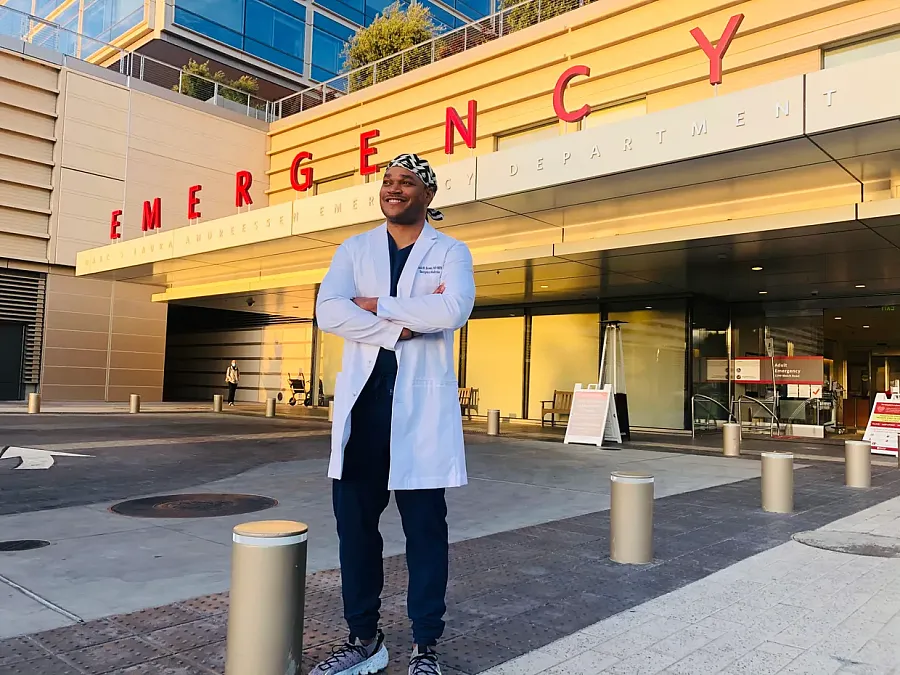
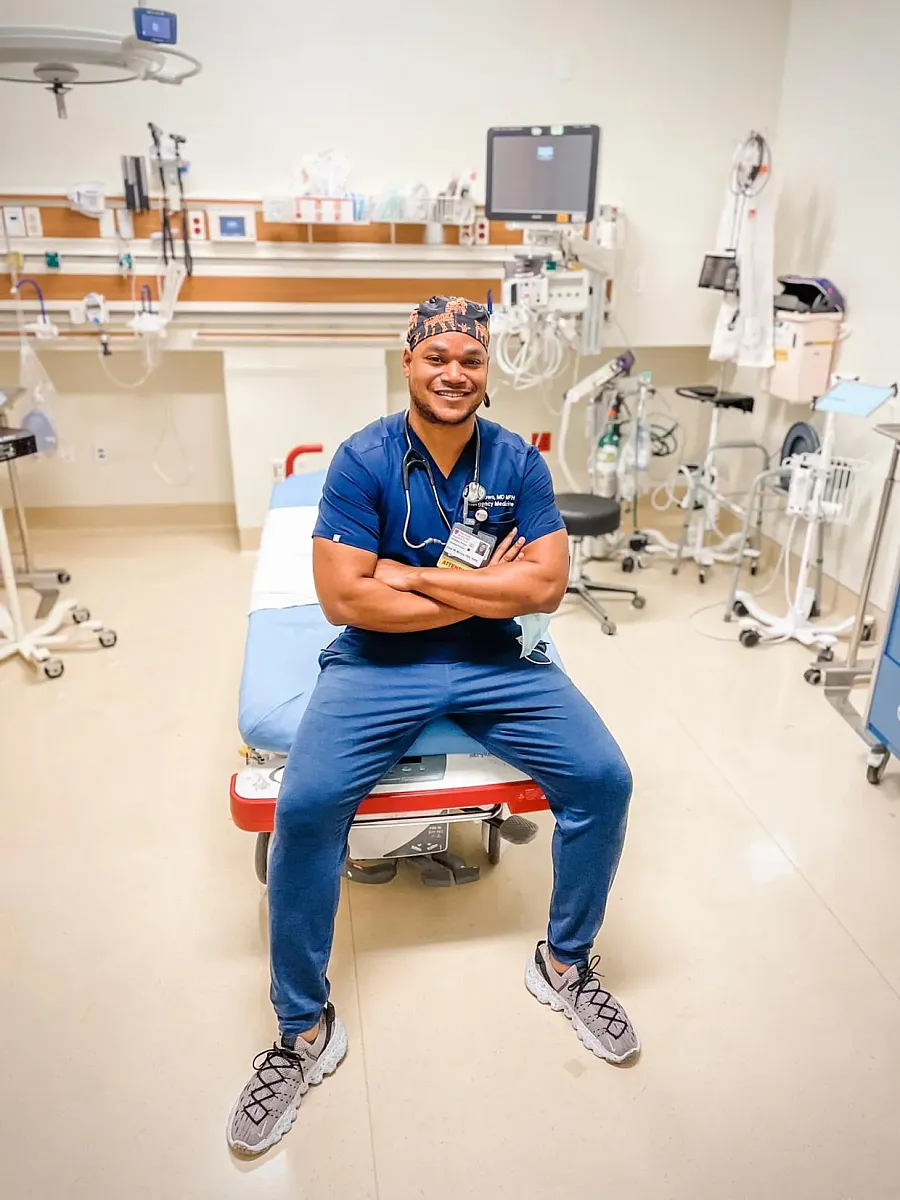
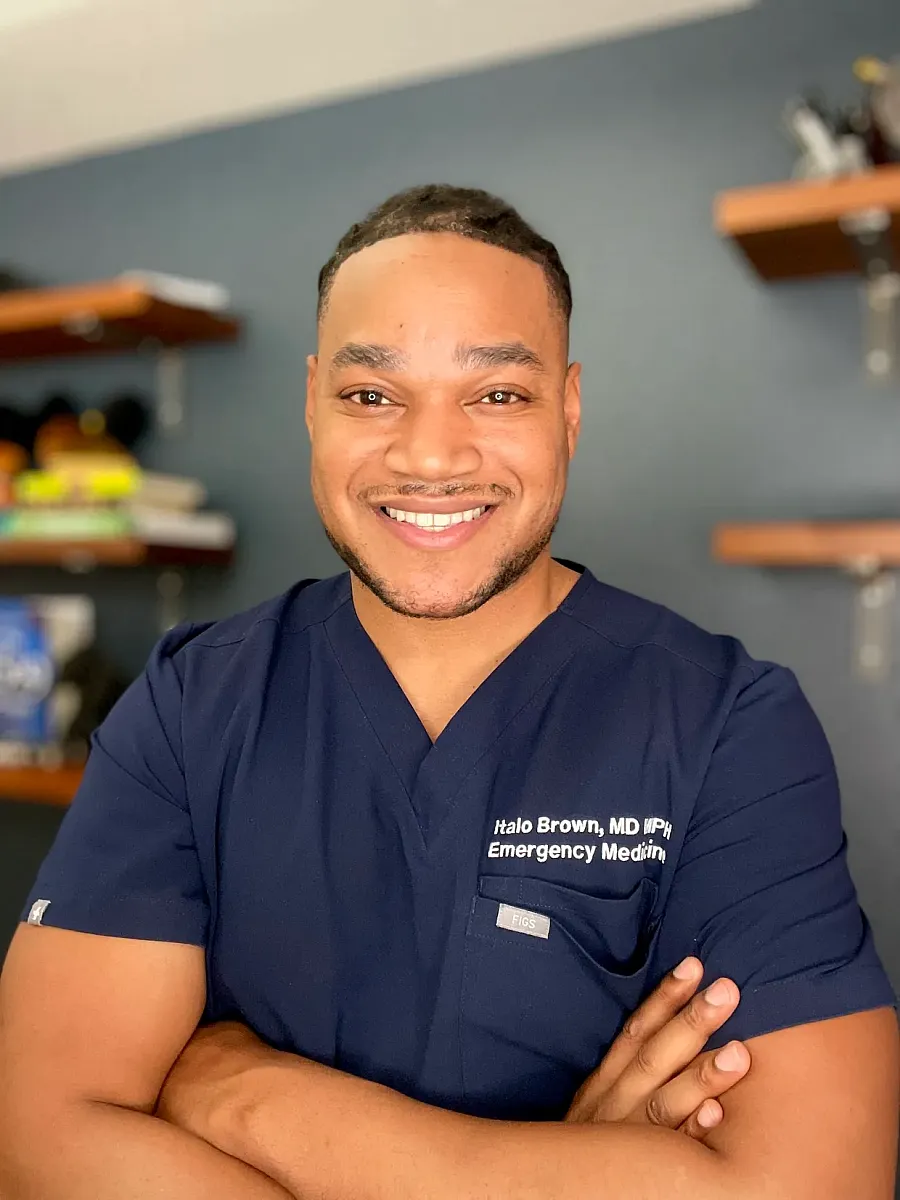
In a tense ER in Nashville, Tennessee, an incarcerated patient refused Dr. Italo Brown’s care, calling him a “monkey doctor.” Without missing a beat, Brown replied, “Well, that’s fantastic, because I don’t treat monkeys.”
Brown met the hostility with composure. The patient laughed, the tension broke and care continued.
“I have a job to do,” Brown says. “I’ve constantly centered the fact that people have their belief systems, but at the end of the day, I’m going on this side of the curtain and if I’m going to treat you, there’s a part of you that’s going to have to respect the skillset and the time and the effort and energies that I put into this.”
Despite the microaggressions that can come with his job as an ER physician at Stanford Hospital in Palo Alto, Brown calls it an “excellent career.”
“I honestly could not see myself doing anything else,” he says.
Still, Brown recently was mistaken by a Black registrar for a therapist rather than an ER doctor.
“People are just not used to seeing Black anything in those positions regularly,” he says.
By simply showing up as himself, Brown challenges the exclusivity often found in medical spaces, but he’s also influencing how other people view the medical field as a clinical professor educating the next generation.
Representation Matters
Brown’s path to medicine can be traced to a commitment to service he saw modeled at home. With a teacher for a mother and a firefighter for a father, he describes his career as “splitting the difference” between their service-oriented professions.
Though there were no physicians in his family or inner circle to provide an immediate road map, a high school opportunity to shadow a local orthopedist sparked his initial interest. That early curiosity was nurtured by mentors — including community advocates and church leaders — who instilled in him a deep sense of responsibility to serve not just as a doctor, but as a tangible asset to his family and the broader public. With these early lessons and support from college advisors, he realized he could build a career that balances high-quality medicine with a deep dedication to his community.
Brown’s approach to medicine is rooted in authenticity. He serves in the ER and walks the halls of Stanford as a “Black dude from Sacramento who doesn’t code switch and talks the way he talks and has locs,” turning every interaction into a teachable moment.
“That is what helps us grow as individuals,” he says.
Black physicians make up less than 6% of the U.S. doctor workforce. In emergency medicine, that representation is even lower, with African American physicians accounting for roughly 3% to 4.5% of practicing and academic ER doctors.
For his first few years at Stanford, Brown recalls being “one of one,” the only Black male in the ER. While Brown believes his department has a respectable number of Black physicians compared to other programs, he says it’s still insufficient given the significant ethnic diversity of the Bay Area communities it serves.
Brown and his colleagues constantly strategize ways to expand the ranks of Black and brown providers in medical specialties. As the world becomes more diverse, he says, the medical workforce must evolve alongside the patients it serves.
“Patient populations are shifting,” he says. “You need enough workforce that reflects that to be able to meet people effectively.”
Room For Change
In addition to navigating the brutal intensity of a level-1 trauma center, where he might be reducing joints or managing trauma surgery, Brown also trains the next generation of medical professionals. He serves as an assistant professor and the health equity and social justice curriculum thread lead at Stanford’s medical school.
In the classroom, he urges students to look beyond the chart, factoring in the social determinants of health and geography.
“I ensure students understand these factors so they can build care plans that encompass the complete patient,” he explains. He encourages his students to treat policy as a vital instrument for change, teaching them to advocate for the funding and programs that address the social factors driving health disparities. By tackling these root causes, he aims to reduce the number of preventable emergency visits.
A volatile mix of federal pushback, funding cuts for equity programs, and rising health care costs are reshaping the medical landscape. Policy shifts and funding cuts are creating a perfect storm that displaces vulnerable patients, particularly those on Medicare or Medicaid.
“They won’t be able to get those PCP [primary care physician] appointments,” Brown says. “They won’t be able to do their subspecialty appointments because they won’t have the coverage anymore. Where are they going to go? To the emergency department.”
Despite a “significant disinvestment in anything related to DEI,” Brown remains undeterred. He leverages technology, viewing the rise of AI as an “unexpected counterweight” that allows him to process demographic data and demonstrate community needs more efficiently than ever.
While there has been pushback and lawsuits filed across the country, Brown’s ultimate goal is to make health equity a core part of medical school. He teaches future doctors to move beyond just looking at data and instead focus on the big-picture causes and practical solutions for the health issues their patients face.
For him, validation comes from students’ consistent demand for deeper engagement and lessons in practical problem-solving. It confirms that his approach is not just working, he says, but is resonating with the next generation of physicians.
“They want more of it, not less,” Brown says.
For the past two years, Brown has partnered with Stanford’s Department of Community Engagement to host a health education booth at the annual Black Joy Parade in Oakland. The booth draws hundreds of visitors and beyond providing screenings — such as blood pressure and blood sugar checks — the initiative serves as a powerful team-building effort. By involving a broad cross-section of the hospital’s workforce, including Black faculty, medical students, nurses, and administrative staff, Brown says the booth fosters a genuine sense of community and connection among colleagues.
Occupational Reality
Black male physicians frequently navigate criticism that their professional advancement comes at the cost of their community ties. This perception often casts them as being “above” their origins, suggesting that by attaining wealth, status, and specialized roles, they have effectively turned their backs on the people they come from.
Brown rejects that view, maintaining that there is a place for Black physicians in every corner of the medical landscape.
“I believe that we need Black doctors in all spaces, whether that is in the community or not in the community,” Brown says. “You need those other places where Black doctors exist, and [for people to see] how good they are. That changes the dynamics.”
For Brown, visibility in elite, non-community spaces is a form of advocacy. “If you’re a Black doctor that doesn’t work in the community, just be clinically excellent,” he says. “Be fantastic, so that whoever encounters you knows Black doctors are clinically excellent.”